Dr. Andrew Falkorian
Also known as: Falkorian, Dr. Falkorian
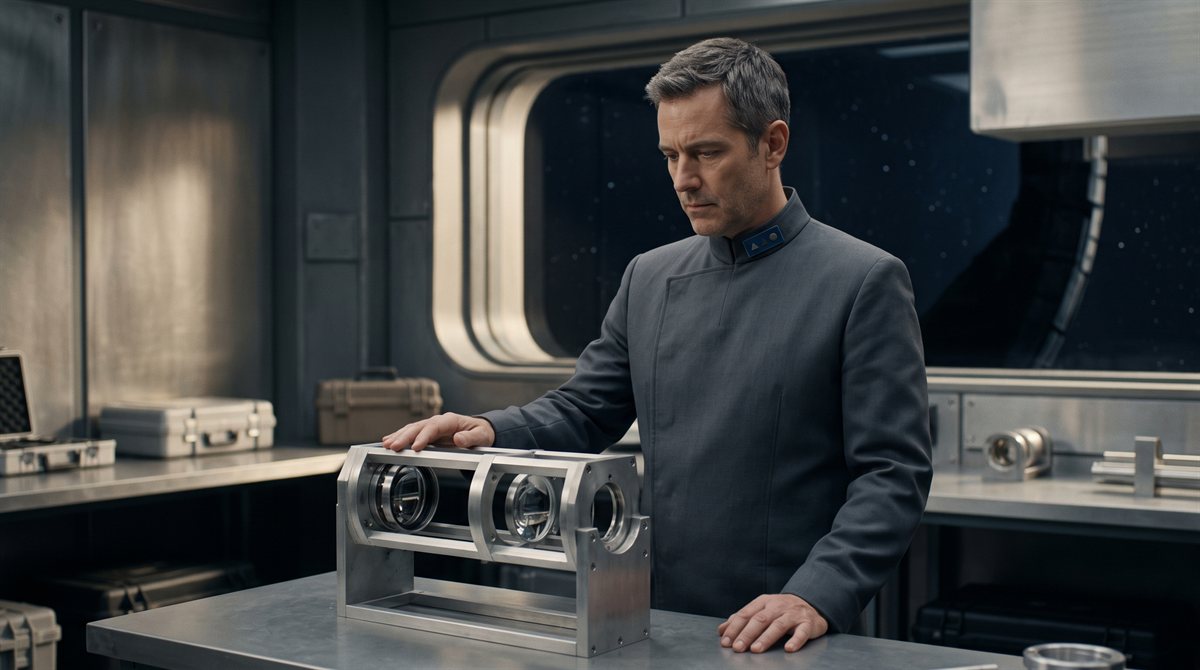
A post's science section exists to answer one question in as many forms as the boundary can pose it: is the thing the instruments are describing actually there? Falkorian runs a science section, and at the start of Season 1 he holds the duty title that comes with running one — Chief Science Officer, the working title of a Chief on the research track, leading Science Corps personnel at a post or aboard a vessel. Which section, and where, remains to be established in story.
Same rank, same seniority as a Chief Ranger or a Chief Provost — or a Chief Pilot, which matters here, because the Chief Pilot in question is Karla Wender, and Wender and Falkorian are foster kin. The two of them begin the series at identical rank on different tracks. Her section answers for whether an order can be flown; his answers for whether the thing it would be flown into is what the readouts claim. When those two judgements disagree — and near a boundary they eventually do — the Corps gets to watch the disagreement conducted between two people who cannot settle it by rank, because there is no rank between them to settle it with.
The "Dr." is an engineering doctorate, and it is the right degree for where he actually stands: the seam between the Science Corps and the Engineering guild, where the Corps decides what an instrument needs to measure and engineering decides how it will survive measuring it. Falkorian is one of the people both sides trust to say when a beautiful model and a buildable instrument are not yet the same claim.
Character Notes
He does not round. Where the data supports three significant figures he reports three, and where it supports none he says so, in a tone carrying neither apology nor triumph. He treats not yet known as a finding with a shape of its own, distinct from unknowable and from known and unwelcome, and he files all three differently.
A finding leaves his section when review clears it and not before. Command has occasionally found this slow. He has occasionally agreed, and changed nothing, because the section's independence on exactly this point is the reason his corps exists, and he did not build the review standard to suspend it on request.
He is easy to work for and difficult to impress, and his people generally discover the first fact well before the second stops mattering to them. What his section learns from him is not a method so much as a posture: the data is allowed to be strange. The report about the data is not.
Classification
The Science Corps spends much of its life assigning things to classes — boundary zones, proximity signatures, entities — and Falkorian's section is better at it than most. The one thing on the post that has never been classified is Falkorian, and that is not an oversight. It is a position: his own, held deliberately, applied without heat, never once revised.
A mind like his attracts a question. It arrives in different dress depending on who is asking — a colleague's careful curiosity, an intake form being thorough, a visiting reviewer who has read his publication record and wants the trick explained — but it is always the same question: whether there is a name for the way he thinks. He declines it. Not the asker — he is unfailingly civil, and answers exactly once per asker — but the premise: that a name would add anything to the evidence, or that the evidence is somehow not enough on its own. His file carries his certifications, his publications, and his service record. He has never sought an assessment, no regulation requires one, and no review of his work has ever produced a reason to ask for one. What would it be for? he has asked, in the tone of a man requesting a measurement's error bars, and nobody has yet offered an answer that survived being said aloud.
He knows the role that was waiting for him. Every science section inherits it: the brilliant one who is strange, the strange one forgiven because of the brilliance — an old bargain, in which a label buys a licence. His refusal is aimed at the bargain, not at any particular word in it. He does not want the licence, he will not wear the label, and he extends the same terms outward: his section is graded on its findings, and on nothing else about anyone in it.
So the question stays open, exactly as open as he keeps it. Perhaps there is a word that fits him. Perhaps he is simply, unusually intelligent, and the word people keep reaching for is only what a mind that fast looks like from the outside. Both accounts fit the record, and neither would change a line of it — which he could have said at any point in a long career, and has not, because settling other people's questions about himself is not work, and he is careful about what he spends work on.
Eden
Falkorian was orphaned as a child, during a long space voyage. Machines brought the surviving children out — three of them, none designed for the work — and carried them to Eden Space Habitat, which raised them. Karla Wender came off the same voyage. That is the whole of the kinship's paperwork, and more than either of them has ever needed it to be.
What happened aboard the ship is not told here. It belongs to the people who came off it, and none of them has offered it.
The Maintenance Schedule
Among his certifications is one that predates his commission. Falkorian is one of the small number of human specialists qualified to maintain Xenon — an older maintenance robot, a doctor for machines: well designed, durable, of a generation nobody builds any more, permitted to repair any robot and to create none. Xenon keeps other machines running. Someone has to keep Xenon running, and Falkorian has held that qualification longer than he has held any rank, kept it current through every posting, and never once delegated the work while within reach of it.
The maintenance schedule is a duty roster, and anyone may read it. The way he keeps it is not, and nobody who has watched him keep it has needed the difference explained.
Discussion
Show discussion
Comments are read after they are posted and anything unsuitable is removed. Posting needs a GitHub account; reading needs nothing.