Aravena
Also known as: the smallest of the three, the one who knelt to the humming stone (the Told)
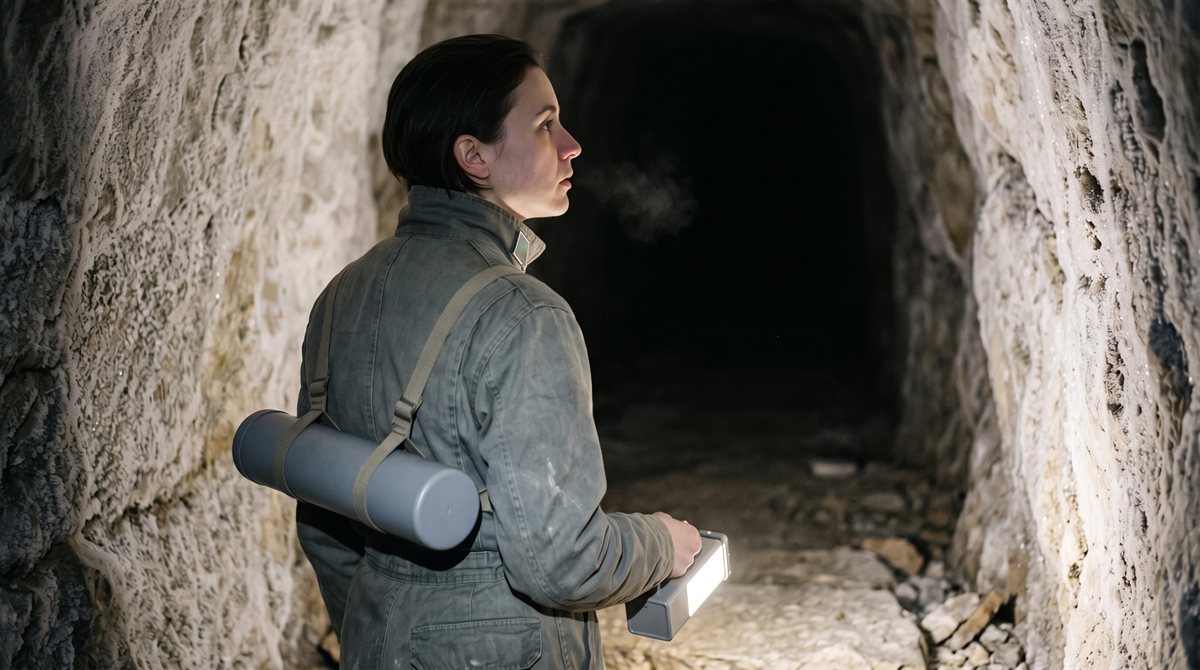
Aravena is the newest of the three people who work the upper levels of Fliade, and the smallest, which on that world are close to the same thing. The surface party is three: Survey Lead Hesper Nakagawa, Instrument Specialist Toma Egede, and Aravena, whose part of the job is the relay unit — carrying it down the long passage on their back, setting it on its base at the junction the party uses as its furthest working point, turning it until it is oriented the way the party orients them, kneeling to it, and dictating the shift log into it. The unit hums once, low, to say it has heard. Aravena likes that, and knows it is not a person, and likes it anyway.
What the Record Holds
The record's own account of the Fliade survey is observational, and Aravena appears in it twice without a name: as the hand that wrote young in the entry that logged the eleven-minute profile, which the survey lead struck the same evening, and as the surveyor who found the party's unit standing upright at the line where the party's own tracks stopped, read its log on the spot, and filed no reading of what it meant. Egede filed that a dropped thing had been returned. Nakagawa filed that a line had been drawn. Aravena, who had knelt to it, said nothing, and the survey does not file what is not said.
From above, Eleven Minutes (S11E02C01) supplies the rest: what Aravena thought and did not file — it was put where we would find it, by someone who held it while it woke — and what Aravena did instead. From the day the unit was lifted, last up the passage at the end of each working time, Aravena turns round with the light held low, faces the deep dark below the squeeze, and asks it, not loudly, whether that was all right. The question goes up at the end. It is asked of the one who carried the unit, whom the party calls Teddy in speech and the log calls Individual Four and Aravena, privately, calls Four. Then Aravena waits as long as you would wait for an answer, and a little longer, and goes up. Nobody told Aravena to do it. Nobody has told Aravena to stop. In Nothing Happened (S11E02C02) the question is on the unit's sound channel every shift and Nakagawa has heard it and said nothing; Egede notices; and, asked at last what the one who knelt had thought, Aravena says it aloud — like a thing at a door — and then the rest arrives: the boulders are the knock, and the party has been walking in for two years without knocking. Aravena had been asking the dark whether it was all right, afterwards, from behind their backs; nobody answers a question asked that way, and the silence might be manners. Something Happened (S11E02C03) is the knock: Aravena goes alone, because a knock is one person at a door, carries a stone of the upper levels through the squeeze held to the front, and comes out onto the silt to find an adult standing on the line, in the open, at arm's length, and it does not withdraw; kneels anyway, sets the stone on the line, steps back, says a thing the log does not carry, and is answered by the shift of a rock — the sound the party had logged for two years and learned only that week to hear. Aravena went back through the crack without running, which was the hardest thing.
What the Record Does Not Carry
A first name, a branch, an age. The survey pages give the other two both names and a rank. Aravena has a surname and a job, and the record has not been given more; the party's log does not need it and the chapters do not use it.
Whether anyone hears the question. From the survey's side, nothing answers. From the other side of the line the same act is told as the sound that rises at the end, heard every working time and not answered, by people who cannot tell what was asked or of whom — and the two records, which name one person, do not know it.
Character Notes
Aravena is the one in the party who looks for the unit first, feels its absence in the stomach, and kneels. The party's fondness for the small one it named for a toy is Egede's on the page; Aravena's is quieter and is not fondness, exactly. It is the sense of having been answered by something that is not a person, and of owing the same courtesy to something that is.
See also: Fliade, Teddy, Hesper Nakagawa, A Proposal to Collar the Anstolik, Refused at Countersign, What the Record Refuses.
Discussion
Show discussion
Comments are read after they are posted and anything unsuitable is removed. Posting needs a GitHub account; reading needs nothing.