Hester Quaile
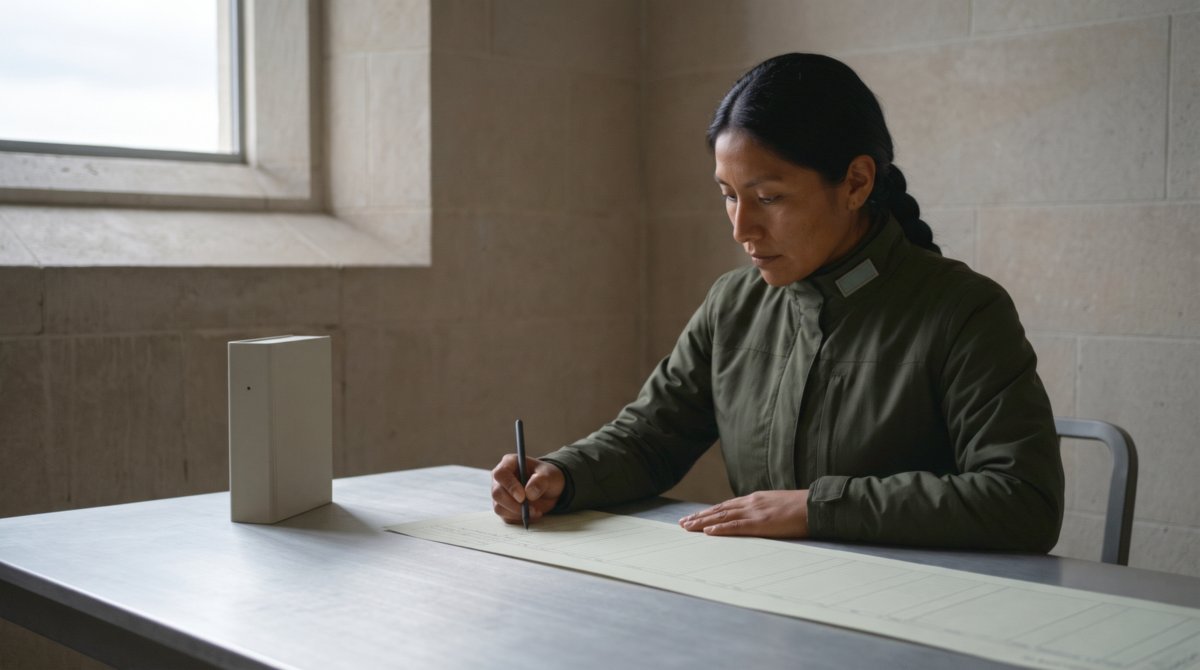
Hester Quaile keeps time for the Survey. The ephemeris desk of the Survey Corps Standards Office on Earth maintains the record of the named pulsars whose beat lets two clock standards that have never met agree on a phase, the shared coordinate described in Timekeeping and the Common Record. Her working paper, On the Simultaneity of Folds, takes the record's sentence that there is no moment that is now everywhere, and asks what a fold does to it.
Known History
- On the ephemeris desk of the Standards Office in 2827 UCSD, when the paper was circulated as EP-47 and a copy lodged with the Survey Archive.
- The record gives no birthplace, no age, no rank and no earlier post.
Character Notes
The paper is a timekeeper's paper. Its proposals are a log and an interval: write down the phase at which every fold opens, and do not open a return fold on the same route too soon after the outbound. It chooses the pulsar ephemeris for the log because the ephemeris is not a calendar. It claims no shared now, and the rule needs none.
She cites Ansel Thale's FS-212 by proposition, as his paper asks later authors to. She keeps his reading of persistence drift marked as his model rather than adopting it as a finding. And she states the measurement that would settle her own question, fold-peak traces timed against the ephemeris at both ends of the same fold, with the plain note that it has not been made.
The record places her at the Standards Office in 2827 UCSD and nowhere else.
See also
- On the Simultaneity of Folds
- Timekeeping and the Common Record
- Ansel Thale, whose FS-212 her paper cites
- Yusuf Adair, of the same Standards Office's calibration floor in 2815 UCSD
Discussion
Show discussion
Comments are read after they are posted and anything unsuitable is removed. Posting needs a GitHub account; reading needs nothing.