Qiren Tal
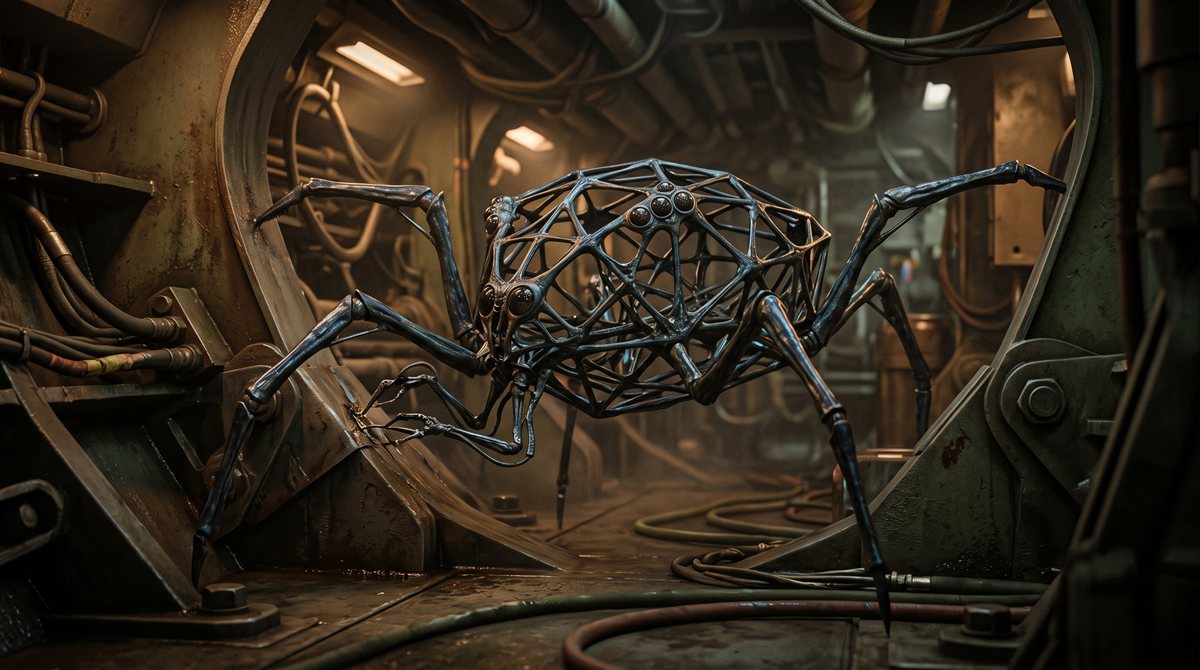
Veyr-3 is active basaltic volcanism, dense mineral aerosols, micro-shocks, and a gravitational field heavy enough that human joints would degrade in a generation. Qiren Tal was born there and carries the physiology it produces: a load-bearing exoskeletal lattice with the dark iridescent sheen of cooled basalt, compound eyes adapted to mineral haze, and a chitin surface that shrugs off abrasion from suspended silicate particles. The slender look deceives — a lattice carries compression the way solid bone never could, which is precisely the engineering their homeworld teaches from birth.
In low-gravity environments, Qiren moves with deliberate restraint. Not caution — calibration. Overcorrecting force on a delicate system is exactly the kind of failure their homeworld training was designed to prevent.
On mixed-species stations they are usually assigned where mechanical stress and thermal risk overlap: outer-ring hull junctions, coolant transit nodes, emergency patch corridors. This is not incidental. This is Qiren being placed where their specific knowledge is actually useful.
Character Notes
Qiren calibrates by material behaviour, not by display confidence. If a panel sounds wrong under strain, they trust the resonance over the monitor readout until both are reconciled. This is not stubbornness — it is the correct epistemological sequence.
Their homeworld training emphasised failure chains caused by heat gradients and pressure differentials across short distances. Qiren is unusually good at spotting early indicators of seal fatigue and microfracture growth during boundary-adjacent transit — the small signs that compound, if ignored, into the kind of failure that requires an emergency jump.
Discussion
Show discussion
Comments are read after they are posted and anything unsuitable is removed. Posting needs a GitHub account; reading needs nothing.