Aspenar
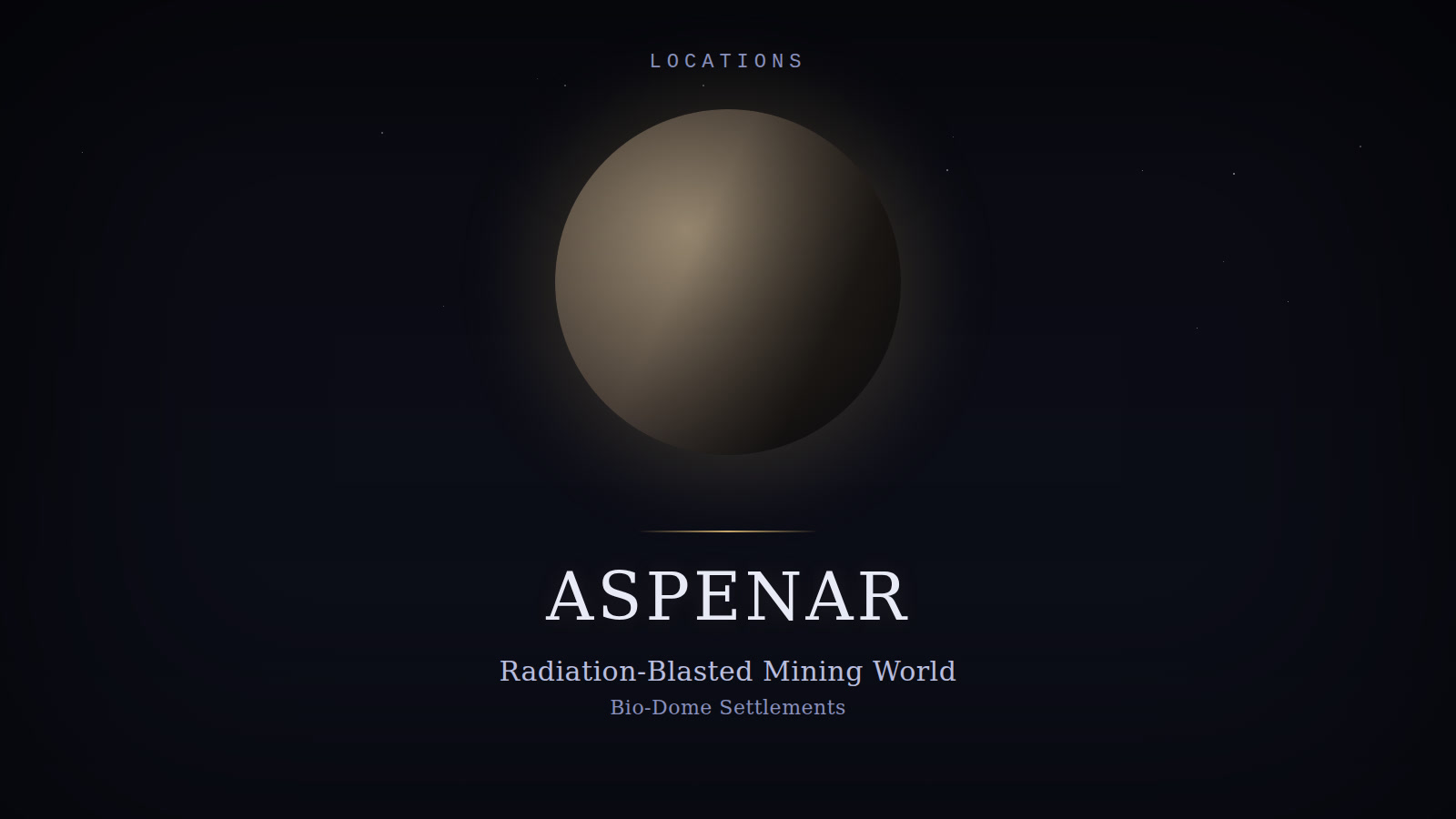
No survey report calls Aspenar beautiful. Every survey report calls it valuable, which is the only adjective its residents have ever asked for.
Aspenar is the second planet of the Calder's Reach System and a charter member world of the Federation of Sentient Beings. It is a rocky, geologically barren world — no native biosphere, no breathable atmosphere, surface conditions hostile to unprotected sentient life of any known biochemistry — and it is, by every metric the Federation tracks, one of its wealthiest members.
Why Anyone Stayed
Aspenar's core is unusually dense even for a rocky world of its size, a consequence of an ancient collision history its geologists are still reconstructing from the debris field still tracked in Calder's Reach. That density gives Aspenar close to Earth-standard surface gravity despite a diameter well short of what gravity like that should require — and it means the same iron, rare-earth, and heavy-metal deposits that built the planet's core are also, in far shallower and far more convenient concentrations, sitting in its crust.
The system's star runs hot and bright for its class, and Aspenar orbits closer to it than comfort would dictate. Surface daylight arrives with a UV and hard-radiation load that unshielded skin — of any known Federation species — cannot tolerate for more than minutes. No terraforming proposal has ever been costed as cheaper than just building downward and staying under glass.
Bio-Domes
Aspenar's surface settlements sit under radiation-hardened dome canopies, each tuned to the atmosphere, light spectrum, and gravity tolerance of whichever population it shelters. Human domes run filtered, dimmed daylight and standard nitrogen-oxygen mix. The Federation's other Aspenar residents — most numerously the Doreth, a heavy-built, radiation-tolerant people whose homeworld biochemistry runs on a denser, sulfur-rich atmosphere no human dome could survive — keep their own sealed sections entirely separate, linked to human domes only through pressure-locked transit corridors rather than shared air.
The domes make no attempt to look natural. Composite decking, visible power conduits, recyclers audible in the walls, maintenance drones on fixed patrol routes — the same register documented generally under Environmental Technology Design for remote and hostile-world stations. Nothing here is hiding its machinery, because the machinery is the only reason anyone is alive to notice it.
Orbital Habitats
A ring of orbital habitats above Aspenar handles what the surface domes can't: bulk ore refining too hazardous for dome proximity, zero-gravity fabrication runs, and housing for residents — human and Federation alike — who simply prefer vacuum-side to gravity-side living. The ring also carries one of settled space's largest orbital compute complexes, linked by shielded telecommunications to the quantum compute centre in the deep crust below — Aspenar's dense, stable rock being exactly what the cavern constraint asks for. Refined material moves down to the surface domes only when a buyer needs it in dome-finished form; everything else ships directly from orbit, since there's no operational reason to land it first.
Economy and Role in the Federation
Aspenar's export economy is almost entirely refined ore, alloy stock, and fabrication-grade rare-earth material, sold under long-term Federation contract rather than open market — a deliberate structure meant to keep any single buyer, including the Federation's own member worlds, from gaining leverage over a planet whose entire population depends on imported food, water reclamation stock, and dome-seal replacement parts to survive a single season without trade.
That same export stream is the material backbone of the Federation's support compact with the Star Rangers: a disproportionate share of the refined alloy and fabrication capacity the Federation contributes toward Ranger operations traces back to Aspenar's refineries, surface and orbital alike. Aspenar's delegates take open, unembarrassed pride in this — the planet nobody would call beautiful is, on its own accounting, the one holding up more of the compact than any other member world.
See also: The Federation of Sentient Beings, Environmental Technology Design, The Founding of the Star Rangers.
Discussion
Show discussion
Comments are read after they are posted and anything unsuitable is removed. Posting needs a GitHub account; reading needs nothing.