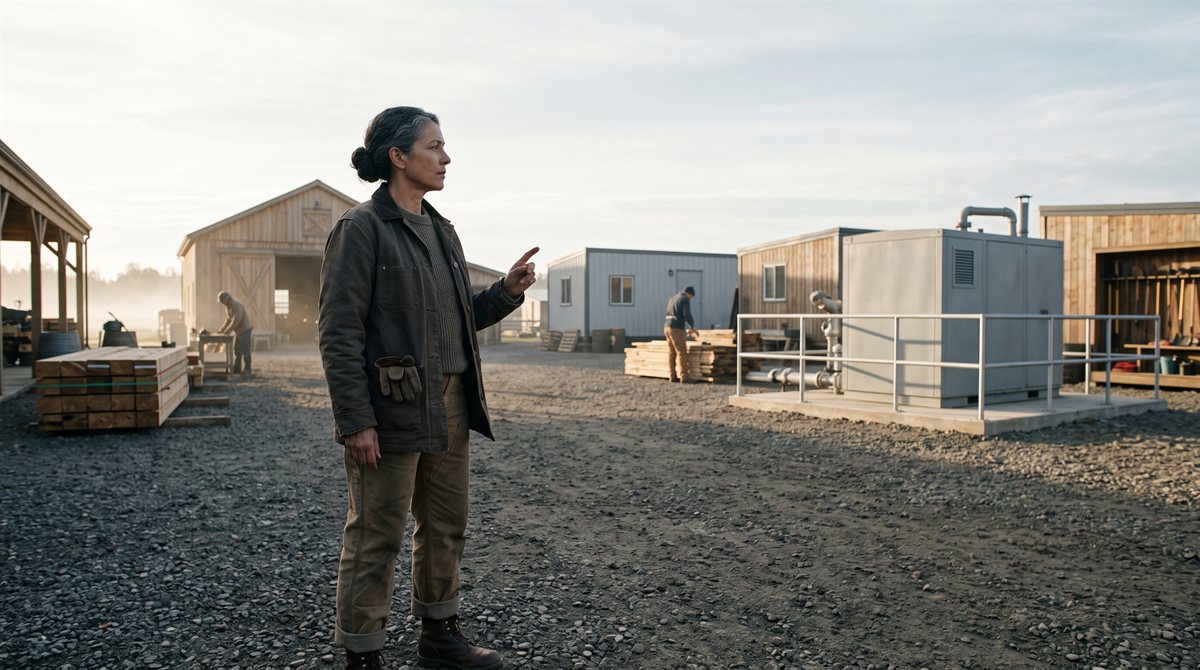
Anne Wender (Human, the eldest survivor)
- Time
- 2788 UCSD — from the Ninth Day of the Wreck to the Arrival at Eden
- Location
- An unnamed long-voyage ship, deep transit — then Eden Space Habitat
By the ninth day Anne had three rules, and the three rules were the whole government of the compartment: everyone ate when she said, everyone slept when the lights dimmed on the cycle she kept running by hand, and every question got a true answer, or the true statement that she did not know. She had made the rules because the children kept bringing her questions, and she had kept answering because there was nobody standing behind her to hand a question up to. She was the oldest. The doors at the end of the corridor had been sealed since the first hour, and by the second day she had stopped telling the children that someone would come through them.
The ship did not hum anymore. She had not known, before, that she had spent her whole life inside a sound; she learned it the hour the sound stopped. After that the compartment ran on her voice and on the rules, and she fed them small and often, because small and often produced fewer questions than large and rarely.
The help arrived first as a feeling in the frame — slow, patient strokes through the hull plating, the pressure of something enormous taking hold of the outside of the world and being careful about it. The children looked at her. That was the compartment's other law, the one nobody had made: everything went through Anne's face on its way to being real. "That's help," she said, and was believed, and then had to sit with the children believing her until it kept on being true.
It kept on being true slowly. The strokes moved along the hull with no hurry in them at all. Twice everything stopped — long, considered stillnesses in which Anne kept her face in order — and twice it began again. Then small machines came ahead of everything else, down the length of the dead ship, cutting and shoring the way as they came. Eight of them. Anne counted them through the door's port, because counting was one of the things that had kept the compartment a country.
Then the seal on the corridor door went from red to a colour Anne had stopped expecting, and the machine that came through was shaped like a woman.
It took in the compartment in the time a person takes to blink — the folded ration wrappers, the sleeping order chalked beside the vents, the children, and Anne last and longest — and then it spoke to her first. "You kept them warm, and you kept them counted," it said, as if reading the compartment's government off its walls. "It was well done. I have them now — and I will need you exactly as much as I needed you a minute ago." Which was, Anne would think later, a strange and precise kindness: not you can rest, which would have been a demotion, and not a word about cost, which would have been a bill.
"My designation is Lucene-9000," it said then, to all of them, in a voice pitched to carry to the smallest. "Lucene is enough."
The children looked at Anne. Anne nodded. After that they let themselves be held.
Where the machines had come from, and who had sent them, the machine did not volunteer and Anne did not ask. It had not seemed, that night, like the missing fact.
Anne's sister had not said much for two days. From inside the machine's arms Karla asked whether their mother was coming — a direct question, and the machine answered it the way Anne would learn it answered everything: completely. The answer was no. It came level and unhurried, and it did not arrive alone: no, and what no was going to mean tonight, and what it would go on meaning after, and the one thing that was not going to change, which was that the arms had her and were not going to open. Anne stood in the cold and listened to a machine take her sister's question more seriously than anyone had ever taken one of hers, and could not have said, then or afterward, why that was the moment the nine days caught up with her eyes.
Then Karla said the machine's name back wrong.
"Lucy Anne."
Anne had been correcting her sister's words all her life. She knew the sound of a mistake, and this was not one: there had been a small pause before it, and Karla had watched the machine's face all the way through it, the way you watch a door you are deciding to walk through. A unit designation had gone into her sister and come back out a person. The machine did not correct her either. It looked at Karla for the length of one slow breath — reading, Anne supposed, whatever it was built to read — and said, "Yes."
The name had Anne's own name inside it. She noticed the way you notice a draught: once, completely, and without the first idea of what to do about it. She never did find out what to do about it. She called the machine Lucene — that night, and every time after.
The carrying went by turns, smallest first, and the compartment emptied the way it had been kept: in order. When the last lock closed on the last of the cold, Anne counted the small machines back, out of habit, because the habit had run a country for nine days and did not know yet that it was over. Five. She set the five beside the eight, the way she now set everything beside everything, and gave the two numbers to nobody.
Discussion
Show discussion
Comments are read after they are posted and anything unsuitable is removed. Posting needs a GitHub account; reading needs nothing.