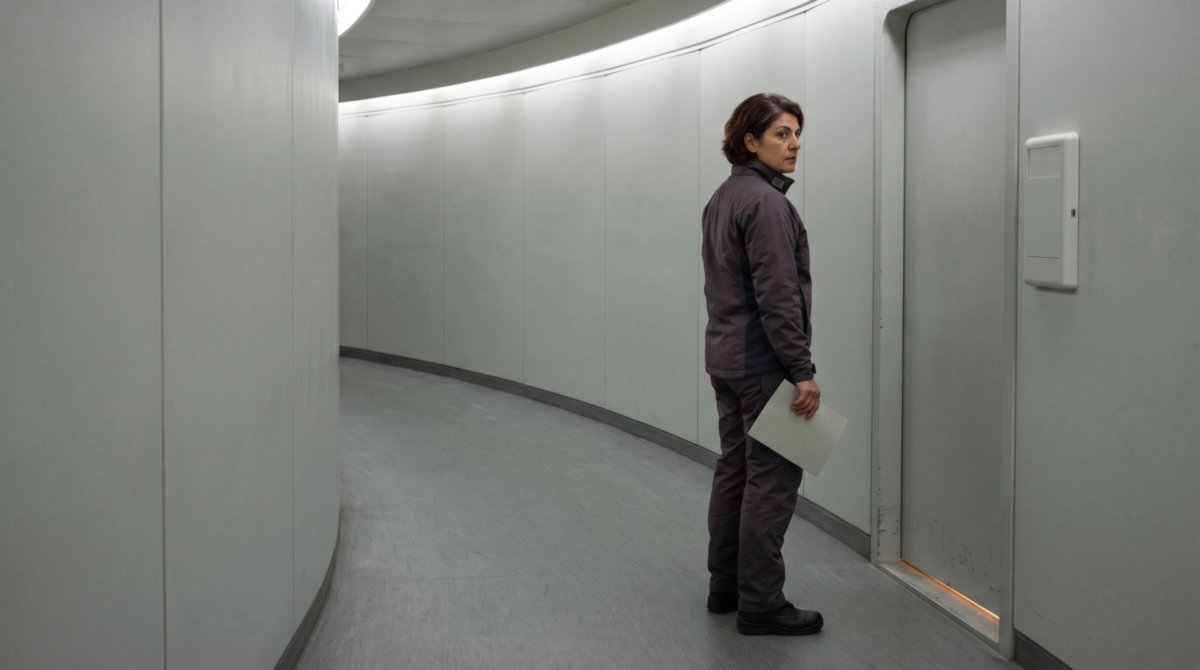
Principal Ilse Varga (Human, Music Corps)
- Time
- 2825 UCSD, Late Summer, the Ring's Night and the Morning After
- Location
- Eden Space Habitat, a common room under the dock ring, and the Survey Corps delegation office
The late set ran until the dock's shift changed, and Varga had been in the room for it fourteen nights out of the last twenty.
Not on duty. The rotation that had put her on Eden was the Survey Corps', ten weeks of it so far, a xenomusicologist attached to the delegation on the standing terms by which a branch borrows a desk where it has no business of its own. The delegation did the Passage's work. Varga did hers in the hours around it, which on a habitat with a dock meant the hours when the dock's people were not lifting things. The common room was under the ring, two decks below the berths, and had the acoustics of a place built for something else. The band compensated for the hum. That was in the name, she had been told, by the man who played strings, who had told her without being asked and had not asked why a Ranger wanted to know.
She had a page open on the table and had written on it, over fourteen nights, less than a page.
What she wrote was what she could show. The set was nine songs and did not vary. The break fell at the same quarter-hour every night, and on the sixth night she had worked out that it fell when the dock master's office was between its night staff and its day staff, because that was when the loaders came off and the room filled, and the band took its break to let them get a drink before it played the last of the nine to a full room. That was a thing an ensemble did. She had seen ensembles do it on four worlds. It was the last song she had come back for.
The room sang it. Not all of it: the chorus, and in the chorus one line, the high one, that the room had decided was its own. And the singer let the room have it. Every night, at the same bar, she came down off the line and sang under it, a fourth below, steady, the plain note the room's line stood on, and the room, which could not have told you it was doing so, sang the line it had been given a floor for. Varga had heard singers leave a line to a room before. It was a trick, mostly, and a good one, and she had written leaves the top line to the room on the second night and a trick beside it, with a question mark, because she did not know yet.
On the ninth night the room was thin, a dock holiday, nine people, and nobody sang. The singer came down off the line at the same bar and sang the plain note under nothing. The line was not sung. The song went on without it, and the nine people in the room sat with a chorus that had a hole in it where the room should have been, and the singer did not fill it.
Varga had struck the question mark that night. Not a trick, then; a trick fills the hole. What she wrote instead was the thing the branch had sent her out to notice, and had taught her to write only when she could point at it: the room's line is the room's. She sings the one she can carry and leaves the other to whoever can. Then, under it, smaller: and when nobody can, it is not sung.
That was the study. How music holds a room was the branch's first question, the one a novice learned before the harder one about peoples, and here was a room held by a singer who declined, every night, the one line that would have held it hardest. It was not modesty. Varga had been in the branch too long to file a thing under modesty; modesty was a reason, and the branch wrote down what it could show and let reasons wait. It was, as far as she could show, a rule the singer kept, and she wrote it as one.
There was a form for that. There was a form for everything in the Corps, and Varga had never once resented it; a form was how a thing noticed by one officer in a common room under a dock ring became a thing the college could act on. The intake recommendation was two pages. The second page was the college's and the first was hers. She could recommend a candidate to the college as a serving officer of its branch. The college would take the candidate on provisionally if it took her at all, a Novice, under evaluation, and would confirm Cadet standing when it was satisfied and not before. The placement, for a Novice of this branch, was an ensemble, for the time the study needed. The ensemble was already in the room.
There was a shorter road, for a candidate who arrived already doing the work, and the college had used it. This one had been in the room a year and had not been doing the work. She had been doing the band's, which was the thing the study wanted watched and not the thing the college certified. The ordinary road, then. A year, about.
She pulled the arrivals line the Compact gives the Passage oversight for every transit, which was all of the habitat's record the Corps was entitled to, and read it at the delegation's desk. Shepherd, Tissadelle. Tír na nÓg. Arrived 2824. The line for prior training said Garda college, Tír na nÓg; boards passed; oath not taken.
Varga read that line twice. She did not know what it meant. A police college on a Union world, finished, and the oath not taken, and then a dock band a long way from any hillside: it could be four things, and three of them were none of the Corps' business and the fourth was. She wrote on her page prior training: see record and nothing else, because she did not know, and the branch had a rule about that too.
She would ask in the morning. In the room she was a woman at a back table, and the band had been kind enough to leave her that.
Discussion
Show discussion
Comments are read after they are posted and anything unsuitable is removed. Posting needs a GitHub account; reading needs nothing.