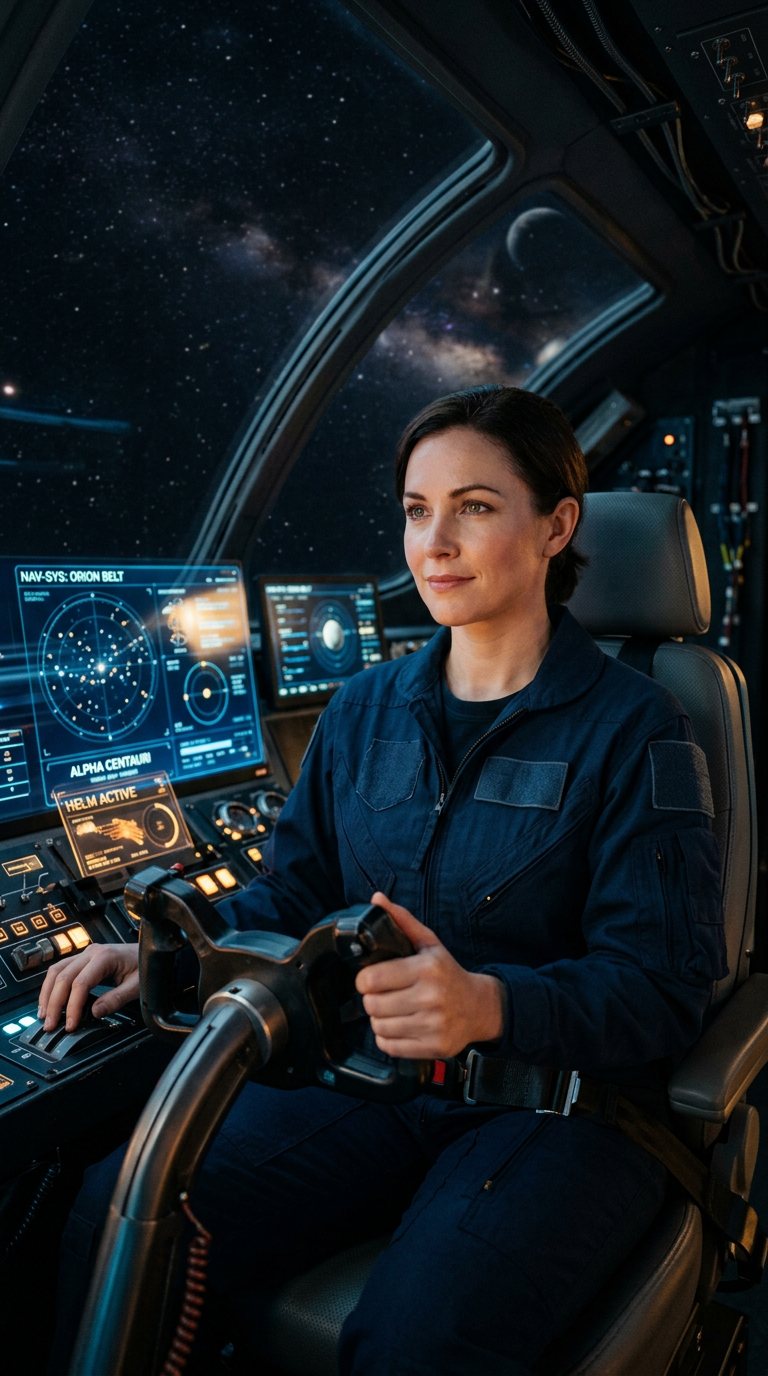
Senior Karla Wender (Human, piloting and navigation track)
- Time
- 2809 UCSD, Late Winter — nineteen days' staging, the crossing, and the first day inside
- Location
- A Tier 1 staging site on the home side, the record does not name which; the Survey Corps platform at the far staging in Deadwater's one staged system
A ship waits before it folds, at any lawful site, and the Steerage Way had been waiting for nineteen days.
Wender had flown the waiting before. Nine years on the one track had taught her that a fold was mostly the time spent not folding: the hull certificate checked against the hull, the route certificate checked against its date, the scaffold grown at a site flat enough to grow one, and all of it watched by people whose whole trade was declining to hurry. The staging site was a trailing trojan point of a world the record did not need to name, Tier 1, where a displaced hull drifted back rather than away and nobody had to spend power holding still. She had held station there for nineteen days, and the lock margin had sat on her board the whole time, a figure in the ordinary place, the way it sat on every board she had ever flown.
The route was the certified one into Deadwater. There was no other. The certificate had been re-issued the previous autumn on the ordinary schedule, and the pilot department's copy carried the ordinary date, and she had read the date before she read anything else, because a route was certified as of a day and the day was the only part of it a pilot could check without instruments.
Then the scaffold reached threshold, and the two regions were brought into adjacency, and she flew the band.
A fold was not a thing a person felt. It was a thing instruments agreed about afterwards, in a recalibration that took longer than the drift. What she felt was the drift's end: the scaffold collapsed behind her, the gradient she had departed from was gone from under the hull, and in its place sat the gradient the far staging had been built on, which was flatter, because the far side had been chosen by people with a long time to choose. The re-sync debt came up as a queue. She started working it in the order the department worked it, which was the order that could be audited, and she had the queue half down before she looked at the margin.
The margin was not there.
Not zero. Zero was a figure, and the board could show a figure. What the board showed was the mark it showed for a value under what the instrument was built to read: not a reading, a dash. She had seen the dash in a dock, with the lattice cold. She had never seen it with the lattice warm and the hull in open space, and she looked at the lattice, which was warm, and at the fault register, which was empty, and then back at the dash, which was still a dash.
"Margin's under floor," she said, to the log.
"Yes, Senior." The relief pilot beside her had flown the run twice. "It will be under floor the whole time we are here. Log it on the hour. It is on the sheet."
It was on the sheet. Item fourteen. She had read the sheet at the staging site, as she read everything, and had read harmonic attenuation, pilot department, under full lattice power, hourly as a line of work and not as a sentence about where she was going.
The station was a Survey Corps platform at the far staging's quiet point, four years crewed, and it kept its date the way the file said it would. The Steerage Way had brought the date in: the ensemble's own, carried in the hull's clock across a crossing that had crossed nothing, and the station's log took it and wrote beside it the pedigree, three hulls deep now, from the last relief and the one before it. There were no couriers to loop against. Nothing here moved faster than a hull, and nothing a hull could do moved faster than light, and so the station's time was what the last ship had brought and the ship's own clock had kept since.
The sheet gave her the launch at the fourth hour.
She ran it the way the sheet said. The lattice to full power, in open space, with nothing docked and nothing within the envelope: the same work she would have done to phase-lock to a corridor signature at home, and she did it with the care she would have done it at home, because the department did not do a thing less carefully for being told it would not work. The front went out. The board showed it going out, as a front, lawful, carrying the lattice's full signature. She watched the figure that was the front's own strength against the distance it had travelled, and the figure fell.
It did not fall as a fault falls. A fault had a shape she had seen in a simulator and twice in a hull: the sharp step, the register filling, the lattice asking to be shut down. This fell the way a thing falls that is being absorbed. By the second light-minute it was below half. By the third it was below what the board called a front, and the board stopped calling it one, and the lattice sat at full power with nothing in front of it, and the fault register stayed empty, because nothing was wrong. The medium had taken the front and given back nothing, and every instrument she had reported that it had done its work and was fine.
She logged it. The figures, the time, under full lattice power, fault register clear. She did not log that she had sat for a further minute with the lattice warm and watched the place where a margin would have been.
Afterwards the station's chart was on the table in the common room, because the chart was always on the table, and she read it the way she would have read any system's chart: a star, its distance, its class, its route. The catalogue ran to the near stars and past them. Every one had a distance against it, and a class, and a line for the route, and in the route column every entry read none. Not unsurveyed. Not pending. None, star after star, in the same hand, as a catalogue fact beside distance and class, and she read down the column for longer than the column needed.
The nearest was under five light-years. On the home side she would have called that the better part of a week.
She put the chart down. She did not ask anyone at the table what they thought of the column, because the table had been looking at it for four years and she had been looking at it for a morning, and the asking would have been a claim about which of those was the harder.
Discussion
Show discussion
Comments are read after they are posted and anything unsuitable is removed. Posting needs a GitHub account; reading needs nothing.