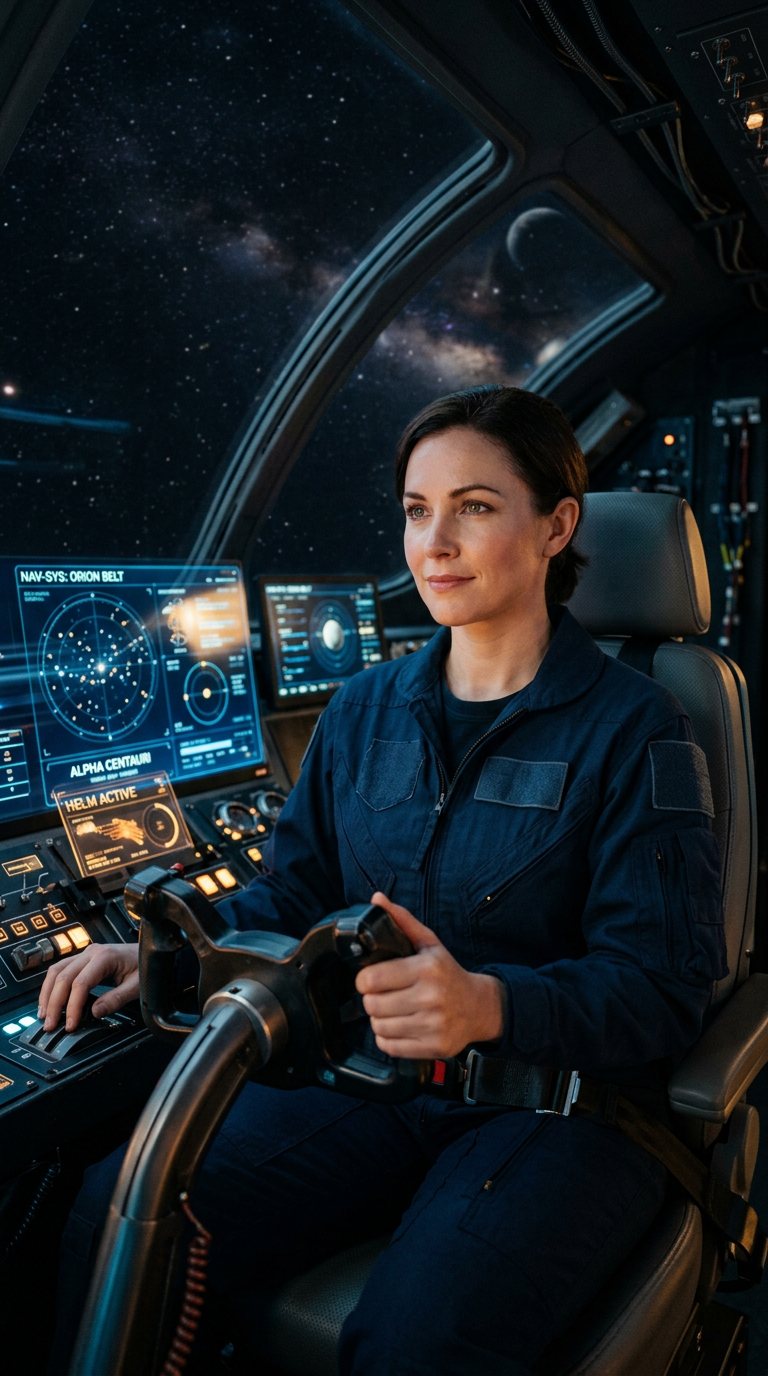
Line Captain Karla Wender (Human)
- Time
- 2829 UCSD, Late Autumn
- Location
- A fold-approach post on the outward frontier, the record does not name which — Shepherd's first command — and Wender's line office
The order came up the line with the morning's others and Wender read it standing, because a thing read sitting down has already been agreed to.
Pairing, command-rank mentorship, on promotion to Starwarden. Mentee: Shepherd, T., Starwarden, fold-approach post, outward frontier, effective on assumption. Mentor: Wender, K., Line Captain. Duty attaches to the mentor. Pairing is on the record and does not lapse with posting.
That was the whole of it. The Corps did not explain its pairings and had never been asked to, on the reasoning, which Wender agreed with, that a pairing explained is a pairing somebody will argue with, and the policy existed precisely so that nobody argued. Above Chief there is no Academy. There is no syllabus for command, no examination, nothing a board can mark, because a command judgement is a claim only its consequences can verify and they arrive too late to teach anyone anything. So the Corps assigns a mentor, formally, as a duty, and the mentor is answerable for it the way a Chief is answerable for a section. Wender had had one herself, on her own promotion, an officer who did the job as a duty and did it well and whom she had not, as it turned out, needed. She had not said so. It was not the kind of thing you said about a duty done well.
What she had needed, she had got a long time before, from a Star Captain in her nineties who had taken an interest in a pilot in her twenties with no policy requiring it, and who was retired on a hill somewhere now and did not write. That was not a pairing. That had been Asteria feeling like it. Wender had never once mistaken the two.
She read the order again, which she did not do.
Shepherd, T.
Wender had been reading that officer's silences for three years. Not on assignment; nobody had assigned it, and if anyone had she would have declined, on the grounds that reading a junior officer's silences was not a thing the Corps could order and was not a thing a superior should be doing on purpose. She had done it anyway, by habit, since Shepherd's year as a Senior, when a former Threshold cadet had turned up on a Survey rotation reading a waveform as sound and had been disbelieved in a review chamber until the finding was reproduced without her, and had stood there, Wender was told, and let it be reproduced. Four seasons. A rank and a half ahead of her cohort, every rotation a different corps, nothing on the record to say why anyone should be watching, and Wender had watched, and had not said that either.
Now it was a duty. The Corps had looked at its command ladder and its small number of officers and found, as it generally did, that the people on it had already noticed each other, and had put a duty under the noticing.
She initialled the order. Then she sat down, because the agreeing was done, and thought about what the duty was going to cost, and found that she already knew, which was the only part of it that worried her.
Discussion
Show discussion
Comments are read after they are posted and anything unsuitable is removed. Posting needs a GitHub account; reading needs nothing.