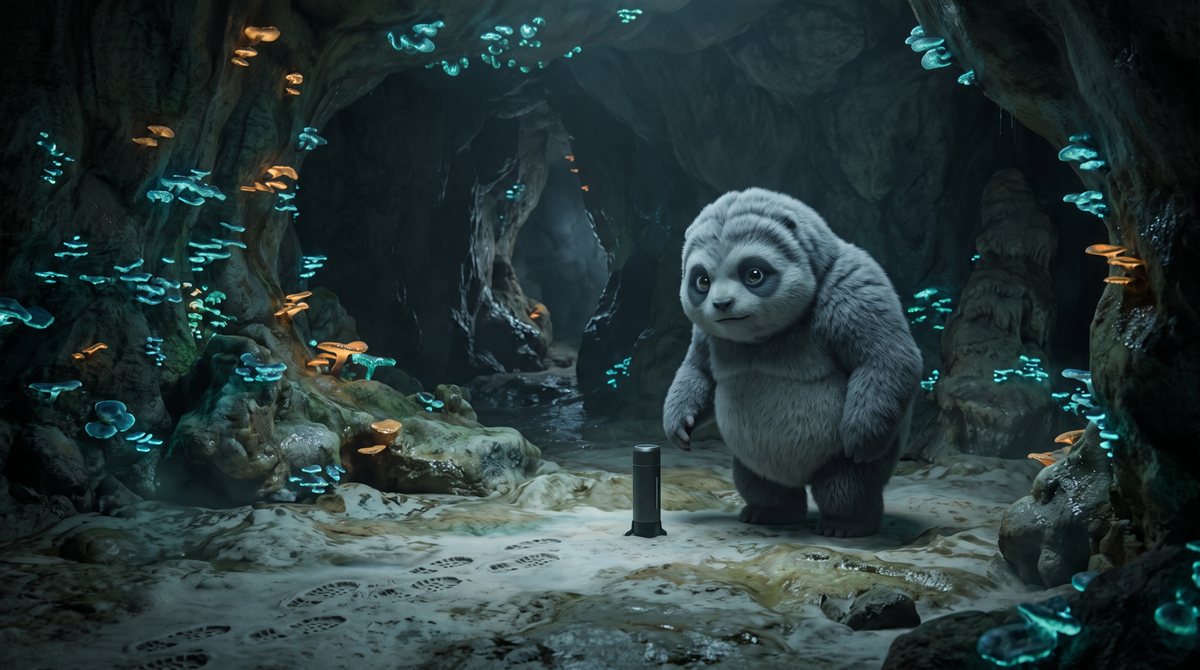
Carried-It-Sleeping (Pandoid, the deep networks)
- Time
- 2832 UCSD, the survey's second year on the ground, many tellings after the stone was lifted
- Location
- Fliade — the warm below the roof, the edge of the up-people's light at the junction, and the line at the top of the margin
Carried-It-Sleeping moved a stone at the bottom of the squeeze, a good one, so that everybody in the warm heard it and knew, and went up.
Two small ones tried to follow. They had been trying since the name. A name does that: the small ones hear a telling being told about someone, and the someone is there, in the warm, and can be followed. Carried-It-Sleeping had not known that a name would come with small ones attached to it. Nobody tells you that part.
"No," said Carried-It-Sleeping, at the foot of the squeeze, and then, because no is not a telling, "you do not fit yet. When you fit, I will take you. Move a stone when you go back, so they know where you are."
The small ones moved stones. Both of them, very loudly. And went back. Carried-It-Sleeping stood a moment at the foot of the squeeze and felt the warm change shape behind them as the small ones left it, and thought: so that is what it feels like. That is what Stone-First feels every time.
Then up, and through, and along the long passage toward the light.
The up-people were there this time. That was what Carried-It-Sleeping had come for. They were at the junction, all three, in their moving light, being loud, and Carried-It-Sleeping stood at the edge of the light where nothing could see them, and did not watch the light, and did not watch the glowing things, and watched, for the whole of a long telling, nothing but the asking.
It was everywhere. Once you were looking for it you could not stop seeing it.
One of them would hold a hand out, empty, toward another. And make a sound. The sound went up at the end, the way a passage goes up toward the cold; you could hear it going up. And then they waited, with the hand out, and the other one put a thing in the hand, and the sound the first one made afterwards went down again, and that was the end of it.
An empty hand. A sound that goes up. Waiting.
They did it for the glowing things. They did it for the humming stone, when one of them wanted it passed. They did it for a thing to drink out of. One of them did it and got nothing, and made the up-sound again, louder, and got the thing, and laughed. They asked each other, by Carried-It-Sleeping's count, more times in one telling than the Told ask each other in a whole life. Asking was most of what they did. It was the thing they were best at.
So Went-Round was wrong, and Went-Round was right. They could ask. They asked all the time. They had never once asked us.
Carried-It-Sleeping was about to go, with the telling complete and good, when the up-people finished their work. They always finished it the same way, gathering their glowing things, and the light swinging, and the talking getting louder as it got ready to go up the long passage toward the cold. Carried-It-Sleeping had seen it twice before and knew the shape of it.
The shape had changed.
One of them, the smallest of the three, the one who knelt to the humming stone, did not go up the passage with the others. Not at once. That one turned round, with the light held low, and faced the dark. Not the dark where Carried-It-Sleeping stood. The other dark, the deep dark, down the way the squeeze was. And stood, and said something.
It went up at the end.
And then the up-person waited. Stood there with the light low and the others already going, and waited, the way they waited with a hand out, for as long as you would wait for a hand to be filled. Nothing filled it. Nothing answered. The humming stone hummed once, the way it did, and stopped.
Then the up-person went.
Carried-It-Sleeping stood in the dark a long time after the light had gone, and the finding sat in them like a stone that has not been moved yet.
That was asking.
Not the hand. There was no hand out; both hands were on the light. But the sound had gone up, and they had waited, and they had waited facing us.
Discussion
Show discussion
Comments are read after they are posted and anything unsuitable is removed. Posting needs a GitHub account; reading needs nothing.