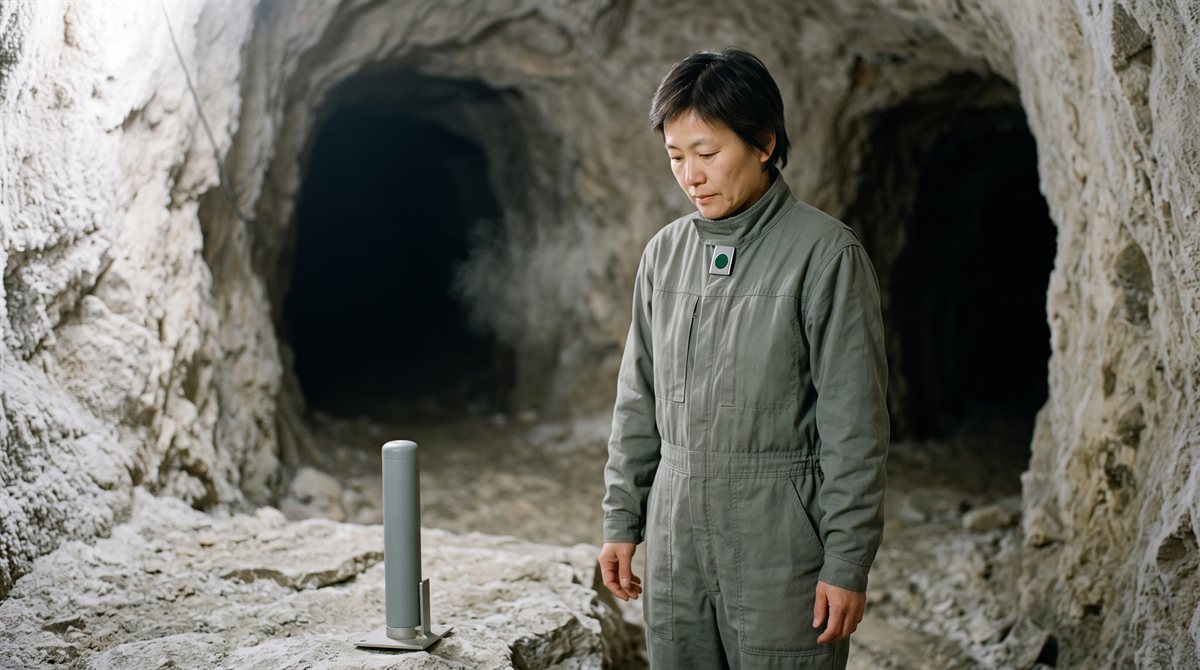
Hesper Nakagawa (Human, Survey Lead, Fliade survey)
- Time
- 2832 UCSD, the survey's second year on the ground
- Location
- Fliade — the upper junction where the surface party works, the station on the roof, and the line in the silt where the party's own tracks stop
Nakagawa read the unit's channels every evening at the station, after the others had eaten, because a thing read the same day is a thing you can still do something about.
The station sat on the roof of the world, on the equatorial plain, in a wind that smelled of ice and stone. Nothing about it would stay if the party left: that was the rule for this planet, and Nakagawa had written half of it. The unit's log came up the relay in the afternoon and waited. Sound channel, nothing. Imager, Anstolik, three, passing. Thermal channel.
Nakagawa read the thermal channel twice, and then sat for a while, and then went and got the other two.
"Look at that," said Nakagawa, and pointed.
A profile. Warm, upright, at the edge of the working light, on the open floor, where the third passage came in. Not moving. It had arrived between one sweep of the channel and the next, without any of the things that usually arrived first — no boulder shifted, no sound, nothing — and it had stood there, in plain sight of anyone who turned, for eleven minutes. Then it was not there.
"Eleven minutes," said Egede.
"Nobody looked up," said Nakagawa. "I didn't. Did either of you?"
They had not. Aravena went a colour.
"It's the small one," Egede said. "It's Teddy. Look at the width of it. That's not an adult."
"That is the fourth individual we have learned to tell apart," said Nakagawa, "and the log will say so." Nakagawa had the entry up. Aravena had written it, that afternoon, before anyone had read the channel — the temperature twice, the tracks, the time — and had added, at the end, from the profile's roundness and the way it held its warmth, the word young.
Nakagawa struck it out.
"We have no way to age a Pandoid," Nakagawa said. "We have never had one. Smaller is what we measured. Young is a guess wearing the measurement's clothes, and if the guess is wrong, every reading we make afterwards leans on it. Smaller."
"He is smaller," said Egede. "Fine."
Nakagawa let he go by. It was the party's word and it did no harm in the party's mouth, and there were only so many things a survey lead could strike out in one evening before people stopped hearing it.
What Nakagawa thought, and did not say, was simpler than any of that. Somebody had stood behind us for eleven minutes, close enough to touch the light, and we did not know. Nobody was hurt. Nothing was taken. And we were watched from nearer than we had ever been watched, by someone who knew exactly how near that was.
"Nothing changes," said Nakagawa. "We go on working. And we write down exactly what happened, and not one thing more."
Eleven minutes is a long time to be looked at. Nakagawa filed the entry, and put the light out, and did not sleep for about that long.
Discussion
Show discussion
Comments are read after they are posted and anything unsuitable is removed. Posting needs a GitHub account; reading needs nothing.