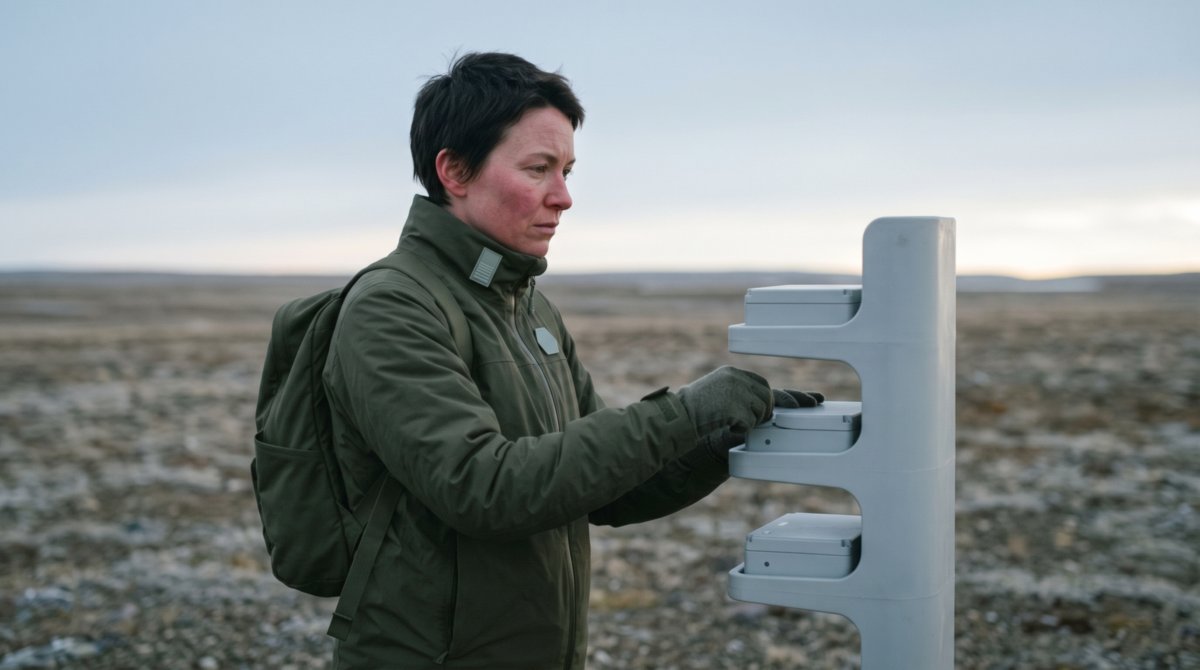
Odile Ferrant (Human, Survey Corps boundary officer)
- Time
- 2834 UCSD, the survey's fourth year on the ground, the shifts after the fourth summary was signed
- Location
- Fliade — the upper junction, the squeeze and the line, and the station on the roof
She did not sleep much, which she would have admitted if asked, and nobody did.
Nine years reading a page for a living, and the thing she had learned to be careful of was the quiet instrument. Not the one that fails: that one tells you. The one that works. The one that sits on its shelf and says nominal to itself seven hundred times, correctly, inside the band somebody set for it, and keeps a record no one on the roof can read, and relays it up under a seal. She had broken one of those seals in this room and read two years out of it in an evening. She had not thought, until tonight, that the survey's own unit at the junction was another one. It was on the party's side of the line. It was theirs. It hummed when Aravena knelt to it. And for two years it had been keeping a thing said to one person by another, filed as a rock, and relayed up, and nobody had set its band, because nobody had thought it was the kind of instrument that had one.
What the survey lead was proposing to do about it was, in her trade's terms, a calibration dark. She had seen a thousand. What she had never seen was a survey choosing to know less than its instruments could tell it, and writing the choice down, every shift, in the survey lead's hand, with an interval on it.
She would countersign that. She had already decided, on the floor, before Nakagawa had asked. She lay in the spare berth and went through why, because a thing you do by instinct is a thing you cannot defend, and she had defended worse.
A boot is an instrument with no log. That was the whole of it. Three people at the junction would still feel the answer come up through the floor, every shift, the way she had felt it once and would not stop being surprised by. They would know it had come. They would have nothing to show for knowing. And the one who had gone to the line would come back and say knock answered, in a voice, into a unit that had heard nothing, and that would be the record: a person saying a thing happened, which could be asked about, and struck, and signed, and believed, and the unit could not have told you any of it.
The people below the margin, if they kept a record at all, kept it that way. She had thought that on this floor a year ago, with the gravimeter's handset on her knee, and it had been a reason then to write exactly what she could stand behind and not one word past it. It was a different reason tonight. Tonight it was a description of what the roof was about to start doing, with boots, and she did not file that, because it was not boundary data and she had no page for it and, for the second time on this planet, did not want one.
The third shelf hummed very slightly in the dark. It would say nominal in the morning. It would mean what it meant.
Discussion
Show discussion
Comments are read after they are posted and anything unsuitable is removed. Posting needs a GitHub account; reading needs nothing.