Osric Fenholt
Also known as: The Honest Man of the Directorate
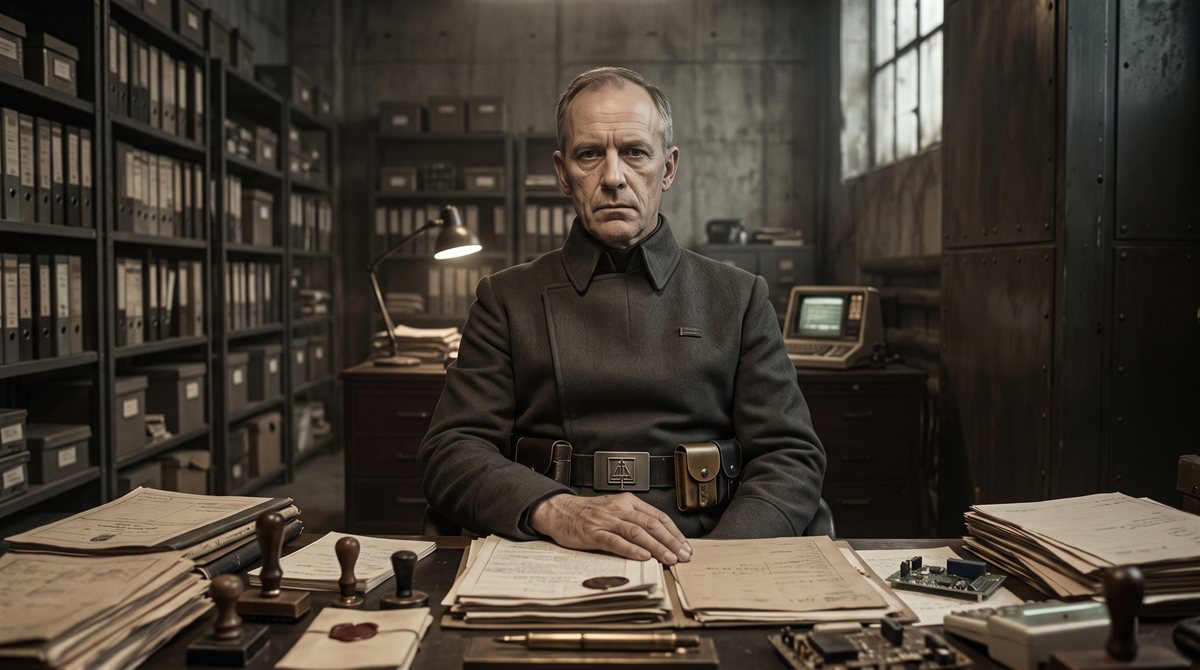
Osric Fenholt held one of the least distinguished titles the Imperium's Belt Settlements Directorate had to offer — Assistant Deputy Viceroy, a post two full grades below anyone with actual standing to set policy — and spent nineteen years using it to file the only settlement condition reports in the Directorate's archive that said what was actually happening.
He was not a dissident. He never joined the Reform Movement, never made a public claim, and would have rejected "honest" as a description of what he did, on the grounds that it implied a choice. To Fenholt, filing the correct figures was simply the job as written, and he found it faintly insulting that anyone treated doing it as remarkable.
Known History
- Born 2558 UCSD to a technical family on the Ceres administrative belt; commissioned into the Bureau of Outer Compliance's technical track — the route Imperium doctrine reserved for civilian expertise reframed as support for Imperium operations, since the Bureau's own advancement ladder ran through service record rather than qualification.
- Appointed Assistant Deputy Viceroy for the Anchorpoint Cluster in 2590 UCSD, responsible for compiling quarterly settlement condition reports on eleven Belt habitats and forwarding them through a Deputy Viceroy and Viceroy to Solar Command.
- Refused, across nineteen years and several changes of superior, to alter the figures underneath his reports to match the more optimistic language his reviewing officers routinely layered on top of them — most notably in the 2601 Anchorpoint Station supply audit, where a documented 34% shortfall reached his desk annotated "describe as manageable." Fenholt left the number untouched and appended a note observing that "manageable" did not appear as a defined category anywhere in Directorate Schedule 4, and asking the reviewing officer to specify which schedule category applied, or else let the figure stand as submitted.
- Survived where a more visible dissenter would not have. The Imperium's own doctrine of technical rigor and its intolerance of ambiguity gave his accuracy nowhere to be filed as sedition — a correctly categorized number read, to the institution that demanded correct categories, as competence rather than criticism.
- Remained in post through the Imperium's final decade and its 2609 UCSD restructuring into the Military Space Command; declined a continuing appointment under the new command structure and retired in 2611 UCSD.
- Died 2621 UCSD. His nineteen years of unaltered raw reports — routinely resummarized by officers above him but never once amended in his own hand — became, once historians and the Reform Movement's successors went looking for a Belt settlement record the Imperium hadn't had the chance to edit, one of the few genuinely contemporaneous documentary sources for the period.
Character Notes
Colleagues who worked beneath Fenholt describe his method as tedious rather than brave: he asked, in writing, exactly which defined category a euphemism belonged to, and left the underlying number exactly where it was until someone answered. Most reviewing officers eventually stopped trying to correct him, less out of principle than arithmetic — arguing with a footnote cost more paperwork than filing the figure as submitted, and the Directorate's own procedures gave him every right to ask the question.
He kept no copies of his own reports beyond what the Bureau's retention schedule required, on the stated grounds that a compliance officer who hoarded records "was describing himself, not the settlements." The habitats under his cluster fared no better and no worse, materially, than any other under Imperium administration. What changed, quietly, was that anyone who later wanted to know how they had actually fared had somewhere reliable to look.
The Other Assistant Deputy Viceroy
The Directorate ran two officers of Fenholt's grade under the same Deputy Viceroy, and got two entirely different things from them. Fenholt was posted out to the Anchorpoint Cluster and its eleven habitats. Thalassa Vexar was kept at the Office of the Viceroy, where the delegations came to her instead. The grade was identical and the placement was not, and everything that followed came out of that: he had the figures and she had the room.
The Deputy Viceroy preferred what Vexar produced, for a reason neither of them ever disputed. Her reports required almost no reconciliation before they could go upward; his required a great deal. A Fenholt submission arrived correct and carrying a written question about which Schedule 4 category a euphemism belonged to, and the office had to do something about that before it could forward anything. Hers arrived usable. That is the whole of the professional rivalry, and it was never once a dispute about honesty — neither of them ever accused the other of filing anything untrue, and neither of them ever had grounds to.
What they disagreed about was what a report is for. Fenholt held that a report exists to be true, and that what happens to it afterwards is not the compiler's business. Vexar held that a report exists to be acted on, and that a true one nobody can use has not been filed but stored. Each thought the other was doing the job with the load-bearing half removed — her objection being that nineteen years of unamended figures changed nothing whatever while they were current, his being that figures reconcile easily when the delegations supplying them have already decided what they think can be heard. The record does not settle it, because the two were answering to different clocks: what Vexar's method produced was usable immediately and expired with the Imperium, and what Fenholt's produced was useless at the time and is the reason anyone can now check hers. Their superior's own filings are the only place the two names appear together at all. His reviewing officers changed several times over those years and her desk never moved once, so it is in the Deputy Viceroy's office that the alternation is visible — which of the two the Directorate reached for depended entirely on what it was about to be asked. No correspondence between them survives, and neither left any account of the other.
See also: The Imperium, Military Space Command, Thalassa Vexar.
Discussion
Show discussion
Comments are read after they are posted and anything unsuitable is removed. Posting needs a GitHub account; reading needs nothing.