Thalassa Vexar
Also known as: Viceroy Vexar
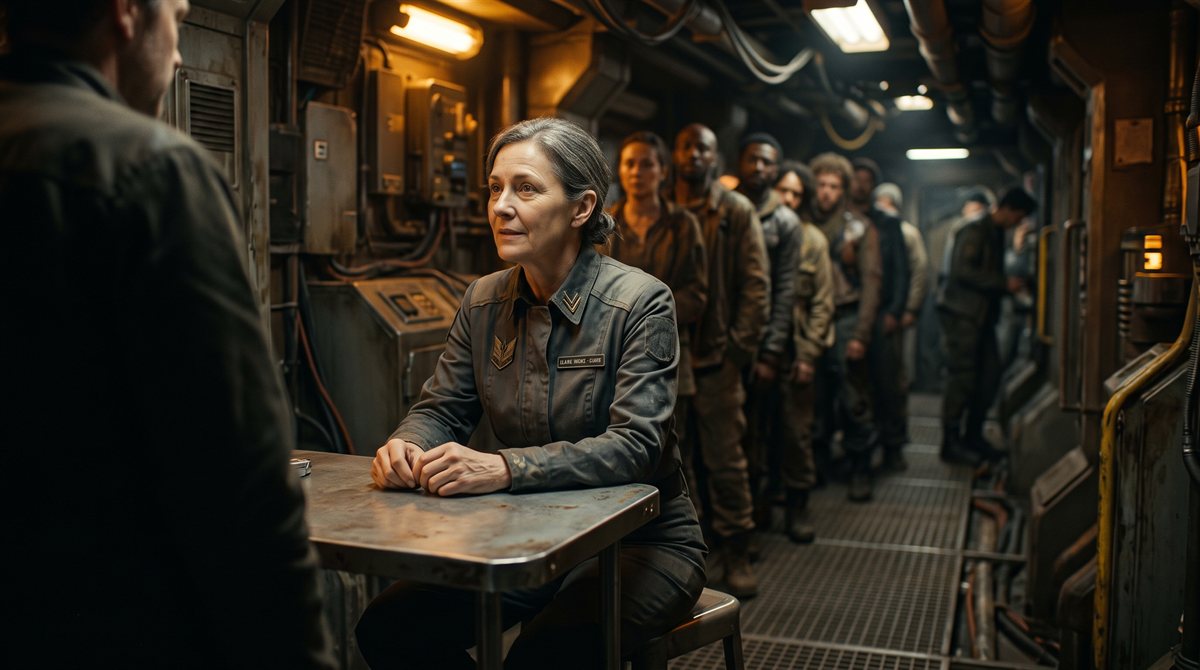
Thalassa Vexar was the most trusted Imperium officer in the Belt, and she held a grade two full steps below anyone who could alter a single condition in it.
She was not a reformer, and she never claimed to be. She never joined the Reform Movement, never obstructed a Directorate instruction, and never told a settlement delegation anything she knew to be untrue. What she did instead was answer every question put to her, remember every name she was given, and forward upward, correctly categorised, everything she was told — which is how the Imperium came to hold the most accurate picture of the Belt it ever had, and how the Belt came to be administered on it.
Known History
- Born 2551 UCSD on the Deimos yards; commissioned into the Inner System Defence Fleet's supply and movements branch, the route by which someone without a combat record could still accrue the service credentials Imperium doctrine required of anyone entering an institutional hierarchy.
- Transferred to the Belt Settlements Directorate in 2584 UCSD and appointed Assistant Deputy Viceroy in 2591 UCSD — attached to the Office of the Viceroy rather than to a settlement cluster, which is the entire explanation of her career. The grade was a cluster officer's grade. The desk was outside the Viceroy's door.
- Named the Directorate's liaison to settlement delegations in 2594 UCSD, on the reasoning of a Deputy Viceroy who had noticed that delegations which would not speak to the grades above her spoke to her at length, and that the resulting reports required almost no reconciliation afterwards.
- Staffed the Directorate's seat on the High Council from its first session, briefing the Viceroy who held the seat and, by arrangement of long standing, the outer-station representatives seated with provisional consultative status — who found her the only member of the Directorate's staff who would tell them, without being pressed, which of their submissions had any prospect of being acted on.
- Retained on the transition staff through the 2609 UCSD restructuring into the Military Space Command, where she contributed to the design of the advisory and consultative architecture the new command modelled on the High Council. She had sat in the one chamber of the Imperium in which outer-station representatives had ever been listened to, and she recommended it be built again.
- Retired 2612 UCSD. Died 2619 UCSD.
Character Notes
Contemporary accounts of Vexar are unusually consistent on one detail and unusually vague on all the others. Delegates who could not agree on her height, her age, or which of the two Directorate uniforms she wore agreed on the pale blue eyes, and several independently recorded the same observation about them: that she looked at the person speaking for as long as the person was speaking. Under an administration that categorised, filed, and reassigned everything within its authority, the experience of being looked at rather than sorted was memorable enough that thirty years later it was what people still supplied first.
She did not raise her voice, and there is no record of her having needed to. She did not soften a figure, promise an outcome she had no standing to deliver, or let a delegation leave her office believing it had been heard by anyone senior to her when it had not. She also did not, in twenty-one years, forward a single recommendation — because the Assistant Deputy Viceroy grade had no line on any Directorate form in which one could be entered, and she declined to enter one anywhere it did not belong. She raised the absence twice in writing, was answered correctly on both occasions, and did not raise it a third time.
Everyone below her grade, and a good many above it, called her Viceroy Vexar. She was never a Viceroy, never a Deputy Viceroy, and never corrected anybody. Nobody senior to her corrected them either, which is the more revealing fact: the Directorate found it useful that the Belt believed it was being dealt with at a level the Belt was not being dealt with at.
This is what makes her difficult in the Belt's own account of the period. Outer-station memory of the Imperium is sixty years of punitive governance imposed by victors who never intended the defeated to forget, and Vexar is the name that account has to stop and explain. She treated settlement delegates decently at a time when nothing obliged her to, and the settlements she dealt with fared no better for it — the supply schedules, the movement restrictions, and the settlement caps applied to her clusters exactly as written. What her decency produced was compliance obtained at a lower cost than force, and a Directorate that knew, in unusual detail, what the Belt would tolerate. The Reform Movement's successors, going through the Directorate archive for evidence of what had been done to the outer settlements, found some of their best material in her reports and were not entirely comfortable about where it had come from.
She left no memoir, no correspondence, and no account of the period after 2609 that any archive has located. The Military Space Command's advisory chambers were still new when she died, and there is no record of what she thought of them.
The Other Assistant Deputy Viceroy
The Deputy Viceroy who made her the Directorate's liaison in 2594 had a second officer of her exact grade already: Osric Fenholt, posted out to the Anchorpoint Cluster, whose settlement condition reports were the most accurate in the archive and the most expensive to move. The observation that got Vexar the liaison appointment — that her reports required almost no reconciliation afterwards — is a sentence with Fenholt on the other side of it. She was promoted into a role on the strength of a comparison she never made herself, and the record does not show her being told what the comparison was.
She was better at the Directorate's job and he was better at the archive's, and each of them thought the other had removed the load-bearing half. Vexar's objection to Fenholt was arithmetical rather than moral: he filed unamended figures for nineteen years and not one condition in the Belt changed because of them, while she could name delegations that got a hearing, a schedule read out to them honestly, and an answer about what was worth submitting. His objection to her — never stated to her, and inferable only from what he did rather than what he wrote — was that figures reconcile easily when the people supplying them have already worked out what can be heard, and that a Directorate delighted to be told what the Belt would tolerate was being handed a weapon and calling it a courtesy.
The uncomfortable half is hers. The Reform Movement's successors went through the Directorate archive for evidence of what had been done to the outer settlements and found their cleanest material in Fenholt's untouched columns and some of their best in Vexar's reports, and only had reservations about one of the two sources. Nothing in her file answers the charge, because nothing in her file acknowledges it: she never wrote about him, he never wrote about her, and the rivalry survives only in a Deputy Viceroy's own filings, where the two names alternate according to what the office was about to be asked.
A note on naming, for anyone cross-referencing the record: the ocean world Thalassa carries this officer's given name and has nothing to do with her. She died in 2619 UCSD, generations before that world's colony charter was issued, and no record places an Imperium Belt officer anywhere near the Nerea System. Thalassa is a sea-name, and a world that is ninety-six percent open water needs no further explanation for holding one — which is the entire resemblance.
See also: The Imperium, Osric Fenholt, Military Space Command, Thalassa (the world).
Discussion
Show discussion
Comments are read after they are posted and anything unsuitable is removed. Posting needs a GitHub account; reading needs nothing.