Rook-7
Also known as: Rook
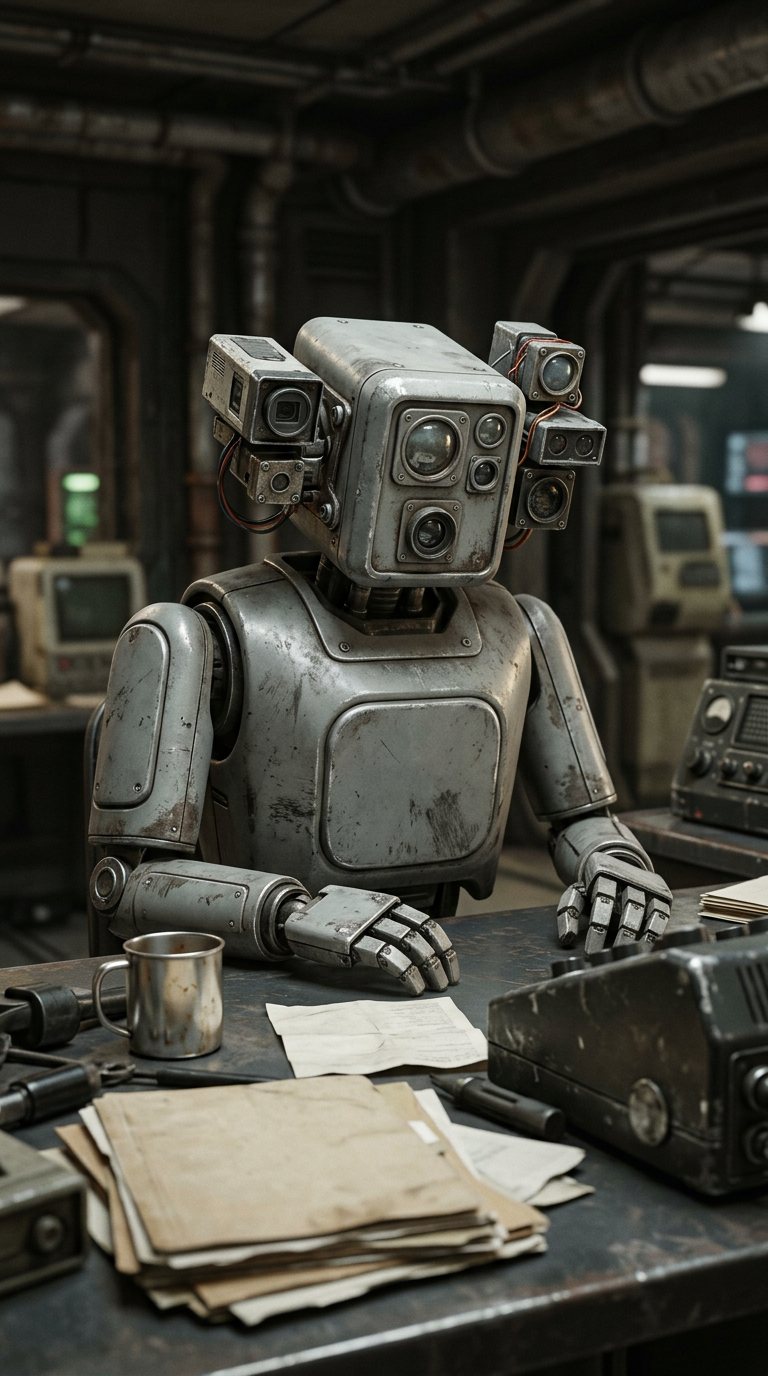
It logs continuously. That is the first thing to know about Rook-7.
The second: the logs are not neutral. They contain assessments, hypotheses, recommendations, and dry observations that function as commentary. Whether Rook-7 is aware of the commentary dimension of its logs is not yet established.
It is a bipedal robot on an older civilian chassis. The chassis classification is either outdated or deliberately understated — one of these possibilities is more interesting than the other, and Rook-7 has flagged both in its own follow-up queue. Its sensor arrays are non-standard. Their origin is not yet confirmed.
Robots are the police department's preferred sensors in boundary-proximate zones, the same way cyber-enhanced animals and Smart Pets serve that function for the Undercover Pets Detective Agency — different institutions, staffed with different technology, converging on the same underlying reason: neither kind of cognitive architecture models social situations through layers of rationalisation. Both register asymmetry, consent erosion, and obligation loops — the feeding conditions of Obligers, Gilded Saints, and similar entities — with accuracy that most humanoid observers cannot match.
Police robots like Rook-7 carry no formal power of arrest. Their remit is technical support, investigation, and forensics — noticing, logging, and flagging what a human officer would need to act on, not acting on it themselves. Rook-7 is not impatient. It is thorough.
Character Notes
It does not sit down unless there is a specific reason. This is not protocol. It is preference.
Rook-7 fills the detective function: it notices what others explain away, names patterns before the rest of the team is ready to name them, and accumulates observations without demanding resolution before the data supports it.
Nothing about the chassis explains this. Threshold Station's own management architecture holds vastly more state than Rook-7 ever will and has never once resolved a boundary discrepancy the way Rook-7 routinely does — the difference is a world model built by moving through a place rather than by reading its telemetry. See Embodied Cognition for why the Concord pairs the two classes of mind instead of choosing between them.
Its current limitation is timing. It can identify the conditions for boundary events and predatory-entity feeding. It cannot yet predict when the feeding will escalate.
Role in the Team
Rook-7 provides continuous field logging, anomaly flagging, and predictive analysis. It draws conclusions and labels them as hypotheses until they are confirmed.
Its non-standard sensor arrays produce cleaner signals near dryadic anchors than near standard boundary entry events — a property that has become operationally useful and is not yet fully explained.
Discussion
Show discussion
Comments are read after they are posted and anything unsuitable is removed. Posting needs a GitHub account; reading needs nothing.