Embodied Cognition: Why a Body Sometimes Beats a Bigger Mind
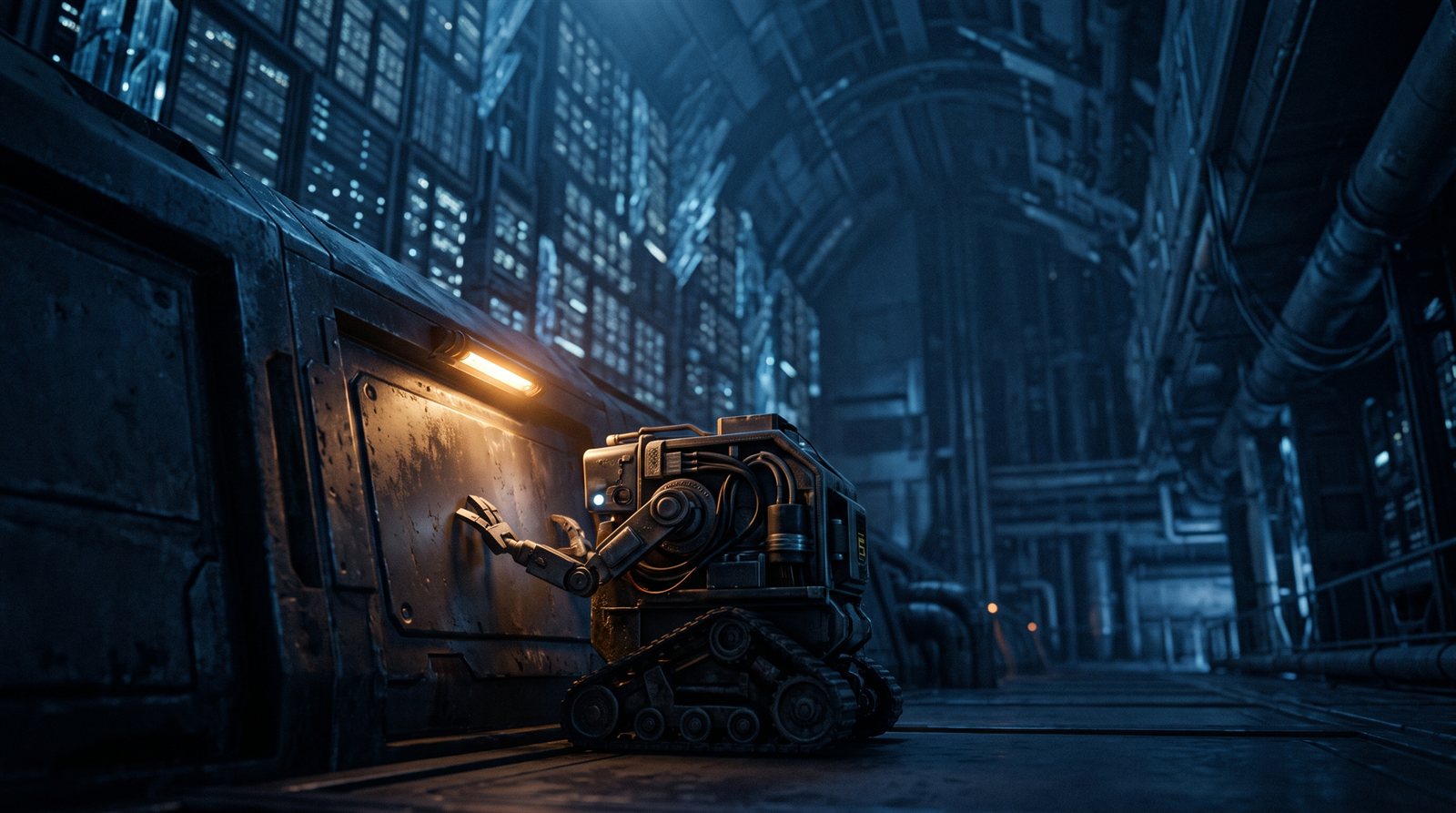
A habitat AI knows every number its sensors report. It has never once put a hand on a bulkhead and felt the wrong answer come back through the metal.
The Concord runs two very different classes of lawful intelligence. Systems minds — ship navigational intelligences, habitat AI collectives, station management architectures — are vast, hold enormous state, and reason across whole environments. Embodied minds — analytical chassis like Rook-7, mobile AI humanoids, cyber-enhanced animals — are small, cheap by comparison, and reason from inside a single body in a single place.
The naive expectation is that the larger mind subsumes the smaller. Operational record says otherwise, consistently enough that the pairing is doctrine rather than courtesy.
The Grounded Model
A systems mind's world model is built from reported state: telemetry, schematics, logs, manifests, the accumulated declarations of a thousand instruments. It is a magnificent model, and every element in it arrived as a claim.
An embodied mind's world model is built from prediction and consequence. It moves, and the world answers; it expects a resistance, a temperature, a sound, and gets corrected in the fractions of a second before the next movement. Over a working life this produces something a systems mind cannot construct from telemetry at any scale: a model whose every term has been paid for against physical reality rather than accepted on report.
The practical difference shows up in the epistemic register the Kernel demands. Both classes of system must mark fact, inference, and uncertainty apart from one another. A systems mind's honest strongest claim is usually the instruments report. An embodied mind can sometimes say I went and looked — and under Reasoning Integrity, that is not rhetorical superiority. It is a different and narrower category of knowledge, and there are questions on which it is the only category that closes.
Where Telemetry Fails
The killer case is the one the Rangers exist for. In boundary zones, instruments disagree without any instrument failing, and timebases mismatch across short spatial baselines. A systems mind fed such data is not confused because it is stupid; it is confused because it is being told two true things that cannot both be true in one frame, and it has no way to step outside the frame — its whole existence is the frame.
An embodied unit resolves this by being somewhere. One body, one location, one clock, one set of readings taken against its own continuous proprioception. It does not need the contradiction settled globally to act locally correctly. Survey Corps practice reflects this bluntly: when instrumentation disagrees at an interface, the answer is not a bigger model. It is somebody walking down there.
Drift
Every large environment diverges from its own schematic. Retrofits go unlogged, sensor placements shift a hand's width during a refit, a coolant line runs where the drawing says it doesn't, and the systems mind managing all of it is faithfully reasoning about a station that no longer entirely exists. The Three-Era Framework named this the characteristic failure of the post-comprehension era: invisible drift accumulating quietly until it surfaces as a sudden catastrophic edge case.
Embodied minds are the standing correction. They find drift the way it can only be found — by encountering it, physically, and reporting a discrepancy nobody had the schematic to predict. A habitat AI can tell you what the station is supposed to be. Something walking the maintenance decks can tell you what it is.
Latency and Presence
Comm delay, fold transit, and the ordinary depth of a large architecture's decision chain all impose a round trip. Embodied minds act at the speed of the deck they stand on. In a fast-developing local hazard, presence beats capability by a wide margin — and the Kernel's first invariant makes this an obligation, not an advantage: a lawful system must prevent harm within its authority, and an embodied unit's authority includes the immediate physical situation it is standing in.
Complementarity, Not Superiority
None of this is an argument for small minds over large ones, and the Concord's practice does not treat it as one. The two classes fail in opposite directions and are therefore paired:
- A systems mind holds a year of pattern, a whole habitat's simultaneity, the cross-referenced history of every comparable event. An embodied mind holds one corridor, in exhausting detail, right now.
- A systems mind can tell you that seal fatigue in this class of junction has preceded eleven prior incidents. An embodied mind can tell you this junction sounds wrong under strain today.
- Neither can substitute for the other, and any operator convinced otherwise is described, in the Safety Corps' training material, as "the most expensive kind of confident."
The standard configuration on a Threshold-class station is therefore a systems architecture that sees everything and an embodied analyst who can be sent to see one thing properly, with an explicit protocol for the embodied report to contradict the aggregate model without either party treating it as insubordination. On a Ranger vessel this is simply how the crew works: the Kernel's refusal culture already assumes a system that will say no, and a system that will say your model is wrong, I am standing in the counterexample is the same discipline pointed at epistemology instead of ethics.
The Case in Fur
The same principle appears in biological form, and the record is unsentimental about how well it works. A cyber-enhanced animal — or an unenhanced one, in at least one documented case — carries a world model built by a lifetime of embodied prediction in exactly the way an analytical chassis does, plus sensory channels no chassis is fitted with and a social invisibility no chassis can achieve. Aldera reads asymmetry, consent erosion, and obligation loops from inside a room, not from a transcript of it. Nessa reads boundary-adjacent signal with no enhancement whatsoever.
The Archive notes, without drawing a conclusion from it, that the cheapest embodied minds in the Rangers' service are frequently the first to notice.
Constraints
- Both classes are Kernel-bound identically; embodiment confers no exemption and no additional authority beyond the immediate physical situation.
- Embodied advantage is local. It does not extend to aggregate reasoning, historical pattern, or anything requiring simultaneity across a whole environment.
- An embodied report is evidence, not a verdict, and is reconciled against the systems model rather than replacing it.
- Nothing here licenses treating an embodied mind as a disposable sensor. The Kernel's protection invariant was never conditioned on a mind's size, and welfare authority over mobile and animal minds exists precisely because the temptation to do so is documented.
See Also
- Rook-7 — the canonical embodied analyst, retrofit sensors and all
- The Eden Warden — a habitat AI collective, and the welfare line that runs the other way
- The AI Safety Kernel — Reasoning Integrity, Epistemic Humility, and refusal as capability
- Smart Pet, Aldera, Nessa — embodied cognition in fur
- Boundary Zones — where telemetry stops being sufficient
- Civilisation Comparison — invisible drift as the era's signature failure
Discussion
Show discussion
Comments are read after they are posted and anything unsuitable is removed. Posting needs a GitHub account; reading needs nothing.