Sildron Drey
Also known as: Director Drey
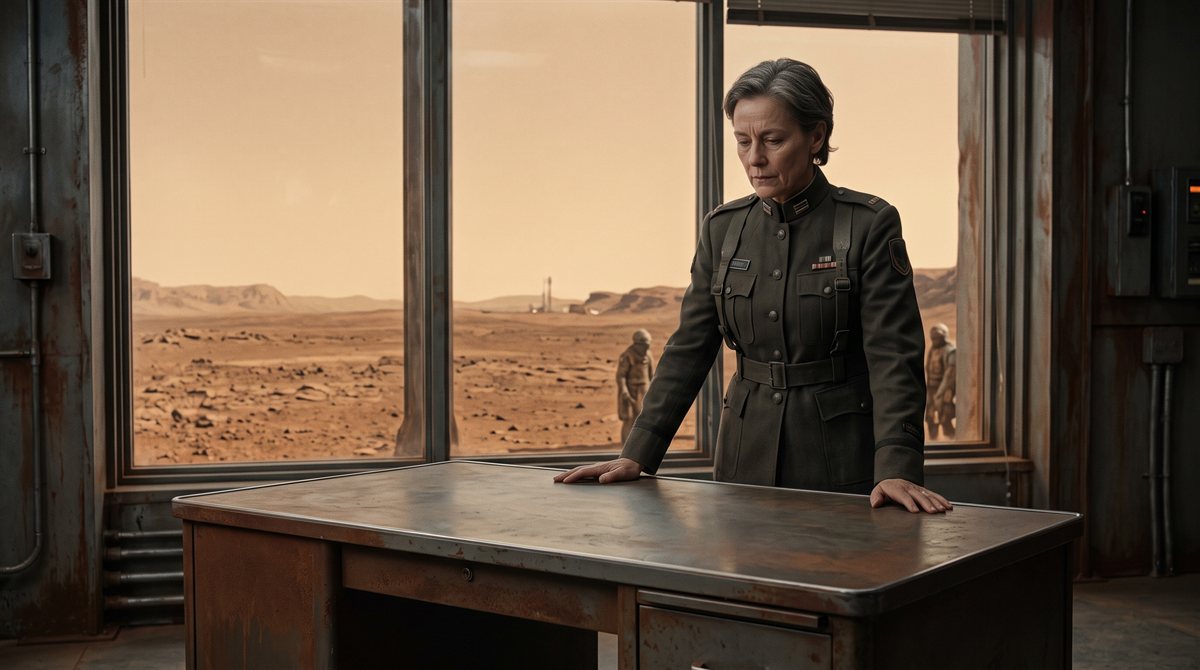
Sildron Drey wrote the careful version of General Krast's argument twenty-one years before Krast gave the careless one, and held the post that had to turn it into orders for nine years after that. The second experience is the reason nobody quotes the first.
Drey came up through the Military Space Command's operations track rather than its engineering or command tracks — the staff side, the part of the institution that converted a committee's finding into a tasking order and was measured on whether the order was correctly formed rather than on whether it arrived in time. She was, by every surviving assessment, extremely good at it.
Known History
- Born 2662 UCSD; commissioned into the MSC's operations staff track in 2684 and posted to Solar Command, Mars, where she spent effectively her entire career.
- Overlapped at Solar Command with Maren Solveig Krast, three years her junior and commissioned five years after her, on the engineering track rather than the staff one. They were contemporaries and not intimates, and Drey's own account of the case for technocratic command is that she arrived at it herself, from the same teaching every officer of that intake received, and would have held it had Krast never existed.
- Wrote On the Cost of Speed (2698 UCSD), a staff paper defending deliberate slowness as a design property rather than a defect — the qualified, footnoted, historically-argued version of the position Krast would state in one sentence at the Outer Stations Consolidation Hearing. It entered the Solar Command officer-track syllabus and stayed there for thirty years.
- Appointed Director of Operations in 2711 UCSD, holding the post through the entire Eden sequence: the eleven months to form an investigative committee, the fourteen months to a preliminary report classifying Eden's fold-adjacent position as monitoring-recommended, and the six years to follow-up findings.
- Drafted the terms of reference for Eden's monitoring officer, and twice requested in writing that the post be given authority to act without further committee approval. Both requests were answered that the change required committee review. Both answers were correct.
- Signed the liability classification for the Patience First expedition in 2715 UCSD — unauthorised, and therefore beyond MSC obligation to the crew's next of kin. She never afterwards argued the classification was wrong on its own terms, which was precisely the part she could not stop examining.
- Gave nine days of technical testimony to the Outer Stations Consolidation Hearing in 2719 UCSD. Her directorate's own response-time figures are the backbone of the hearing's finding of structural inadequacy, and she supplied them without contest, correction, or a single request that a number be characterised more favourably.
- Was in the chamber, in the eleventh week, when Krast volunteered the word.
- Took accumulated leave in the spring of 2720 and did not come back from it. Her deputy signed the directorate's orders for a season, then for two, and the post was filled substantively in the autumn.
- Was carried on indefinite medical leave under a classification the MSC's personnel schedule provided for and its officer culture read as a finding about the officer. Resigned her commission in 2721, before the Consolidation Accords, and did not take a post in the Solar System Defence Command when the restructuring offered her one.
- Answered the Accords negotiators' questions in writing from Mars in 2722 UCSD, supporting the jurisdiction limits the SSDC formally objected to — see What They Were Forbidden to Become (S00E03C01). She declined to appear in the chamber and gave no reason for declining.
- Died on Mars in 2744 UCSD, twenty-one years after the charter she had helped make the case for and never once claimed credit for.
Character Notes
The disillusionment was not a moment and Drey never described it as one. What she described, in the only extended account she left — a reply to a Solar Command instructor who had written asking whether her paper should still be taught — was an accumulation: nine years in a post whose entire function turned out to be holding urgent things until a structure elsewhere was ready for them, and the slow recognition that every individual delay in that period had been lawful, procedurally correct, and defensible in exactly the terms her own paper had supplied.
She did not ask for On the Cost of Speed to be withdrawn from the syllabus. She asked that it be taught with her directorate's response-time tables bound in behind it, and left the choice of whether to do that to the instructor, who did.
Her account of Krast's answer is the least dramatic thing on her record and the most quoted line of it, in the small circle of people who read hearing transcripts rather than clips: "She said my paper. She said it in one sentence, without any of the conditions, and the room heard it as the whole of the argument — which it was. The conditions had never been doing any work. I had written them for myself."
What happened the following spring the record states plainly and does not name. Drey went on leave with four years of it accrued, having taken almost none of it since the fold route opened, and found that she could not do the work when the leave ended. Not would not; the distinction mattered to her and she made it in writing, once, to a personnel officer who had not asked. She was not ill in any way the MSC's medical schedule had a line for, and she was not able to draft an order. The institution's answer was a classification that let her be paid and kept her name off a duty roster, and its officer corps read that classification the way it read every other finding about an officer's fitness — as something the officer had turned out to be. It would be another century before the successor institutions that eventually descend from this one settled the position that a stress injury is an injury, and nobody who wrote Drey's file was in a position to anticipate it.
She recovered slowly, incompletely, and without any of it being a story. What she got back was ordinary life on Mars, correspondence, a long acquaintance with the instructor who taught her paper, and no further employment of any kind. She did not describe the years after 2721 as wasted and did not describe them as peaceful, and when asked directly by the one correspondent who asked directly, she wrote that she had been extremely tired for a long time and that the tiredness had turned out to be the least interesting thing about it.
Drey's own relationship to the famous nine seconds was uncomplicated and slightly bitter. She had spent nine days establishing, on the record and under examination, the specific structural failure the hearing was convened to find; a general had answered one question badly for ninety words; and the hearing's actual findings reached the outer stations, when they reached them at all, as a footnote to a clip. She thought Delegate Solano's decision to release it was correct. She also thought it had taught every institution watching the wrong lesson about what makes a true thing land, and she held both of those views at once for the rest of her life without ever proposing what should have been done instead.
She is not a whistleblower and the record should not be read as making her one. She broke no confidence, leaked nothing, filed no dissent, and made no public statement between 2719 and her death that was not an answer to a direct question. What she did was stop defending a structure she had authored the defence of, decline the successor institution's offer, and give the delegates who dismantled her Command's authority the figures they asked for. Solar Command's institutional memory has never entirely settled on what to call that, and settled on a word for the spring of 2720 almost immediately.
See also: General Maren Solveig Krast, Military Space Command, The Founding of the Star Rangers, Eden Space Habitat, The Volunteered Word (S00E02C02), Unauthorised, Therefore (S00E02C01).
Discussion
Show discussion
Comments are read after they are posted and anything unsuitable is removed. Posting needs a GitHub account; reading needs nothing.