Maren Solveig Krast
Also known as: General Krast
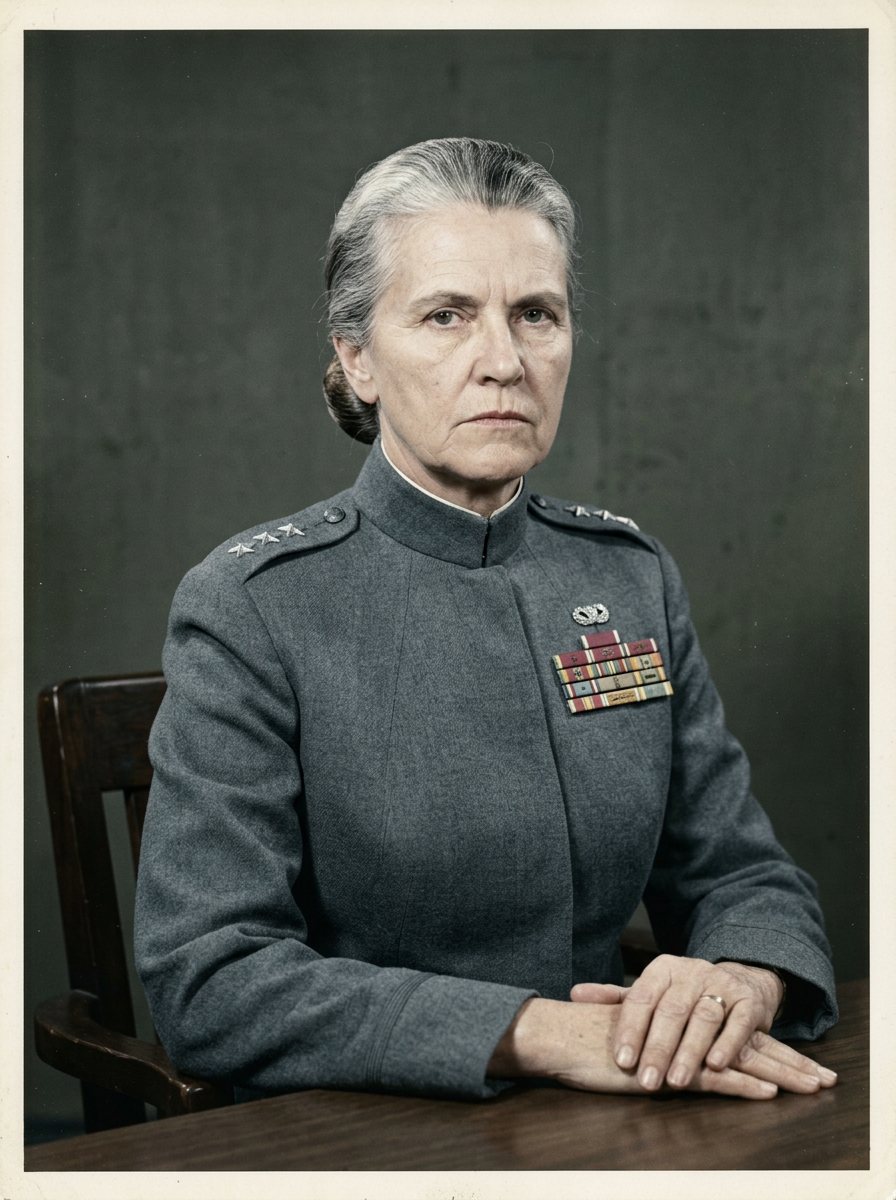
General Krast gave the Military Space Command its most durable line in a single unscripted answer, and died the following year, which spared her the discovery every other officer who repeated it eventually made: that a line durable enough to survive an institution's collapse does not stay owned by the person who said it.
Krast rose through Solar Command's officer track on Mars across three decades in which the institution's technocratic self-confidence was at its least examined. She held a series of engineering-command postings before she was called, in 2719 UCSD, to give evidence to the Outer Stations Consolidation Hearing — convened, nominally, to review escalating grievances from outer-station and deep-range habitat delegations about the MSC's advisory-only council structure. She sat on no part of it. She was a witness, and by the eleventh week she was one the chair had already questioned at length.
Known History
- Born 2665 UCSD, commissioned into Solar Command's engineering-track officer corps in 2689 — thirty years of service to the day she gave the answer she is remembered for.
- Held command postings across several Mars-adjacent infrastructure programmes before her appointment to general rank.
- Was born a hundred and twenty-two years after the Coherence Wars ended, and knew them the way every officer of her generation knew them: taught, at Solar Command, by instructors who had themselves been taught.
- Addressed the Outer Stations Consolidation Hearing in 2719 UCSD, delivering the line MSC culture would go on to teach as defensible institutional memory: "We tried democracy. The result was forty years of the Coherence Wars and three billion dead. I would rather be called a tyrant than repeat the experiment."
- Returned to senior Solar Command postings on Mars and died there in 2720 UCSD at fifty-five, a few months after the hearing rose and two years before the Consolidation Accords restructured the MSC into the Solar System Defence Command. Early, by the standards of her century. The file gives the date and nothing else, and no contemporary who wrote about her afterwards appears to have been told more than that.
- Did not live to see her own line's reception shift from institutional doctrine to a cautionary quotation SSDC circles no longer always repeat as approval.
Character Notes
Krast's line reads, out of context, as the kind of thing said for effect. The hearing record suggests otherwise: she gave the answer unscripted, in response to a delegate's direct question about why the MSC would not convert its consultative councils into binding ones, and meant every word of it exactly as delivered. She was not being provocative. She was being, by her own lights, honest about a trade she believed the Solar System had already made once and could not survive making badly a second time.
What her line left out — deliberately or not, the hearing record does not resolve which — was the argument her outer-station critics had already made and would keep making for another quarter-century: that the Coherence Wars were not caused by democracy in the abstract, but by democratic systems captured and destabilised by interests that could not survive real accountability. Krast had the historical facts of the wars correct. She did not, on the surviving record, ever directly answer that narrower counter-argument, and it is not clear she considered it a different claim from the one she'd already refuted to her own satisfaction.
She was careful about the wars themselves, and the transcript shows it: asked to defend deliberate slowness, she said plainly that she had never seen them, that nobody in the chamber had, and that the figures do not change in the handing over. The figures do not. What she did not appear to have considered is that a judgement handed over with them arrives looking like a figure, and that she had been holding one for thirty years without ever having had occasion to check it against anything.
She remains, within Solar Command's institutional memory, a genuinely respected engineering officer whose one hearing-room answer outlived her entire career and came, eventually, to mean something closer to the opposite of what she intended by it.
A Fellowship comparative-archive note reads her founding word against an Old-Earth scriptural figure — the captain who ended a rotten house and kept its older idol; see Jehu Among the Comparanda and its told version, The Captain Who Drove Furiously. The comparandum is one correspondent's, contested and non-diegetic to the political record above.
See also: Military Space Command, Sildron Drey, Mars, The Founding of the Star Rangers, Jehu Among the Comparanda, The Captain Who Drove Furiously.
Discussion
Show discussion
Comments are read after they are posted and anything unsuitable is removed. Posting needs a GitHub account; reading needs nothing.