Mars
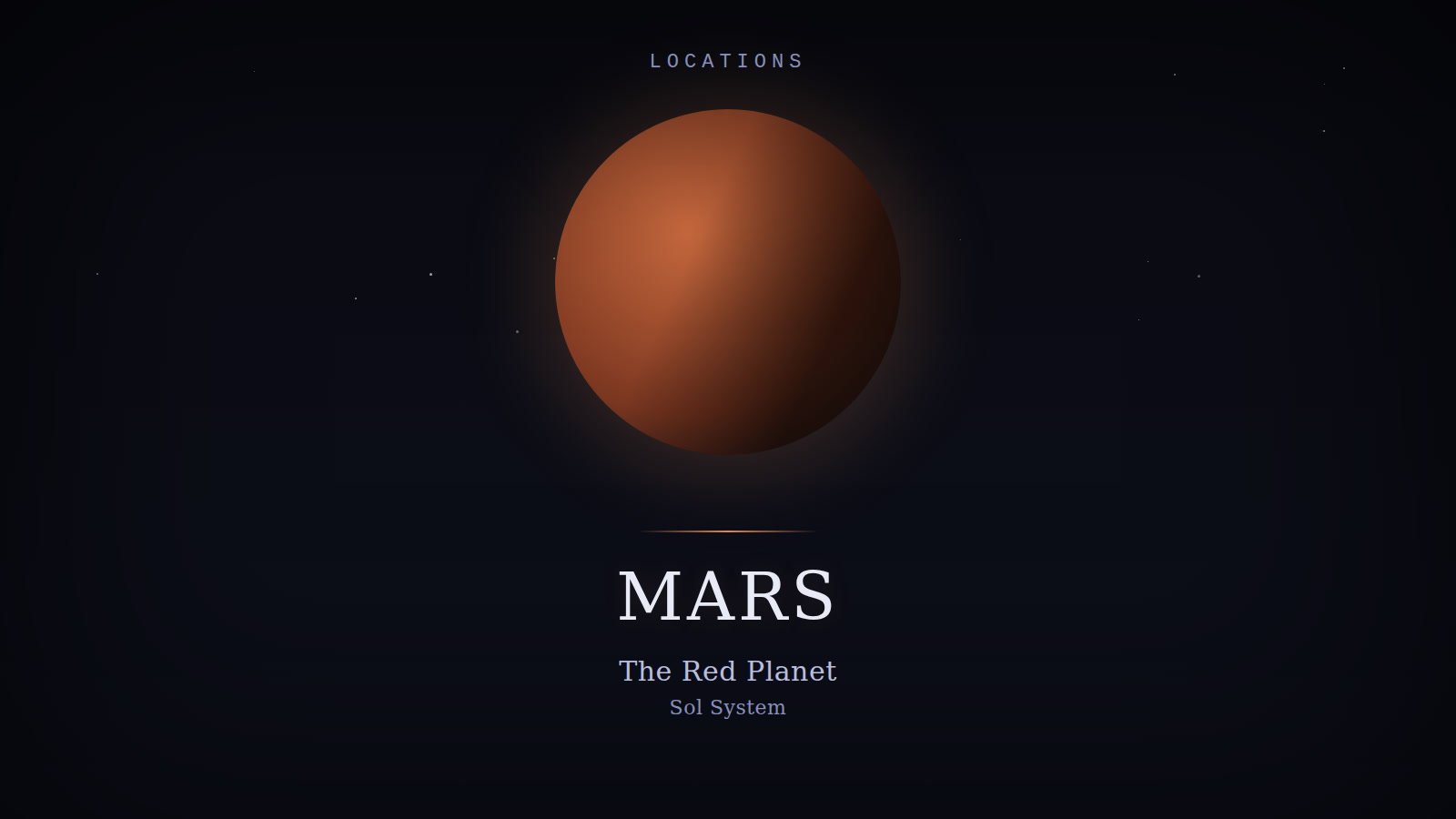
Every governing body the Solar System has produced — democratic, authoritarian, and technocratic in turn — has kept its command chair on the same red dust. None of them asked Mars first.
Mars is the oldest permanently settled world beyond Earth, and the only one that has been the seat of interplanetary authority under all four of the Solar System's successive governments: the Navigation and Trade Accords, the United Space Consortium, the Imperium, and today's Solar System Defence Command. Whatever the Solar System calls its government in a given century, that government's command floor is on Mars.
A World Half-Finished on Purpose
Mars was never fully terraformed, and by the time the technology existed to finish the job (it matured on Earth first, on an emergency's schedule — see Climate Repair and the Origin of Terraforming), the planet's oldest domed cities had accumulated four centuries of civic identity built specifically around the dome-and-open-ground contrast. Successive planetary councils have voted down full atmospheric conversion proposals for longer than most Martians can trace family history — not from technical doubt, but because a fully terraformed Mars would erase the thing its oldest settlements are proudest of surviving.
The result is a planet in two registers at once. Beneath sealed, radiation-hardened domes, the oldest districts run dense and heavily infrastructural: visible conduits, audible recyclers, centuries of retrofit layered onto retrofit — the same design register documented generally under Environmental Technology Design for remote and hostile-world stations, worn in by four hundred years of continuous habitation rather than built fresh. Outside the domes, thin-atmosphere open country stretches between settlements: survivable in a pressure suit for a working shift, lethal without one, and host to a modest permanent population of surface engineers, terrain researchers, and the scattered pressure-hermitages of the Monasteries of Mars, whose residents chose that thinness deliberately over the reach of dome authority.
The Command Throughline
Solar Command — the interplanetary government's operational and military nerve center, under whatever name the government of the day has used — has been physically headquartered on Mars since the Navigation and Trade Accords of 2337 UCSD (2137 CE). Every subsequent government inherited both the building and the assumption that it belonged there.
- Under the United Space Consortium, Mars-orbital interests sat close enough to Solar Command to informally out-influence Earth-based delegations on procedural matters, a structural advantage the USC's own charter never formally acknowledged.
- Under the Imperium, the Inner System Defence Fleet's officer corps — the institution that ended the Coherence Wars and then ruled for sixty years — was Mars-headquartered from its first unified command structure onward. Command culture on Mars during this period ran openly stratified by service record, exactly as Imperium doctrine prescribed everywhere else.
- The Military Space Command kept Solar Command on Mars without debate, including the overcentralization its own historians would later name as a structural flaw: a single-habitat incident elsewhere in the system still routed through Mars for resolution, adding weeks to decisions that boundary environments needed answered in hours.
- Today's Solar System Defence Command, narrowed and civilian-overseen under the Consolidation Accords, maintains Solar Command on Mars still — smaller in mandate than its predecessors, but occupying the same command floor as all three.
Martian Civic Life
Ordinary Martians have a complicated relationship with being, by accident of institutional inertia, the address of every government the Solar System has ever run. Command-adjacent employment is a significant part of the planetary economy, and Solar Command's continuous presence has funded infrastructure most comparably sized outer settlements never received. It has also meant that every grievance an outer station holds against Solar System governance lands, rhetorically, on Mars's doorstep, whether or not any Martian civilian had a hand in the policy.
Planetary civic culture has answered this by drawing a hard line, generally respected in both directions: Solar Command's officer corps runs Solar Command, and Martian civic government runs Mars. The two overlap far less than off-world assumption tends to expect, and Martian elected councils have more than once publicly declined to endorse Solar Command decisions made on their own soil.
Jurisdiction and the Star Rangers
Mars is a fully self-governing planet under the Star Rangers charter's jurisdiction limits: the Rangers have no standing authority there and may enter only by invitation, the same as any other planet or major habitat. In practice this means Solar Command's own headquarters sits entirely outside the operational reach of the institution most associated with the Solar System's frontier — a fact SSDC officers raise, periodically and pointedly, whenever the Rangers' jurisdiction limits come up for renewed argument.
See also: The Founding of the Star Rangers, Military Space Command, The Imperium, United Space Consortium, Environmental Technology Design, Venice.
Discussion
Show discussion
Comments are read after they are posted and anything unsuitable is removed. Posting needs a GitHub account; reading needs nothing.