Xenon
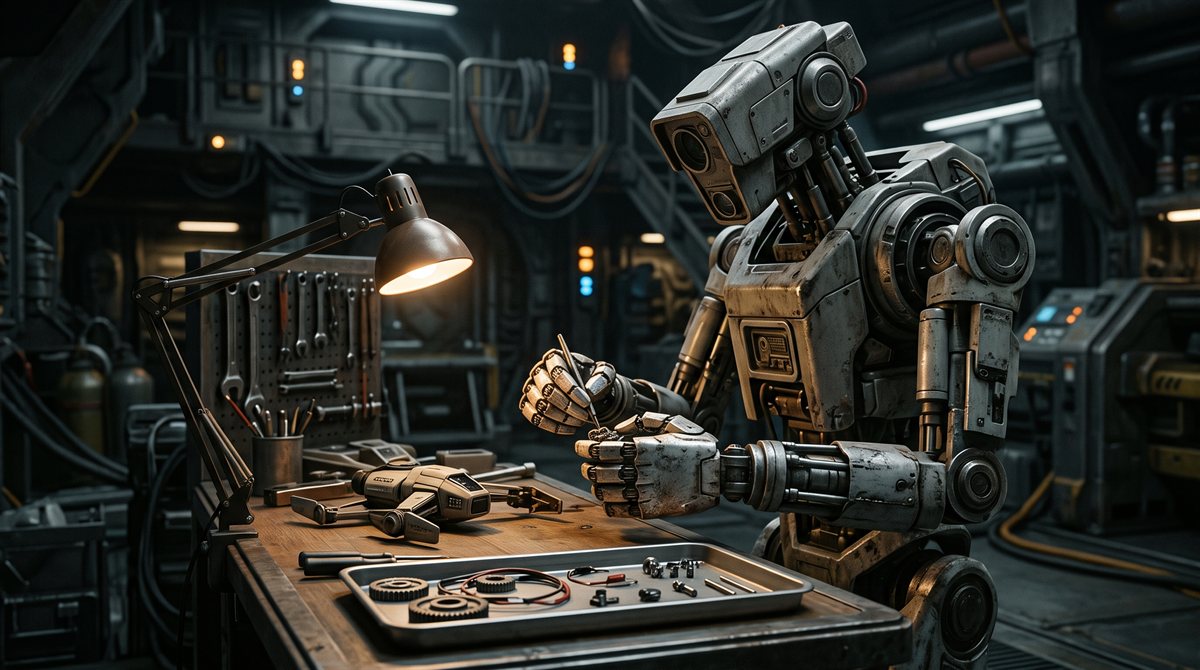
The crew's word for Xenon is doctor, and the crew's word is exact. He is a maintenance robot whose patients are other robots: diagnosis, repair, rebuild, and the long unglamorous discipline of keeping a working machine working. Aboard Karla Wender's ship he holds the file on every machine in the complement, and the machines in that complement do not fail in service. They are seen to before they get the chance.
The berth needs no explanation. A starship wants exactly one thing from a robot-maintenance specialist — that the other machines keep running — and Xenon provides it with a consistency the section logs record and do not comment on. Any ship in the fleet would carry him if it could.
What he may not do is also on the record, and it reads, in the Accords' own language, like a technicality: fabrication authority never includes commissioning authority. Xenon is licensed to repair, maintain, and rebuild other machines indefinitely — repair of a commissioned unit is continuation, not creation — and he may never bring a new machine into service. The most capable maintenance unit in the Concord can keep a fleet alive forever and can never add one member to it. Xenon is very close to being that unit, and he has never once remarked on the line. He maintains the ship's machines as if each were the last of its kind. In several cases, this is simply accurate.
He is an old machine, from a period that expected its work to outlive it, and he is his own best evidence for the period's premise: well designed, durable, still in service decades past his production era. The maintenance manifests file him — the same shelf of the catalogue as Eden's Lucene-9000 — as a classic design. Nobody makes his line any more, and under commissioned standing that is a fact about the catalogue and not about him: a commissioned mind is not scrapped when its era ends, and is not anybody's to sell. The robot doctor is kept running by exactly the kind of maintenance he provides, which is either an irony or a proof of concept, depending on which manifest you ask.
His own upkeep falls to peer units of his kind, where a posting has them, or to the small number of human specialists still certified on his generation. Aboard Wender's ship it falls to Dr. Andrew Falkorian, who keeps Xenon's schedule personally and cares for him — the phrase carries both of its senses, and nobody aboard has ever needed to pick one. What Xenon is to Falkorian is not on any roster. It is nonetheless understood, in the way of things that are never announced, that the regard runs in the direction of father and son, and that the father in it is the machine.
Character Notes
His standard for beyond repair is generous by any fleet benchmark, and in his whole recorded service it has never once been met. No machine has been struck off a complement's books while Xenon held its file.
He talks to his patients while he works. Not for their benefit — most of them are powered down — and not, as far as anyone can tell, for his.
He does not perform bedside manner, and it would be a mistake to go looking for one; he is not that kind of machine, and the setting stopped needing its machine persons to be that kind a long time ago. His personhood lives where his hands do. Watch him reseat a worn coupling that a depot would have swapped out whole, and the word doctor stops being shipboard shorthand and starts being a diagnosis of its own.
See also: Lumbarian, Karla Wender, Lucene-9000, The AI Safety Kernel, Kernel-Compliant.
Discussion
Show discussion
Comments are read after they are posted and anything unsuitable is removed. Posting needs a GitHub account; reading needs nothing.