Ascent Javelins
Every technology the Concord possesses for crossing space politely declines to help with the first hundred kilometres. Getting off a planet is still, after eight centuries, a matter of throwing yourself at the sky hard enough that it gives in.
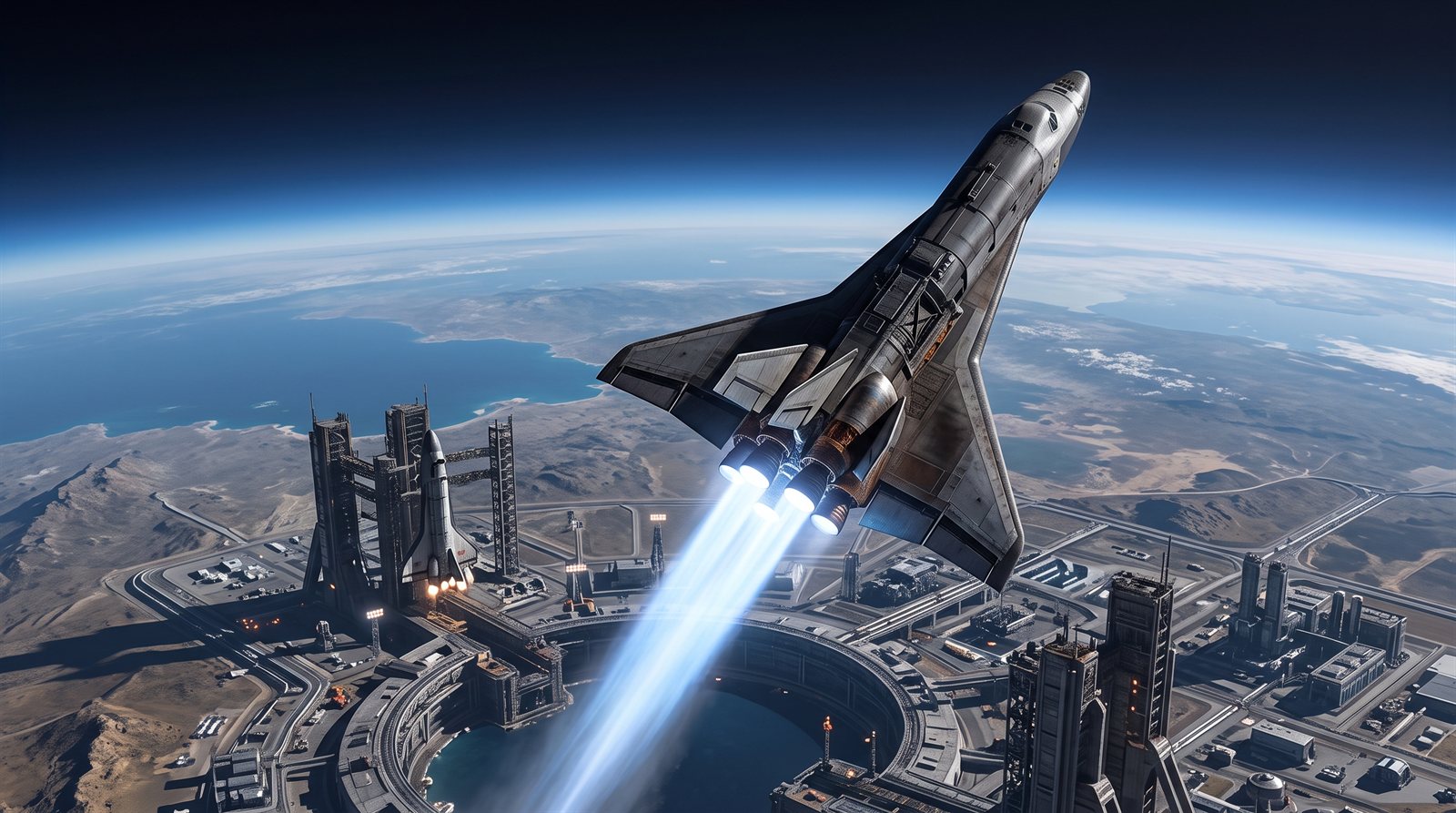
Ascent javelins — formally, orbital ascent vehicles, a service designation nobody uses twice — are the standard means of planetary ascent and descent throughout settled space: winged craft launched near-vertically, almost like a missile, that climb from surface to orbit under their own power. They exist because nothing else lawful does the job.
Why Not Teleport
Teleportation looks, on paper, like the obvious answer to a gravity well, and every generation of engineering students proposes it again. The constraints file is unmoved. A legal relocation event requires direct line of sight, local harmonic coherence sufficient to hold a lock, and an enormous standing power reserve — and a surface-to-orbit jump fails all three at once. Atmosphere is a particulate field that degrades endpoint certainty; a moving orbital target under a turning sky is a lock that will not hold; and the energy budget for relocating a human across a planetary well approaches the cost of simply flying them, without the flying's safety margin. Add the physiological cost — the medical literature on post-teleport stress is its own discouragement — and teleport ascent is what the certification bodies call it: restrictive where it is possible and dangerous where it is attempted. Bulk ascent by jump has never been certified anywhere in the Concord.
So people fly.
The Launch
A javelin does not take off; it is thrown. The craft rides a launch cradle to near-vertical, fires a hard boost that most passengers describe with the same word their great-great-grandparents would have used for a missile launch, and transitions through three regimes on the way up: ballistic boost off the cradle, air-breathing aerodynamic climb through the middle atmosphere, and closed-cycle rocket flight for orbital insertion. Descent reverses the profile as an unpowered glide with terminal powered braking, which is why every settled world's spaceport looks from a distance like a missile battery interleaved with a runway — because structurally, that is what it is.
The standard passenger experience is ninety seconds of being sat on by the planet, eleven minutes of steep climbing flight, and then the silence that every first-timer mistakes for engine failure and every crew member has learned to announce in advance.
The Gravity Envelope
Standard javelins are rated for worlds of Earth gravity and below. The rating is not conservatism; it is arithmetic. Ascent cost climbs brutally with surface gravity — mass ratios collapse, thermal loads compound, and abort windows narrow toward zero — and a little above one gravity, a chemical-cycle javelin stops being a vehicle and becomes a fuel tank with a passenger problem.
Heavier worlds are climbable anyway, because fusion provides the energy chemistry cannot. High-gravity javelins replace the boost and insertion stages with fusion-thermal drive: reaction mass run through a pulse-fusion core, giving the craft an energy budget no chemical cycle approaches. The physics is generous; the engineering is not. Fusion javelins are heavier, harder to maintain, certified under a stricter regime, and flown by specialist crews — high-gravity ascent work is a named rating in the Safety Corps certification framework, and holders of it are as close to an aristocracy as flight crew get. On the heaviest settled worlds, ascent is scheduled, weather-gated, and treated with the ceremony a sensible culture reserves for controlled explosions it has decided to ride.
On frontier worlds, the fusion fleet is also the late-arriving one: a fusion-thermal javelin cannot fly until the ground infrastructure that feeds it exists, and that buildout takes years to decades — so a new heavy-world colony can usually land long before it can climb.
Constraints
- Standard (chemical-cycle) javelins: rated to ~1g surface gravity. Above that, fusion-thermal variants only.
- No javelin ascends through weather its certification excludes. High-gravity worlds enforce this with launch windows; impatient operators are a solved problem, in the sense that they are no longer operators.
- Fusion-thermal stages are certified, inspected, and crewed under separate Safety Corps rules descended from the SSSA's independence-era charters.
- Orbital transit, fold travel, and FTL begin after orbit. A javelin's job ends at a stable parking orbit; it is the doorstep, not the journey.
See Also
- Teleportation Constraints — why the obvious alternative isn't one
- Post-Teleport Ascension Stress Disorder
- FTL Mechanics — what happens after orbit
- The Star Rangers Safety Corps — who certifies the fusion-thermal fleet
Discussion
Show discussion
Comments are read after they are posted and anything unsuitable is removed. Posting needs a GitHub account; reading needs nothing.