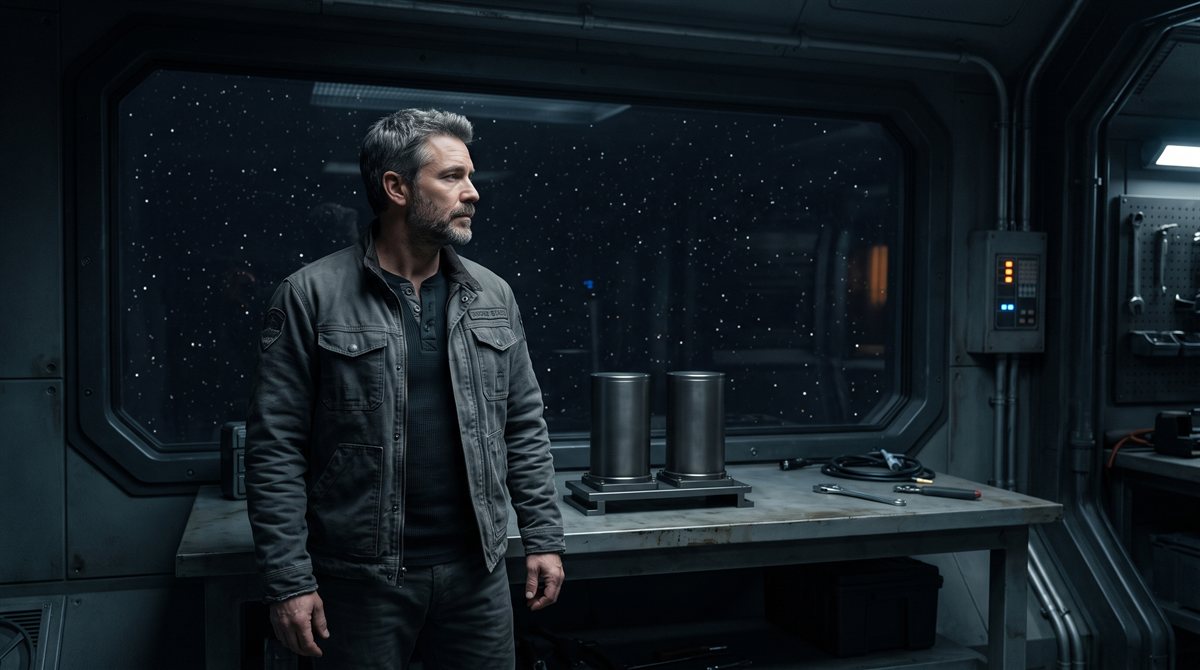
Starwarden Luke Valerius (Human)
- Time
- 2825 UCSD, Late Autumn — a thirty-one-hour window, and the hour after it
- Location
- A boundary-proximate post on the outward frontier, the record does not name which — the operations watch, and the Starwarden's viewport
The window had been due to turn by fourteen hours and had not, and at twenty hours Valerius stopped calling it late.
Late was a word for a thing with a schedule, and the interface his post monitored had a period rather than a schedule: windows that ran between six hours and fourteen, each one ending when it ended, alternating which side of the Interval set the clocks. Fourteen was the longest the post had logged in the year and some he had answered for it. Twenty was a figure with no entry above it. He had the watch enter it as a figure and not as a word.
The two reference housings on the bench behind the operations desk were matched to the half-second at every turn and read, between turns, the interface's own number: twenty-six seconds, at this post, for as long as the post had kept them. He read the upper one and then the lower, which was the order he read them in, and the figure between them was no longer twenty-six. It had been fifty at the twelfth hour and two minutes at the eighteenth, and the climb had no shape he could file as a rate, because a rate assumes a baseline that holds, and that was the one thing nothing in the approach was doing.
"Say the figure," he said.
"Two minutes forty, Starwarden." Field Officer Holm said it to the log rather than to him, which was correct. "Upper leading."
Upper leading. He had never once allowed which suggests on this post and he did not allow it now. Upper was leading because that was where the number was. Which side of the Interval that made dominant for the window was a Safety Corps question with a Safety Corps answer, and what he owed the officers who would answer it was the figure, in order, with the time against each one from both clocks.
What he also owed them was the Fair Return.
She was a Union salvage hull, four aboard, working the approach's permitted edge under a permit his own readings had drawn: the edge sat where the divergence had never yet reached a figure the Safety Corps considered a hazard to a docking clock, which was an edge drawn from twenty-six seconds. He had the permit on the desk. He had, beside it, two minutes forty, and a hull whose master had called in at the eighteenth hour to say, with a courtesy that had not quite covered the question underneath it, that her own clocks had started doing something she would like the post to confirm was the post's.
It was not the post's. He had told her so, in those words, and that the figure was climbing, and that the permit stood until he withdrew it, and that he was not withdrawing it, because withdrawing a permit from a hull already inside its terms told her nothing she could use. What she could use was the callouts.
"Paired callouts from here on," he said. "Every transaction. Both clocks, upper then lower, and she reads back both."
"Starwarden."
He went back to the viewport, because the viewport was where he did the arithmetic that did not go in the log, and there was nothing to see in it, which was ordinary. The boundary his post monitored was not out there. It was not at any distance that existed, in any direction a viewport faced, and he had corrected enough filings to that effect that the watch no longer wrote beyond the approach and he no longer had to strike it. What was out there was an ordinary starfield and, four seconds of light to his left, a salvage hull whose master was now going to read two numbers back to him for every one she used.
He had not asked her to choose between them. He noticed that he had not, and filed the noticing where he filed the things with no scope.
Discussion
Show discussion
Comments are read after they are posted and anything unsuitable is removed. Posting needs a GitHub account; reading needs nothing.