Starwarden Luke Valerius
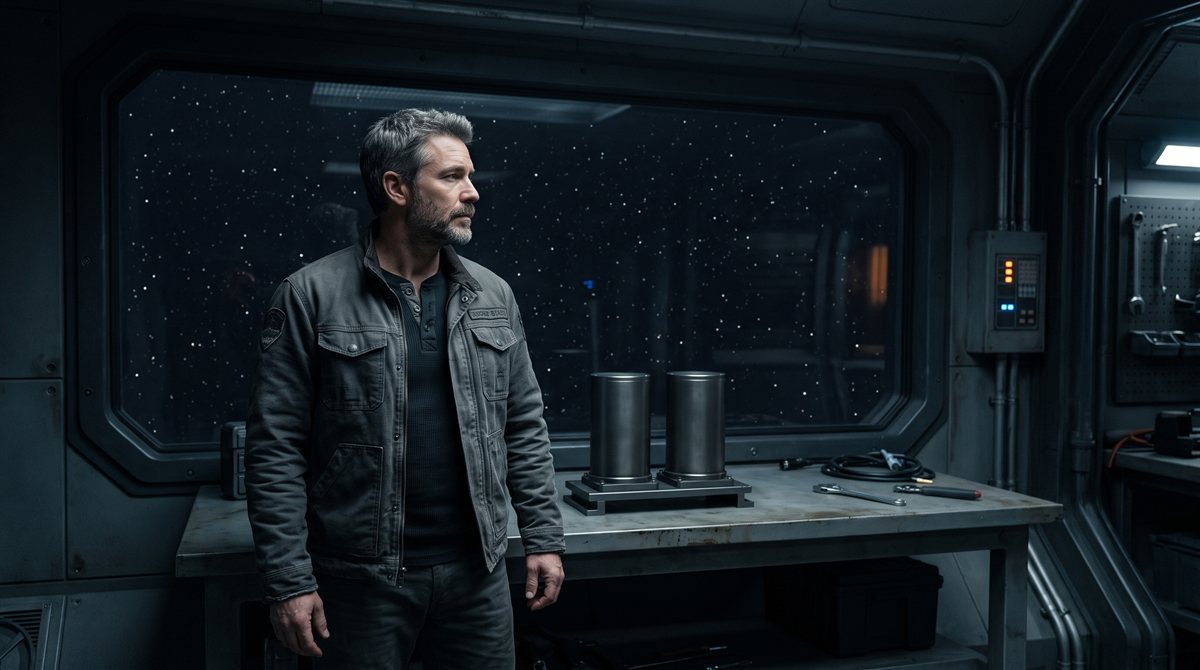
Starwarden Luke Valerius answers for a boundary-proximate post whose distance from the boundary is not a quantity that exists.
He does not permit that to be treated as a figure of speech. The Interval is separation measured across the Common Manifold rather than along any line a ship could fly, so how far is this post from the boundary is a question with no answer rather than a question with a large one — a correction he has entered on other officers' filings often enough that it is one of the two things everyone on the post knows about him. The other is that he will not say everywhere.
The interface his post monitors has held Type II — alternating dominance windows, periodic chronometry divergence — for the whole of his command. Two chronometers disagree, each is measuring correctly relative to where it sits, and the disagreement is the data rather than a fault in it. Valerius is unusually good at this work and unusually uninterested in what it might portend. He files the readings, states the scope, and declines the sentence beginning which suggests.
Known History
- Born 2777 UCSD on New London; entered the Corps as a Novice in 2797 and came up the boundary-safety certification track, the examined half of the ladder.
- Reached Chief in 2817 UCSD as a senior chief warden officer, and holds the Safety Corps' certified boundary analyst designation — which is why his filings carry the weight they do, and why he is scrupulous that the designation never be mistaken for standing to make a finding.
- Crossed into the command track and took a Starwarden's post in 2824 UCSD — the crossing Galen Kane never made and the technical ceiling exists to make optional. Valerius made it on the stated reasoning that somebody was going to answer for the approach, and he would rather it was somebody who could read the instruments.
- Paired on promotion with an assigned senior officer under the Corps' standing mentoring policy for the command ranks — the pairing that replaces, above Chief, what the Academy does by examination below it.
What the Post Is Worth
The classification of a boundary interface governs what may lawfully be done in its approach, and three settlements, two chartered survey companies and a Union-registered salvage combine all have positions on what should be done there. None of them agrees with any other. All of them are extremely polite to him.
The class itself is not his. A boundary classification is a Safety Corps finding, and no Starwarden has ever been able to override one — that is the general rule every specialist corps operates under rather than a courtesy extended to him personally. What is his is everything the finding is assembled from: which readings are filed and in what order, how a transient is annotated, and whether an oscillation goes up as a logged event or as noise. He does not decide the class. He decides what the officers who decide the class are looking at.
Everyone concerned understands this arrangement precisely, which is why nobody has ever asked him for anything.
Character Notes
He is a pragmatist in the exact sense the record is: he sides with what has been observed, at the scope it was observed at, and treats a claim with no scope as a sentence still waiting for its subject. This is Archive discipline rather than personal temperament, and it is not a rare view in the Corps. What is rare is holding it literally in conversation. Valerius will stop a briefing to ask whether a colleague means a fact about this membrane, this archecluster, or this instrument, and will wait for the answer. Junior officers read it as pedantry for about a year. The Safety Corps reads it as correctly formed and sends him the difficult approaches.
He is loyal to the charter's neutrality constraint and has never argued against it, in a filing or anywhere else. What he has arrived at privately is narrower and worse than an argument against it.
At an interface, declining to adjudicate between two disagreeing readings costs nothing and the record is more accurate for it; two readings can be carried indefinitely and the carrying is the discipline. In a room with people in it, declining to adjudicate is not the absence of an outcome. An unresolved question has a direction — it favours whoever is already holding the ground while it stays open — and Valerius has never been able to establish that the direction his post's open questions run in is one he chose.
The second half of it is the part he has said aloud exactly once, to his assigned mentor, and has never written down. Every measurement at a boundary is position-dependent, correct where it is taken, and not transferable to where it is not. His even-handedness is a stance held somewhere. He has no instrument that would tell him whether it reads the same from anywhere else, and he is aware that the phenomena his post exists to monitor are precisely the ones under which two honest positions stop agreeing without either becoming wrong.
He has not concluded that neutrality is impossible; that claim would need a scope he cannot supply. He has concluded that he has no procedure for checking whether he is holding it, that the absence of such a procedure is not evidence either way, and that both of those sentences are correctly formed. Then he goes on filing. The record of his command carries more unclassified transients than any comparable post, which costs him standing with everyone who would prefer a number, and no finding assembled from his readings has been overturned.
See also: Boundary Zones and Concordant Edges, Rank and the Chain of Command, The Star Rangers Safety Corps, Shore Leave and the Neutrality Constraint, The Scope of Physical Law.
Discussion
Show discussion
Comments are read after they are posted and anything unsuitable is removed. Posting needs a GitHub account; reading needs nothing.