New London Space Habitat
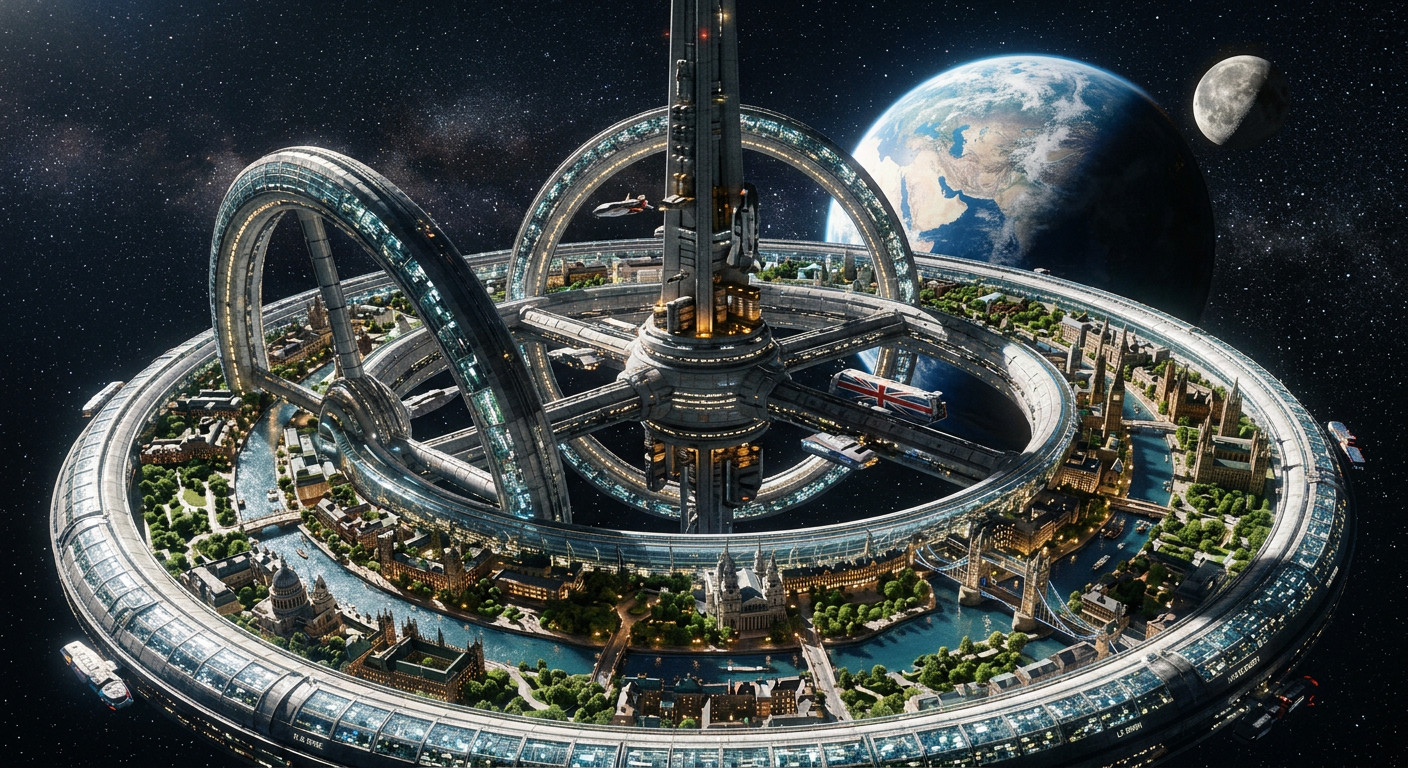
New London was built because the British Isles were drowning. It is still here, at full occupancy, three centuries after they stopped.
New London Space Habitat holds station at Earth–Moon L5, sixty degrees behind the Moon in its orbit, in one of the two stable equilibria of the Earth–Moon system. The site was chosen for the least glamorous reason available: a habitat placed there does not need to spend fuel to stay there. Displaced slightly, it returns on its own. For a project whose founding assumption was that Earth-side support might not survive the century, passive station-keeping was not an engineering preference. It was the whole argument.
Founding
Construction began in the 2380s UCSD — the 2180s CE, a dating the habitat's own archives still print alongside the standard, in the same custodial spirit that keeps everything else there in its original form.
The habitat was a response to the Crisis Centuries, and specifically to the climate-driven coastal fragmentation events of the 2130s and 2140s CE that had already cost the historical record its 2130s data-loss gap and reshaped every low-lying coastline on Earth. Large parts of the British Isles came out of those decades uninhabitable. What went up to L5 was an attempt to keep something that had been coastal, low-lying, and heavily archived from being lost in the same way twice.
It was, by construction, a hedge against Earth's failure — begun roughly four decades after the United Space Consortium formed and while the recovery effort was still scattered coalition work rather than an institution anyone trusted.
The hedge did not pay out. Earth recovered. The patchwork of seed archives, assisted-migration corridors and habitat-continuity programmes consolidated through the USC, carried unevenly through the Imperium, and hardened into Solar System Defence Command's environmental protocols — the standing authority now credited with keeping Earth's unmanaged biomes healthier than at any point since the early industrial era. The catastrophe New London was insurance against was contained by the same century that built the habitat.
New London did not close. Its founding rationale expired and its population stayed, which left it doing something subtly different from what it was chartered for: not preserving a heritage against extinction, but maintaining one at a remove from the place it came from. The distinction is live in habitat politics and has been for three hundred years.
Structure
Three interconnected Stanford torus rings, each 1.5 kilometres in diameter, rotating for Earth-standard gravity at the rim — a shade under 1.1 rotations per minute, with a rim speed of about 86 metres per second. The rate matters: it sits well under the threshold at which the inner ear begins to object to head movement, which is why New London's residents can be born, live and die in the rings without the vestibular adaptation regimes shallower habitats require.
The rings are named Westminster, City, and Crown, after the traditional divisions of historical London.
They connect to a central non-rotating hub, The Spire, which carries administration, docking, and zero-gravity manufacturing. The Spire is the only part of the habitat where nothing weighs anything, and by long convention it is also the only part where nothing is preserved — the rings hold the heritage, the hub does the work.
The Thames Canal
The habitat's most distinctive feature is the Thames Canal: a water system running through all three rings, serving genuine circulation and thermal-management needs and an entirely deliberate symbolic one.
It is not one river, and the engineering is more interesting than the name suggests. Each ring carries its own circumferential channel; transfer between rings runs up through the spokes and across The Spire under pump, where the water crosses the hub weightless and enclosed. What residents experience as a single continuous Thames is three canals and a lift, presented as a river because that was always the point.
The flow direction is not arbitrary either. Water moving with the ring's rotation weighs fractionally more than water moving against it, so each ring's channel runs spinward, and the canal's banks are cut asymmetrically to match. Visitors notice the asymmetry before they are told why; residents stopped noticing generations ago.
The bridges over it have become the habitat's civic landmarks and its default meeting places — the addresses people give when they do not want to name a building.
The Weather Indoors
Nothing about the interior is accidental, and very little of it is efficient. New London's architecture sets neo-Victorian frontage against space-age structure without apology — narrow cobblestone streets winding between plainly modern buildings, opening into intimate courtyards that no habitat engineer would have laid out from first principles. The effect is a city that behaves like an old one: hard to see across, easy to get lost in, full of corners.
The sky is a decision. Ring lighting holds a perpetual soft overcast, the flat grey-white of the weather the founders left behind, and on a schedule nobody publishes in advance it rains — real water, briefly, running off the streets into the Thames Canal, which is where the habitat's circulation wanted it to go anyway. The air carries tea, damp stone, and roses off the Royal Gardens. Temperature is held between sixteen and eighteen degrees, cool enough that visiting habitat staff comment on it and cool enough to keep the islanders' layered dressing a practical habit rather than a costume.
The sound is recorded. Hidden arrays carry an ambient wash of pre-collapse London: bells at a distance, the murmur of crowds that are not there, birdsong from species the rings do not host. On the central promenade, holographic projections of landmarks stand where the buildings themselves could not be brought — monuments, explicitly, to what was lost rather than reconstructions of it.
At night the rings dim to a warm amber pitched at gaslight, and the transparent ceiling sections show stars arranged to match the constellations as they stood over Britain before the collapse — not as they fall from L5, which is a different sky entirely.
All of which sits awkwardly beside the fact that the Crown-in-Parliament below it passes real legislation. New London is at once the most theatrical and the most functional thing in Earth orbit, and it does not experience the two as a contradiction: the birdsong is a recording and the bills are law, and the habitat's own answer, when pressed, is that a culture is entitled to decide which of its inheritances it keeps working and which it keeps merely present.
Population and Governance
New London houses approximately 180,000 residents, some sixty thousand to a ring, most of them descended from the British evacuation programmes. Immigration policy was restrictive for most of the habitat's history and has relaxed considerably in recent decades, a shift that tracks the slow argument above about what the place is now for.
It operates as a constitutional monarchy, preserving British parliamentary tradition as a working system of government rather than a re-enactment. This is the sharpest thing about New London and the most easily misread: the forms are old, and they are not ornamental. Bills are passed there.
It is also a constitutional monarchy with nobody on the throne, and has been for most of its history. The succession did not fail dramatically; it simply ran out somewhere in the evacuation record, in the same decades and for the same reasons the historical record lost everything else. Rather than resolve the question — by locating a claim, electing a house, or abolishing the office — New London declared the throne in perpetual vacancy and carried on. Royal assent, the summoning and dissolution of Parliament, and the appointment of ministers are discharged by a Council of State, whose members hold their seats ex officio and serve without precedence over one another, so that the Council can act for the Crown without any individual becoming it.
There is no House of Lords, and no register of who would sit in one. Parliament is a single elected chamber and has been since the habitat's first sitting.
The peerage was not abolished. Nothing so decisive happened to it. A peerage is, before it is anything else, a register — a claim about descent that means nothing unless somebody holds the paperwork — and the evacuation lost paperwork in exactly the way it lost the succession, in the same decades and to the same causes. What went up to L5 was whatever had been archived well enough to travel. Some titles arrived with documentation sufficient to satisfy anyone who asked. Some arrived with a family's certainty and nothing else. No process was ever established to sort the second from the first, because the office that would have adjudicated it is the vacant one: the creation, confirmation and extinguishing of a peerage are all Crown acts, and the Council of State has consistently held that it can perform none of them. The position is not hostility to the institution. It is incapacity, stated plainly and without any evident regret.
So New London recognises no hereditary peer and disputes nobody's claim to be one. Titles are used at court functions, carry precedence in the order of procession at a state occasion, and appear on no writ, roll or ballot. A Lord of New London is a social fact, sincerely observed, that the constitution declines to notice — and a Lord whose great-grandfather's letters patent did not survive the lift is, in every respect anyone aboard treats as mattering, exactly as much a Lord as one whose did.
An upper chamber would also cut across the arrangement holding the rest of it together. The Council sits ex officio and without precedence precisely so that no individual can become the Crown; seating a house of hereditary peers would put precedence back into the constitution at the one point the vacancy was designed to keep it out. Parliament is therefore one chamber, and the Crown-in-Parliament that passes real legislation consists of a Crown nobody holds and a house nobody inherits.
The result resembles the Kingdom of the Five Islands, whose Old Houses likewise keep their precedence and administer nothing — but the two arrived there by opposite roads. The Five Islands' nobility was reformed out of authority by a Crown that proposed the reform itself. New London's was simply never re-recognised by a Crown that is not there. One was a decision. The other is a vacancy doing the work of one.
Proposals to appoint a regent surface roughly once a generation and have never carried. The standing objection is not sentimental but procedural: a regent is a placeholder for a person expected to arrive, and no one is expected. The Council's own position, recorded in terms that have not changed materially in two hundred years, is that a vacancy honestly kept is a more truthful constitution than an office filled for the look of it — and that the habitat which decided its birdsong could be a recording is not obliged to pretend about this either.
The arrangement has one practical consequence worth noting for anyone reading the orbital chain of command: because there is no monarch, there is no viceroy. New London has never had a Governor-General, and the title Governor in Earth orbit refers unambiguously to the Compact's office and to nothing here.
Crucially, New London is not a member of the Orbital Habitats Compact. The Compact's five self-governing habitats answer to a Governor of Orbital Space Habitats for civil administration; New London answers to its own Crown-in-Parliament and never entered that chain. Its relationship with Eden Space Habitat and the other major orbital settlements is therefore genuinely diplomatic — treaties, standing missions, and negotiated protocol, rather than a shared administrative ceiling. It is the largest inhabited body in Earth orbit that no Compact officer has jurisdiction over.
The L5 Problem
New London has been at Earth–Moon L5 since the 2380s. Fold transit did not become practical for anyone until the Eden Passage was confirmed in 2712 UCSD, more than three centuries later.
When Survey Corps subsequently classified Lagrange points for fold operations, the criterion it settled on was gravitational flatness — and L4 and L5 of any stable two-body system, a planet and a large moon included, fell into Tier 1: designated fold-staging zones, the preferred sites for aperture generation.
Which is to say the designation arrived around a city of 180,000 people that had been sitting there for three hundred years.
Nothing about this is dangerous in itself; a fold scaffold is not a hazard to a habitat holding station beside it, and New London's own position is what made the site attractive to both parties for the same underlying reason. But it puts a sovereign polity outside the Compact in permanent proximity to infrastructure the Survey Corps and the Solar System Defence Command have charter interests in, with no shared administrative chain to resolve a disagreement through. Every arrangement governing traffic, scheduling and clearance at Earth–Moon L5 is a negotiated instrument between governments. There is no framework above them to appeal to.
Habitat administration regards this as satisfactory. So, on the record, does the Survey Corps.
Two Answers to the Same Question
New London is not the only response in the record to the fear that a culture can be lost by administrative neglect. Roughly two centuries later, the Celtic Union of Planets' Currach Fleet answered the same anxiety in the opposite direction: six generation arks that left the Solar System entirely, unauthorised and unconfirmed, to keep their founding languages alive somewhere no institution could reach them.
New London stayed. It kept its heritage in orbit around the world that heritage came from, close enough to visit, inside the jurisdiction it distrusted. Both projects are still running. Both have preserved what they set out to preserve.
The two are occasionally compared in Solar System historiography, usually to argue that one strategy was correct. The comparison holds better as evidence that the anxiety was real and the correct answer was never obvious — a point on which New London's own archives, which still print CE dates beside UCSD for the same reason the Union's clan records do, decline to editorialise.
See also: The Commonwealth, Eden Space Habitat, The Orbital Habitats Compact, Lagrange Points and Fold-Space Transit, The Crisis Centuries, The Celtic Union of Planets, Universal Concord Standard Date.
Discussion
Show discussion
Comments are read after they are posted and anything unsuitable is removed. Posting needs a GitHub account; reading needs nothing.