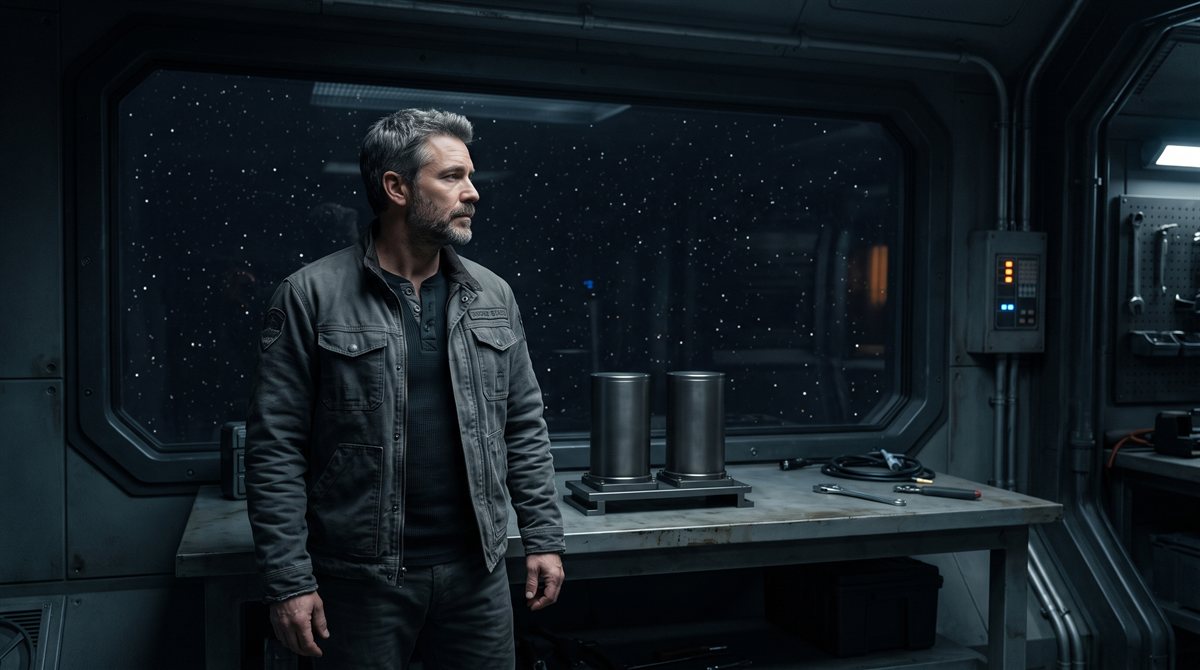
Starwarden Luke Valerius (Human)
- Time
- 2825 UCSD, Late Autumn — a thirty-one-hour window, and the hour after it
- Location
- A boundary-proximate post on the outward frontier, the record does not name which — the operations watch, and the Starwarden's viewport
He would not afterwards describe it as a meeting, because meeting assumed a second party, and he had no instrument that would establish one.
What he had was the viewport, and the ordinary starfield in it, and the bench behind him with the two housings on it, which he could see in the viewport's reflection and had been watching there, because the reflection showed him both at once and he was tired enough to want them in one glance. The figure had been four minutes and nine. Then it had been twenty-six and the lower was leading, and he had felt the post come back under him the way a deck does when a vessel stops yawing, and he had stood there a while longer because the arithmetic that did not go in the log had a great deal in it that night and he had not finished.
The window had run thirty-one hours. A hull had come in off an edge he had drawn. He had drawn it from twenty-six seconds, as he was required to, and it had held until it had not, and the four aboard were alive because a woman four seconds away had been willing to say two numbers back to him for two hours when every instinct of a ship's master was to pick one and act. He had not asked her to pick. He had been proud of that at the twentieth hour and was less sure, at the thirty-second, what it had been instead of asking.
That was where he was when the reflection had someone else in it.
He did not turn round. He noticed that he did not, and that the not turning was not fear, and that it was not calm either; it was the habit of a man who reads the instrument before the thing the instrument is pointed at. In the viewport, where the bench was, between the two housings and not behind them, there was a figure. A woman, he would have said, if required to say, in no uniform he knew and no colour he would have put a name to under oath. It was the kind of green that is also the kind of blue, and the viewport had a tint, and he knew the tint and could not subtract it. She was standing where the bench was. That was not possible, because the bench was there, and he could see the bench, and he could see her, and neither of them was in front of the other.
He had read the lore. Every certified boundary analyst had read it, and most of them had read it the way he had, as a set of claims with their scopes stated, and the one line he had never known what to do with was the line that said the witness supplies the figure. He supplied, apparently, a woman at his bench who was not at any distance from him he could have stated. He noted that the question he most often corrected on other officers' filings had just become a question about the inside of his own compartment, and he did not allow which suggests, and it cost him more than it had ever cost him on a filing.
Then there was a question, and it was which one he had read first.
He would not afterwards say that she had asked it. He would not say anything afterwards, which was the one decision about that hour he was sure of. What he had was the question, in no voice he could have placed in the compartment, and the plain fact that it was a question and not an instruction and not a comfort, and that it waited.
He thought it meant the crew. He had taken the four statements in order, master first, and could have said so. Then he thought it meant the hull's two clocks, docking and navigation, and which the master had believed when they parted. Then he was looking at the two housings in the reflection, upper and lower, matched to the half-second at every turn for the whole of his command, and he knew which one he read first, because he had read it first that morning and every morning, and had given it first on every callout, upper then lower, and had never been asked, and had never once asked himself what a year of readings taken in one order did to the record they were assembled into, by officers who were not here, who would be told the figure and the time and not the order.
He did not answer. He had no answer with a scope.
When he looked at the bench itself and not the reflection there was the bench, and the two housings on it, close together and identical, with nothing to read on them from where he stood. He looked back at the viewport. An ordinary starfield. Holm, behind him, saying his rank, and a band in the field traces that the register had a name for.
He went and read the entry, because that was what the entry was for.
Discussion
Show discussion
Comments are read after they are posted and anything unsuitable is removed. Posting needs a GitHub account; reading needs nothing.