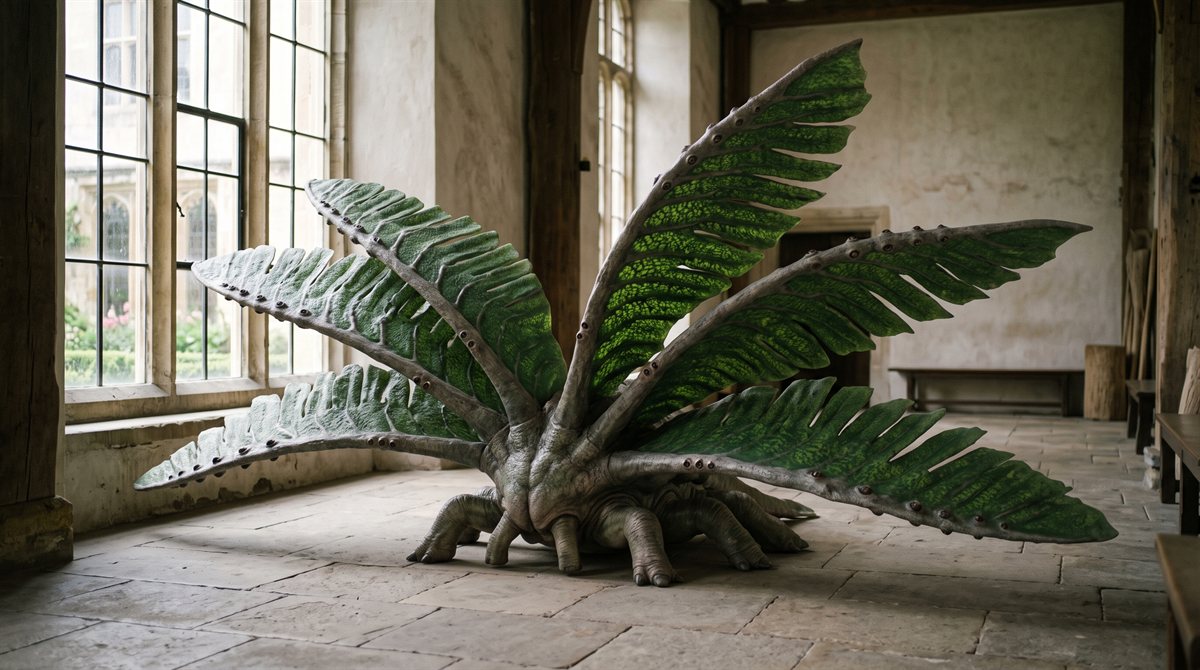
Delegate Isren Farrowkin (Verdani, Verdance's seat)
- Time
- 2826 UCSD, Early Summer — the second day of an assembly session, and the evening after it
- Location
- A kept room of a Federation facility the record does not name, where the assembly sat that session; the terrace outside it
The second day opened on item seven, which was Isren's, and the witness had already drawn her feet in.
That was how a Mnemari came into a room built for other bodies: not through the door so much as past it, the three legs gathered until the arch of them cleared the frame, then let out again one at a time, two always down, until the hub stood where it was going to stand, higher than any head at the table, and the body slung under it hung still. Ulessa had done it on the first morning while the roll was read and had not moved since except as a witness moved, which was by the neck. The long neck came forward under the arch of her own legs and laid the head at the height of the table, and whoever was speaking got the near side of it: one small dark eye, deep in the hide, level and unhurried, the breathing slits beside it, and nothing else. There was no face to speak to. Isren, who had none herself, found that restful, and had noticed over two days that the delegates with faces did not.
The room was a kept one, long and pale, the table long and low, the light from a slot above it, soft and even and, to a kinbed, worth nothing at all. Isren had her vanes folded, which was correct in a room and cost her a little for every hour she spent in one, and had budgeted the two days the way a delegate from Verdance budgeted anything, by deciding in advance what the afternoon would not contain.
Item seven was a proposal. The Federation's standing compact with the Star Rangers was older than anyone at the table but one, and every delegate could give its terms without the sheet: member worlds contributed refined materials, fabrication capacity and fold-route survey data toward the Corps' operations, and the compact bought the Federation nothing, the Corps' neutrality applying to the Federation as it applied to everyone, which the Federation's founding delegates had called entirely reasonable and had meant. What the compact did not say was anything about what came back. The Survey Corps mapped lanes. A lane had a member world's sky at the end of it, and the Corps' instruments read that sky at a resolution no member's own could reach, and what the Corps learned of a member's approaches went into the Corps' record and stayed there, not because anyone had decided it should but because nobody had ever decided anything else. Isren's proposal was that the assembly ask for it. Formally, by instrument, member by member. She had sponsored it under her own seat as the first formal proposal of its kind, and had said on the first day why: a people whose biology depended on knowing exactly which light fell on which ground had a stake in boundary data that no other people at the table could feel in their metabolism, and she would rather argue from that than from fairness, because fairness could be argued back.
The Prismere seat had argued back anyway, on the merits, which she respected. Prismere supplied the compact's fold-corridor expertise through its guilds, and its delegate, Full Wings and on the floor for it, which was not cowering, had put the position plainly on the first afternoon. The compact's data term ran one way by its words, toward the Corps, and a Federation that began asking for things back had altered what the compact was. It had been a gift. Make it an exchange and it became a thing the Federation had bought, and the Corps had said at the first table that nothing was for sale. The delegate had not said that Prismere's guilds had a trade in corridor knowledge that returned data would undercut. Isren had not said it either. Each knew that the other knew, and the argument was the better for leaving it where it was.
So the question the chair put, when the session came to it, was what the first table had said. Not what it had meant. Whether toward had been in the words when they were spoken, or had got into them afterwards, by way of the hand that kept the minute, which had been one member's hand in one member's rendering. The minute was on the table. Three worlds' translations of it did not agree on the preposition. That was why the assembly had requested a witness, and why the witness it had requested was the one who had been there.
She had raised the standing item at the opening, as a Mnemari witness did, before the roll was closed: that the Ollune delegate was not in the room, that Cirrane's position on the session's items would arrive by courier, lagged, and be read into the record by someone who was not Ollune, and that this had been raised before. She had given the session at which it was first raised, by the name of that day's chair. Nobody at the table had heard the name. Isren had written it down, because she wrote down what she could not place, and had not yet found a use for it.
"The chair asks the witness of Ilenne for the words of the term as they were said," the chair said. "In order, and the words around them."
Ulessa's head turned. Not quickly; nothing she did was quick. The near eye left the chair and came to rest on the middle of the table, on nothing, and Isren understood that she was not looking at the room.
Then she gave them.
Her voice was low and did not carry, in a room. It was made for open country and she kept it down, and the recorder's housing at the chair's end took it without trouble. She gave the term as the Corps' officer had spoken it, and it was the term, materials and capacity and survey data, toward, and the delegates who had been waiting for the preposition heard it, and the Prismere seat's wings shifted on the floor and were still. She did not stop at the term. The chair had said the words around them, and she gave those: the chair of that day taking the term and naming the next item; and then a reader, given by role and not by name, rising with a mark that had come in that morning by courier, from Cirrane, asking the chair's leave to read it into the record on the item just closed, and the leave given.
Then the mark, in the reader's cadence, which was not Ulessa's. Isren heard the difference and could not have said what it consisted of.
Cirrane has the term. Cirrane asks where what the Corps learns of a lane is carried, and to whom, and whether a member that cannot come for it may have it. Cirrane asks that the question be kept until an answer can be carried back.
"The chair of that day said: Noted," Ulessa said. "The chair of that day said: Item nine."
She stopped. The near eye came back to the chair. The neck did not move again.
The Prismere seat asked the question somebody always asked, and asked it well, without heat. "Is the witness certain of the words? Of the mark in particular. It was read by a reader, in a rendering. The witness gives it in that rendering."
"I give it as it was read," Ulessa said. "Certainty is not the question the session has. The question is whether anyone present can contradict me." A pause, and not for effect; Isren had watched her for two days and had decided she did not have effects. "Nobody present had been there."
The chair took the words and thanked the witness and did not ask her what they meant, which was right, because she would not have said. The session had what it had asked for. What it did with it was the session's. Isren watched the chair look down the table at this session's reader, who had a mark on the table in front of them, come in that morning by courier, lagged as every mark was, on an item the session had passed the day before; and the chair did not look away quickly.
Discussion
Show discussion
Comments are read after they are posted and anything unsuitable is removed. Posting needs a GitHub account; reading needs nothing.