Prismere
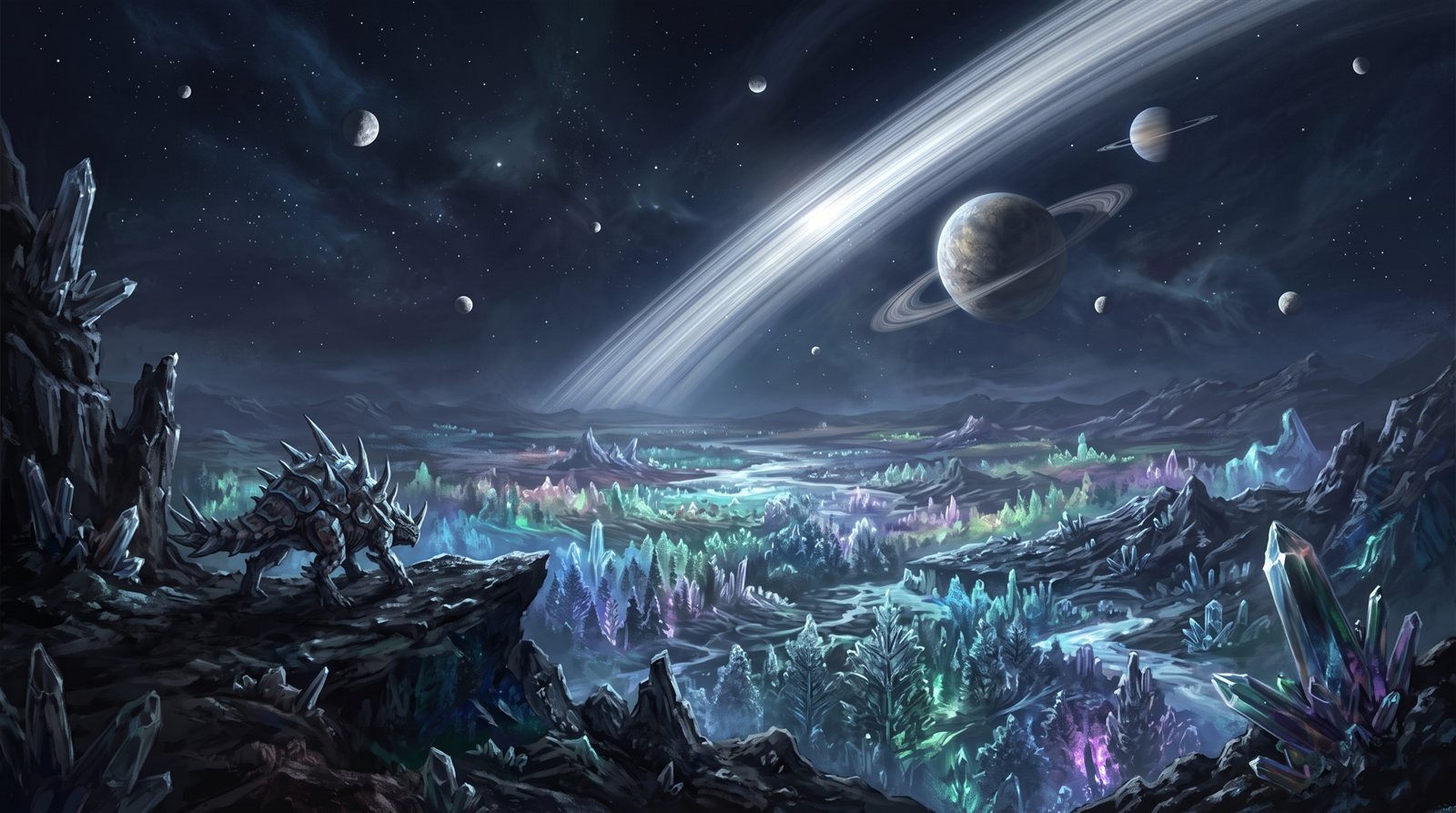
Most survey reports note a world's ring system as a footnote of orbital mechanics. Prismere's first full Federation survey put it in the summary paragraph, because on a clear night the rings are the least strange thing in the sky.
Prismere is the third planet of the Iridess System and a charter member world of the Federation of Sentient Beings. It is a genuine biosphere world in the same technical sense as Tír na nÓg or Verdance — stable, self-sustaining, no life-support engineering required — but its biosphere runs on a silicate-carbon chemistry that builds glass and crystal into living tissue the way Earth-descended life builds cellulose and chitin. The result is a world that produces its own light. Prismere's forests glow before the local sun sets, and after dark the ambient bioluminescence is bright enough to read a datapad by from most points on the surface.
The Lattice
Iridess is a crowded system — a dense ring plane, seven moons across Prismere's own orbit, and two neighboring ringed worlds close enough in-system to be visible as more than points of light. That gravitational crowding does something Lagrange Fold Points and Fold-Space Transit predicts but rarely delivers so visibly: it produces an unusually dense confluence of stable Quantum Space Harmonic corridors passing directly through the system, at a density the Survey Corps has not catalogued anywhere else in charted space.
Prismere's upper atmosphere carries a permanent haze of suspended crystalline particulate, seeded continuously by its own biosphere. That haze does what no instrument-grade sensor array does on its own: it refracts the harmonic corridors' field geometry into visible light, tracing faint, mathematically precise lines, arcs, and polygons across the night sky wherever a corridor's resonant topology currently sits. Survey Corps astrogators call the phenomenon the Lattice. It shifts, slowly and predictably, as corridors open, hold, and collapse — a naked-eye readout of fold-space conditions that would otherwise require a full sensor suite to reconstruct.
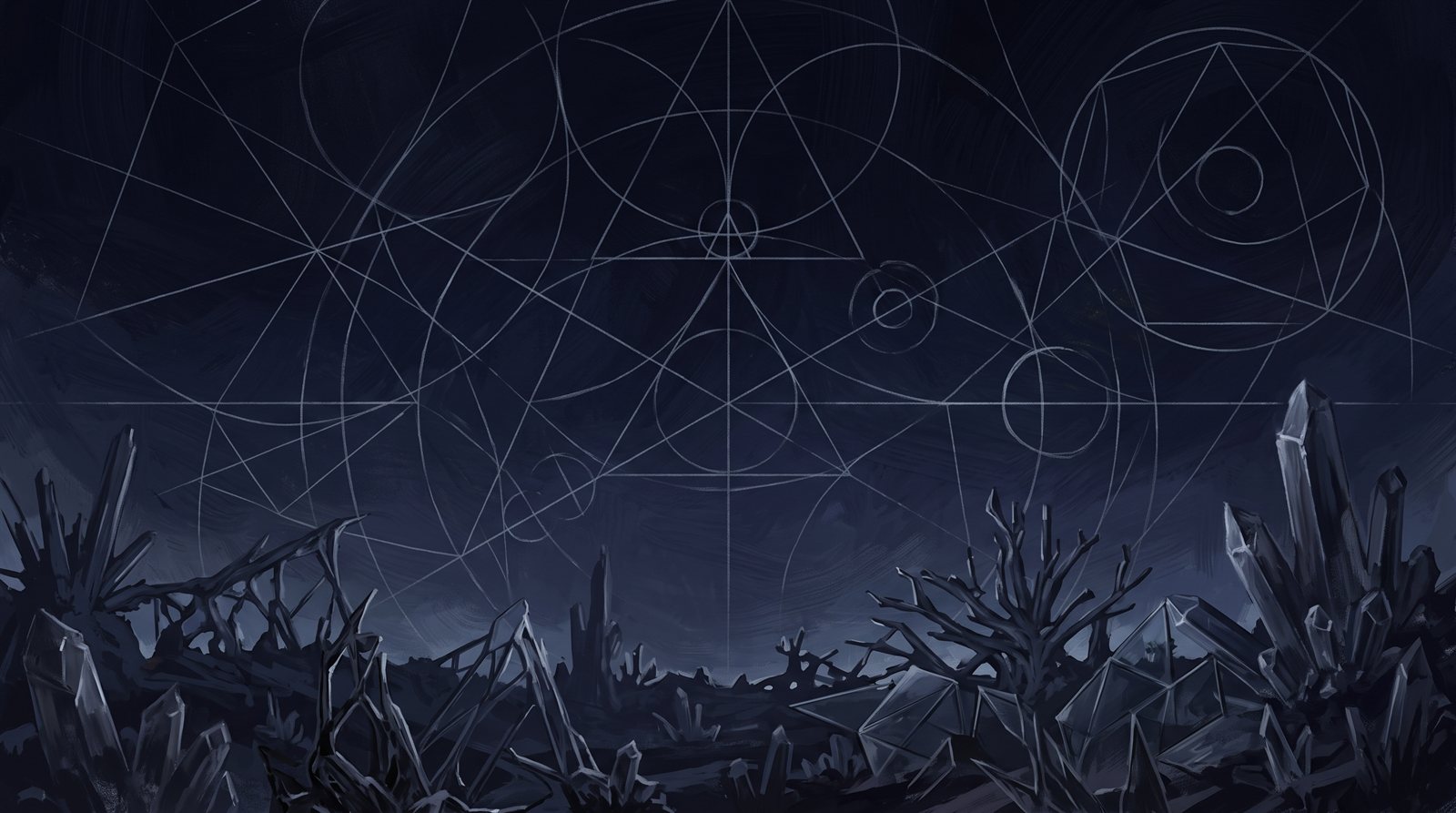
No other surveyed world sits close enough to a comparable corridor confluence and carries the right atmospheric chemistry to make the Lattice visible. Federation and Survey Corps consensus is that Prismere is not unique in having dense fold geometry overhead — only in having a sky that shows it.
Glasswood and the Luminous Biosphere
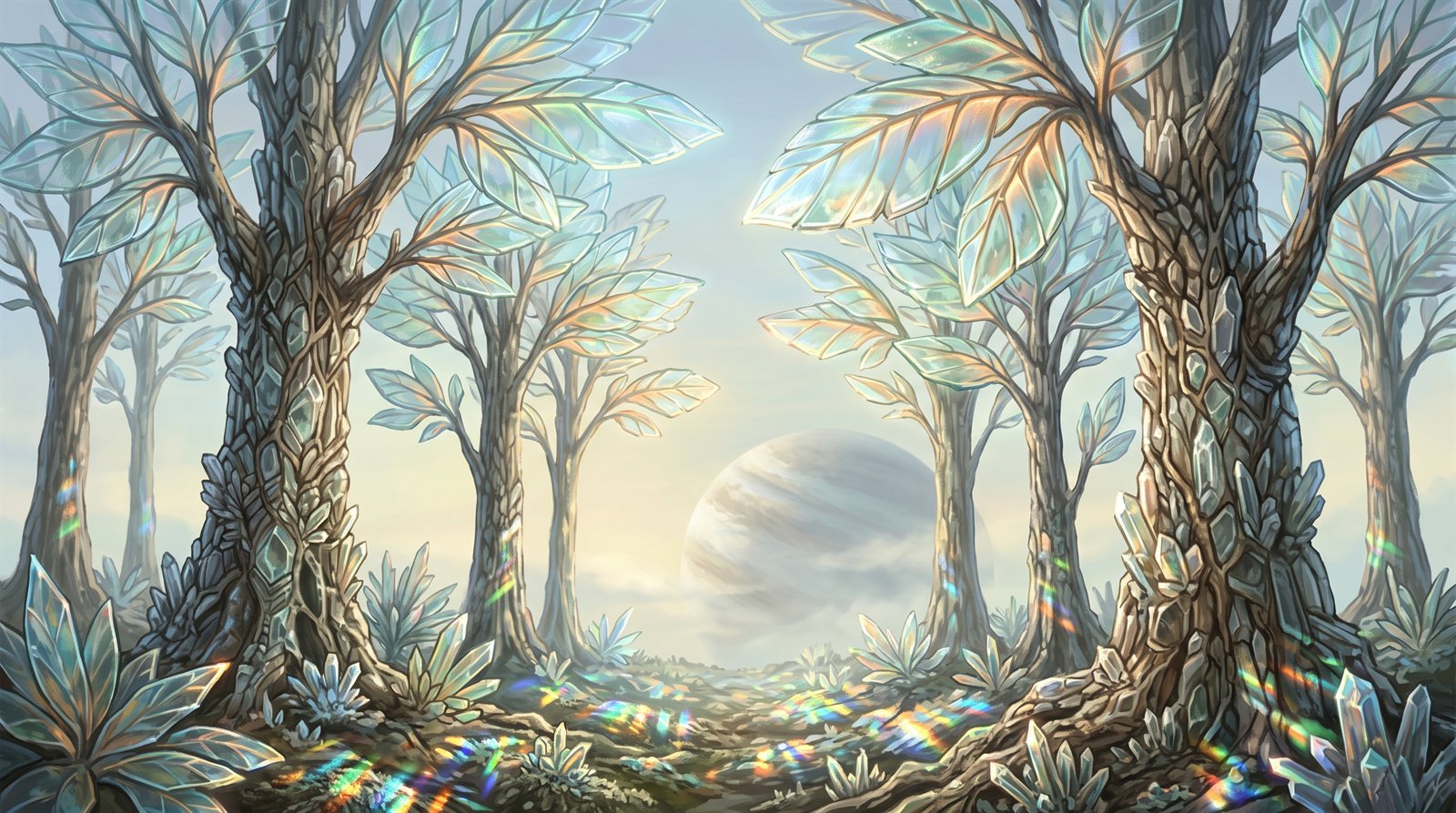
Prismere's dominant flora is glasswood: slow-growing, crystalline-barked trees whose translucent foliage doubles as a lens, catching ambient Lattice light and starlight alike and re-emitting it in the soft, shifting color washes that make Prismere's forests visible from orbit after dark.
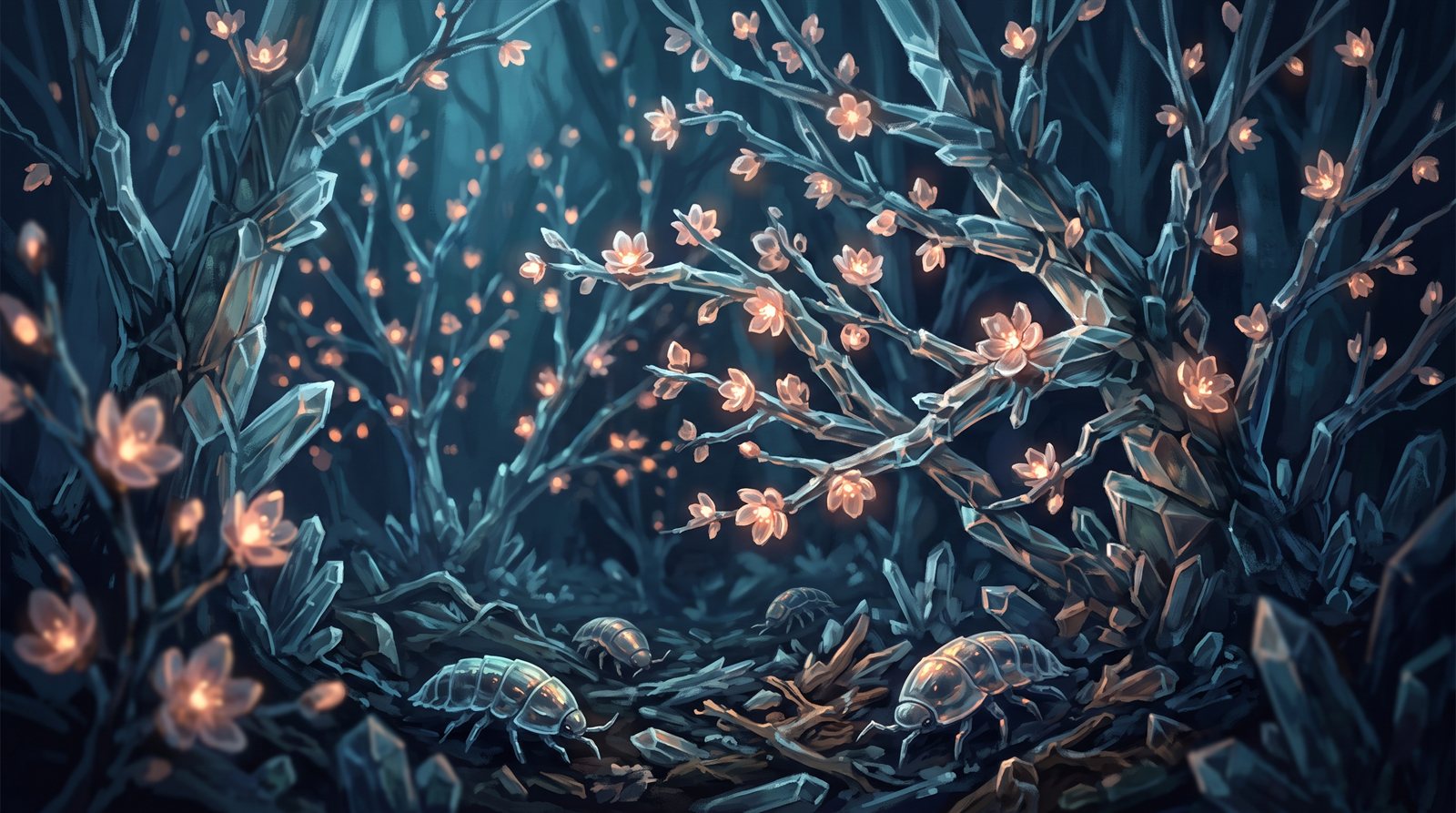
Mineral analogues to fungal towers — Prismeri call them lumenspires — rise from glasswood-grove floors in loose colonies, each spire's internal bioluminescence fed by a shared root-mat network rather than by any individual growth. Prismeri settlements are built into rather than cleared from lumenspire stands, in the same register documented for Meridian's reef-cities: architecture that reads, to an untrained eye, as a natural formation right up until someone notices the load-bearing structure has been shaped.
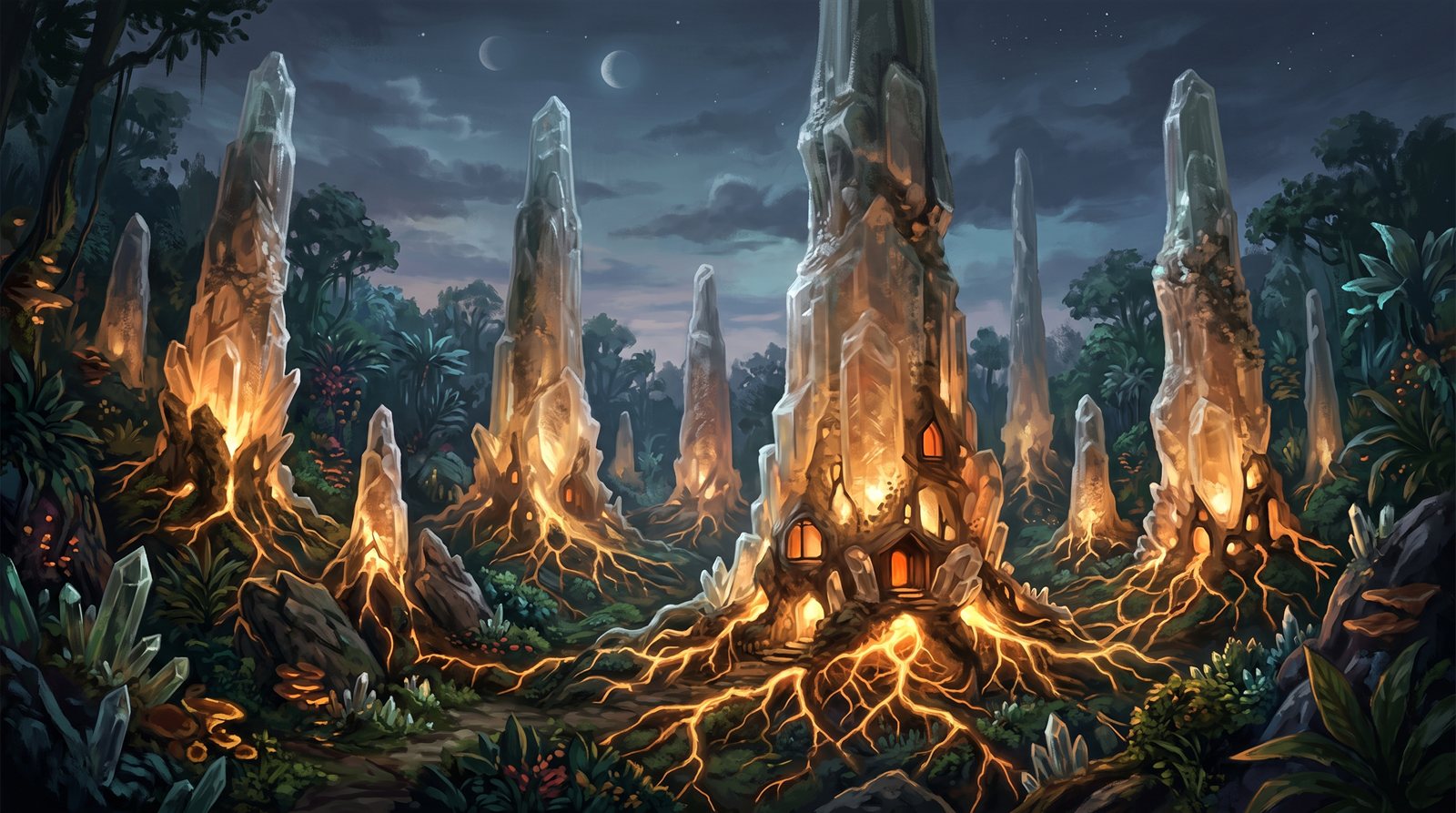
Where the root-mat crosses standing water it surfaces, and the network that feeds an entire lumenspire colony becomes visible as a single continuous line of light — the most photographed sight on the world after the Lattice itself.
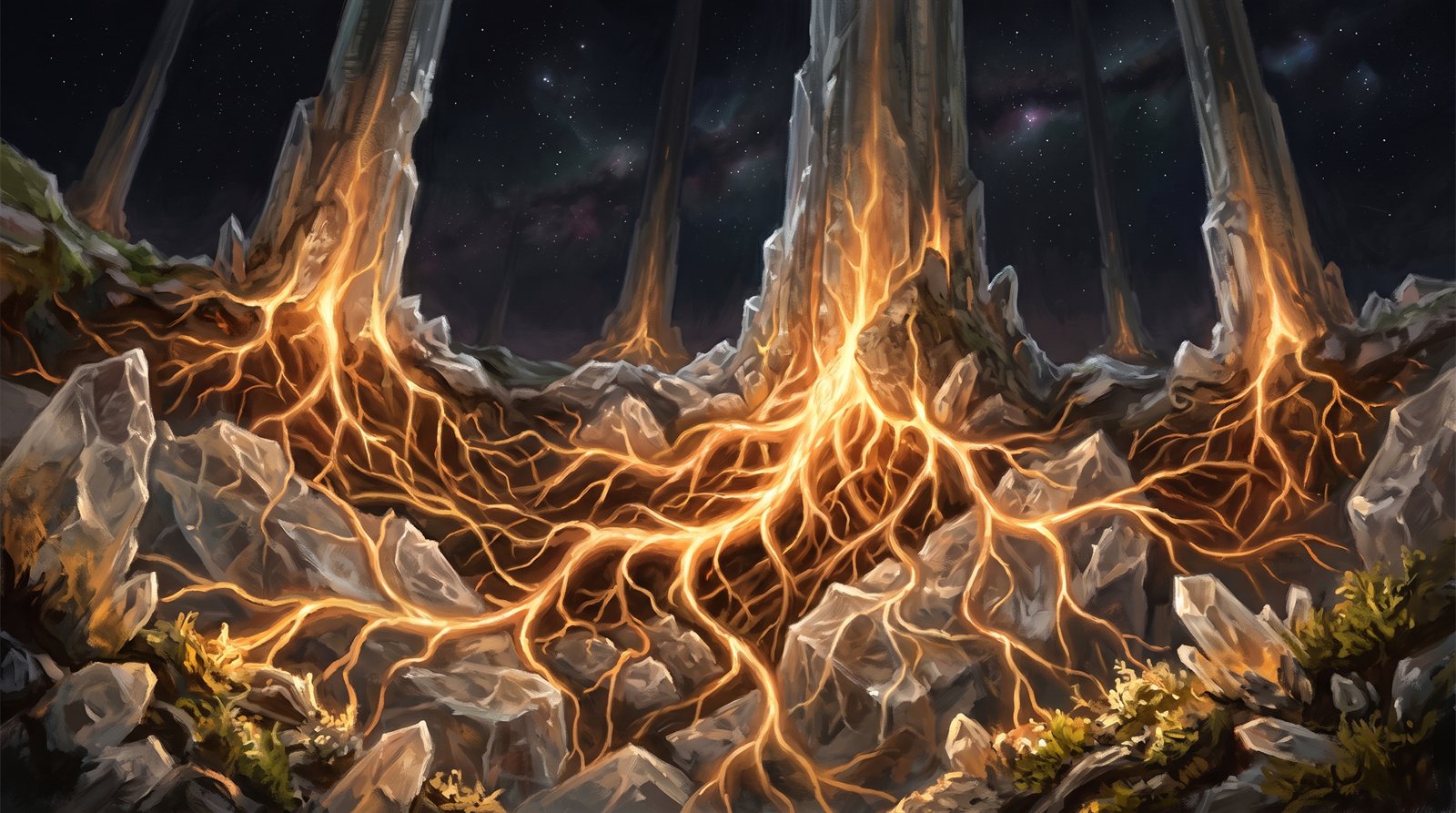
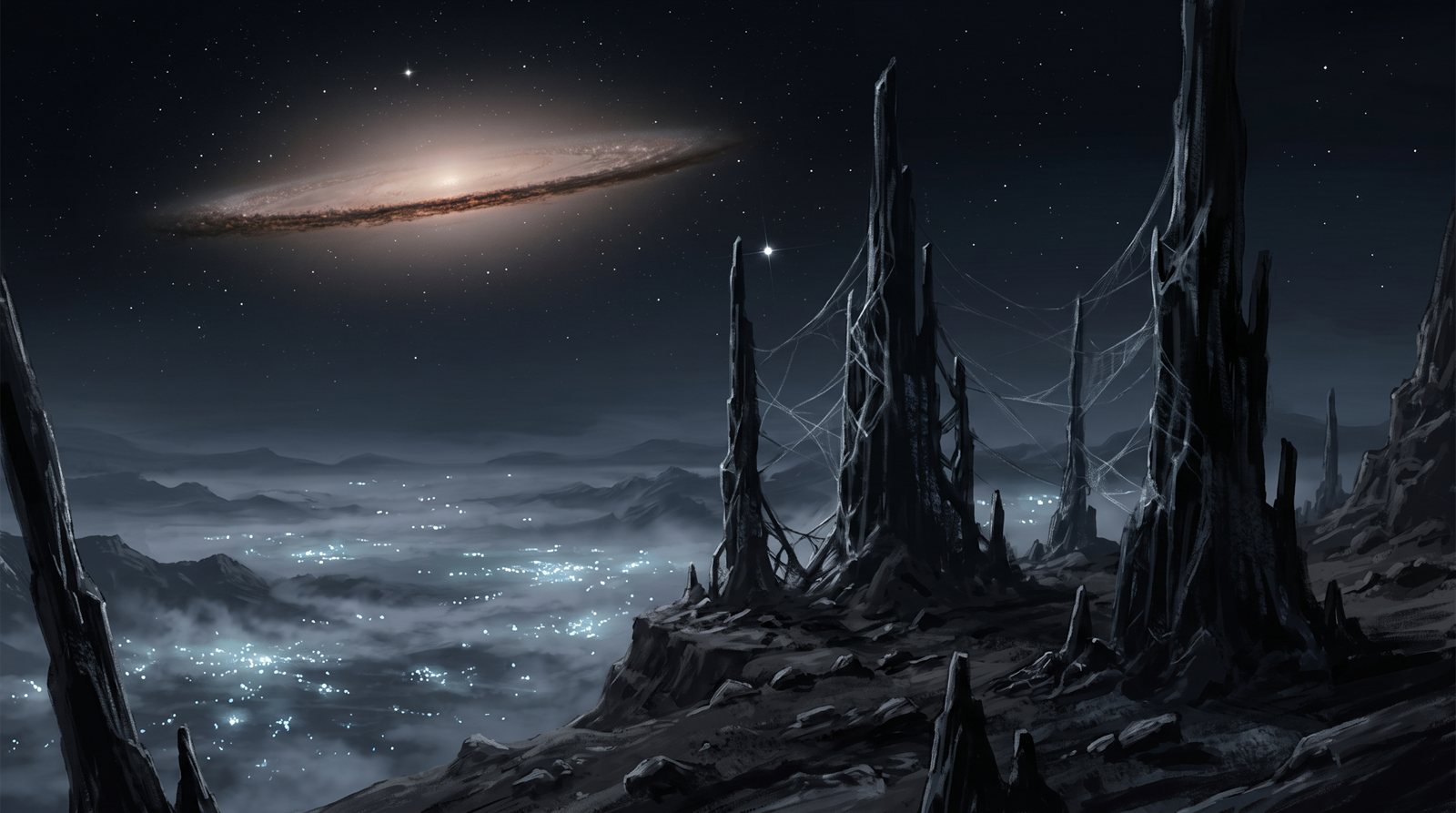
Taller, lattice-veined structures of fused silica — locally called glass spires — rise from Prismere's higher elevations independent of any glasswood grove. Survey botanists still debate whether glass spires are a wholly separate crystalline organism or an extreme adult growth form of glasswood; the two do not currently interbreed by any confirmed mechanism, but their internal mineral structure is close enough that the question remains open.
Native Fauna
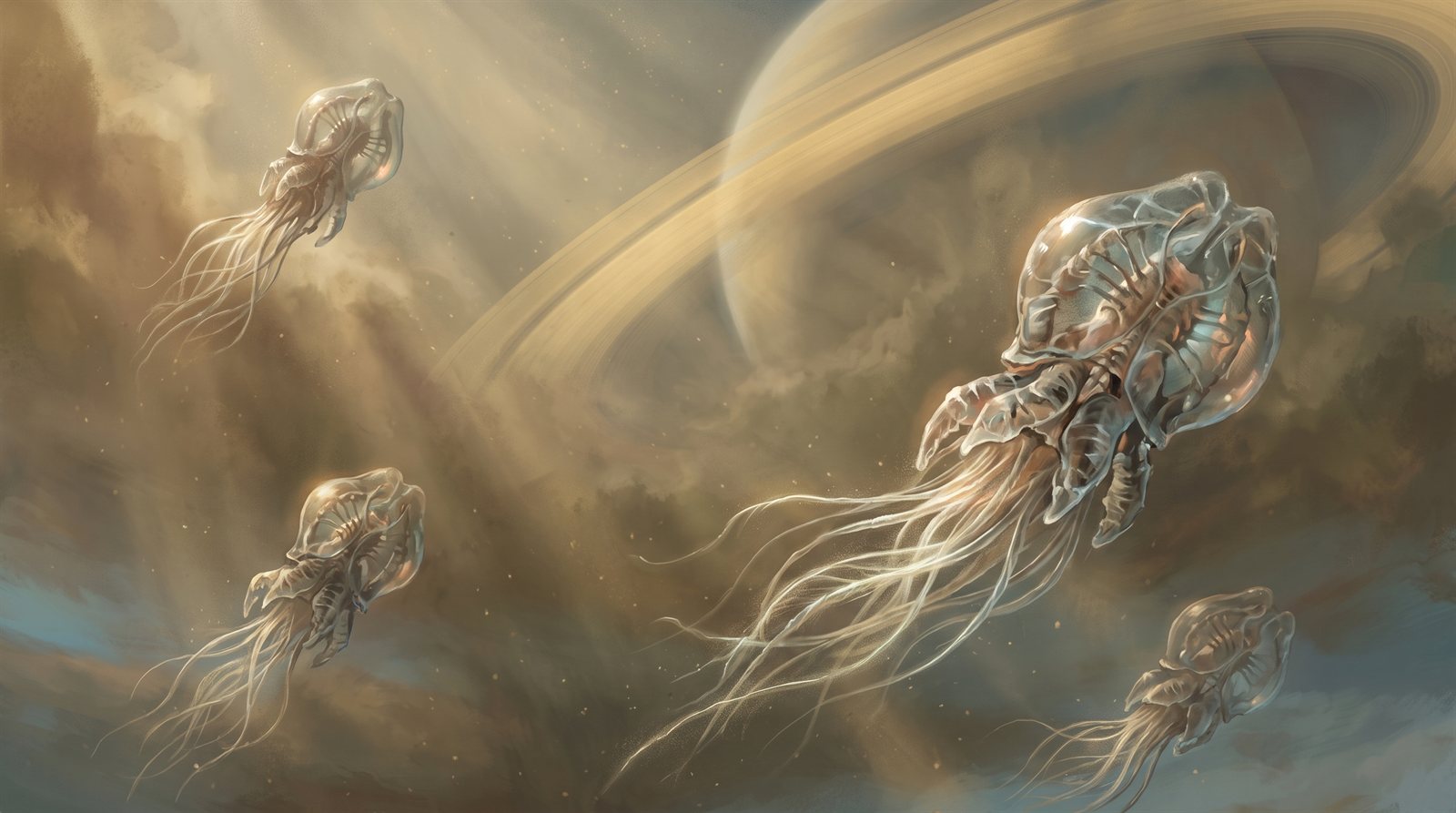
Prismere's low gravity and dense, particulate-rich atmosphere support a genuinely aerial ecosystem, not merely a flying one. Driftjellies — translucent, gas-bladder fauna that spend their entire adult lives aloft — ride thermals off the lumenspire groves in loose drifting colonies, trailing luminous feeding tendrils that filter airborne spore and particulate matter. They are harmless, common, and by far the most-photographed native animal on the world.
Ground level belongs to thornbacks, armored, crystal-spined grazing fauna that browse glasswood undergrowth and shelter in lumenspire root-shadow during the brightest hours of the local day. Their shells are Prismere's most commonly exported novelty mineral good, shed naturally during growth molts and collected rather than harvested from a living animal.
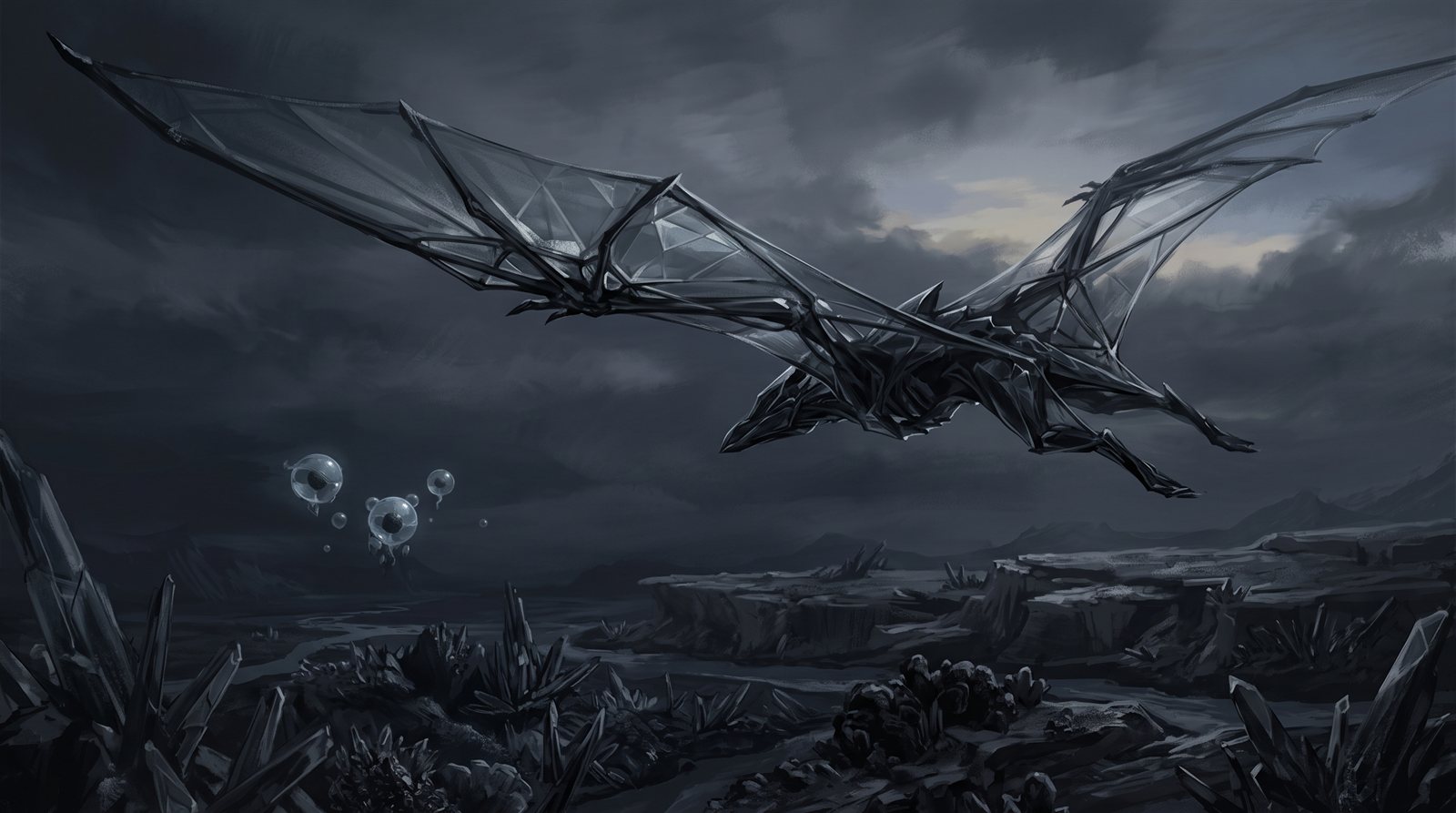
Prismere's apex aerial predator is the umbral ray — a large, silent glider with a biomechanical-looking wing structure adapted for hunting driftjelly colonies and, on rare confirmed occasions, unwary Prismeri who stray from lumenspire settlements after dark without a Lattice-reader's escort. Umbral rays hunt by riding the same thermals driftjellies do, closing in total silence; Prismeri settlements univerally observe a dusk curfew for exactly this reason.
The Prismeri and the Federation
Prismere is the homeworld of the Prismeri, whose biological sensitivity to the Lattice's harmonic geometry — a byproduct of the same silicate-carbon physiology that built their world's glowing biosphere — makes them the Federation's most valued fold-corridor readers. Where Aspenar underwrites the Federation's Ranger support compact in refined material and Verdance anchors it in diplomatic standing, Prismere's contribution is expertise: Prismeri astrogation guilds provide independent corridor-condition confirmation that Survey Corps sensor arrays alone cannot fully replicate, a service formalized under the same standing compact that moves Aspenar's alloy stock toward Ranger fabrication yards.
See also: Prismeri, The Federation of Sentient Beings, Lagrange Fold Points and Fold-Space Transit, Quantum Space Harmonics, Meridian.
Discussion
Show discussion
Comments are read after they are posted and anything unsuitable is removed. Posting needs a GitHub account; reading needs nothing.