Quantum Space Harmonics
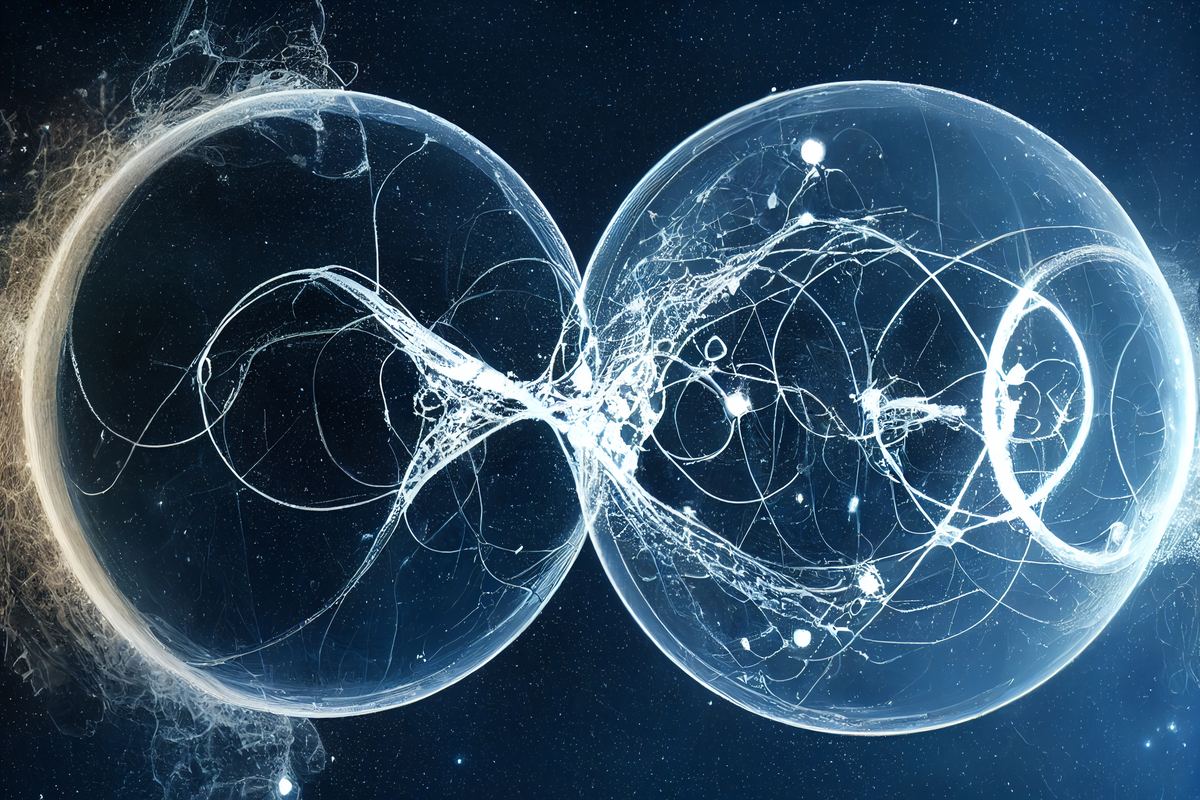
A harmonic route is never just a road waiting in the dark. It is a brief agreement between geometry, vessel, and destination, and it ends the moment that agreement fails.
Quantum space harmonics are the field-level structure that makes Quantum Space Harmonic Wave transit possible. They are lawful physical behavior, not mystical effects.
Core Principle
A quantum harmonic corridor is a temporary coherence tunnel formed when three conditions overlap:
- Resonant topology in local spacetime geometry.
- Phase-admissible vessel signature produced by the ship's drive lattice.
- Concordant-compatible exit state at the destination boundary.
If any one of these conditions is missing, no legal corridor forms.
Harmonic Corridor Anatomy
- Carrier band: The dominant frequency family the corridor can sustain.
- Node intervals: Stable phase points where corridor drift is lowest.
- Envelope limit: Maximum transit mass-energy profile the corridor tolerates.
- Re-sync gradient: The Concordant phase offset that must be paid down on exit.
The corridor is not a permanent road. It is a bounded propagation event that exists only while coherence remains inside tolerance.
Why Routes Are Predictable but Not Permanent
Published routes are recurring harmonic opportunities, not guaranteed openings. Navigation guilds map statistical recurrence windows, then revise them continuously as boundary conditions shift.
That is why a corridor can be known for decades and still fail to open on a given departure cycle.
Range and Pace
Quantum space harmonics are a medium-range channel. Averaged across a route's recurrence windows, a corridor advances a vessel on the order of a light-year a day — quick enough to make interstellar traffic ordinary, and too slow for the longest crossings. It is a mechanism in its own right, unrelated to higher-dimensional folding: the two share neither physics nor route map, and a harmonic corridor is never a substitute for a fold, nor a fold for a corridor.
Cluster Scope
Corridor structure is an archecluster fact twice over. The quantum kernel the wave rides is itself archecluster-scoped — identical, throughout this cluster, to real-universe quantum law — and which harmonic paths are admissible is the cluster's finer vocabulary within it, drawn from the local Archewright's archetypes and possibility space. Quantum space harmonics are therefore specific to, and defined within, the local archecluster: every route on every guild chart is a fact about this cluster's vocabulary, and in a neighbouring cluster the term does not fail so much as fail to refer. Fold transit is scoped one tier higher — to the local formcluster, whose Common Manifold it is a property of — which is the deepest form of the rule that the two channels share neither physics nor route map. See FTL Mechanics. The kernel/extension frame behind this scoping is set out in A Generalisation of Quantum Mechanics.
Boundary Interaction Rules
Quantum space harmonics do not bypass Concordant constraints. Near active boundary zones, corridor lock quality degrades faster because overlapping Concordant expressions introduce phase ambiguity.
Operationally:
- Entry windows narrow.
- Safe dwell time in corridor decreases.
- Forced drop-out probability rises.
The figures behind those three lines are worth stating concretely, because the difference is not marginal. In a stable zone, lock tolerance gives a vessel minutes. At Threshold Station with boundary overlap active, it gives seconds before ambiguity climbs — which is the whole reason drop-out risk spikes at boundary stations rather than being distributed evenly across the route map. Harmonic Debrief (S01E02C03) is where that comparison is put in front of a team lead with ships due through the sector in two days, in the form Syra chose for it: your safety margins become fiction.
Failure Signatures
Three signatures are considered canonical:
- Phase shear: corridor lock slips but recovers; arrival delay and sensor ghosting likely.
- Decoherence cascade: lock collapses beyond recovery; emergency drop-out required.
- Re-sync debt overload: vessel exits but local systems remain phase-offset until staged recalibration completes.
These signatures are measurable and auditable in station records.
A Worked Case: The Threshold Coupling
The clearest documented instance of harmonics being read across layers rather than within one is the Threshold Station coupling of 2826 UCSD. Three traces were overlaid on one operations table: eleven years of station chronometer drift, a residue pattern captured that week at the Marsh Causeway, and a signal taken from the oldest tree in a dryadic grove at a 0.22-second leaf phase-lag baseline. They did not line up point-for-point. They lined up in phase families and recurrence intervals, which was enough to stop three problems being filed as three problems.
The coupling ratio was 3:7 — band coupling, not numerology, the causeway residue sitting in the same harmonic family as the station drift and offset by layer. What the finding cost the station was the comfortable position: one anomaly had been carried as instrumentation error and the other as local folklore, and neither classification survived the overlay. The practical yield was a forecasting capability rather than a fix — high-risk lock windows became predictable some eighteen to twenty-six minutes ahead of decoherence threshold crossing, depending on sensor quality and local volatility, which is short of prevention and long enough for a traffic-control advisory.
Canon Continuity Constraints
- Every transit event must declare Quantum Space Harmonic Wave or Higher-Dimensional Folding.
- A declared harmonic transit must include lock state, tolerance margin, and re-sync status in mission logs.
- Stories may present uncertainty in interpretation, but not uncertainty in the underlying physical rules.
See Also
- Harmonic Debrief (S01E02C03) — the coupling explained in operational terms
- Teleportation Constraints — the same coherence law at intra-station range
- Boundary Zones and Concordant Edges — why lock quality degrades where it does
- Dryadic Trees — the Etheric side of the Threshold coupling
Discussion
Show discussion
Comments are read after they are posted and anything unsuitable is removed. Posting needs a GitHub account; reading needs nothing.