Meridian
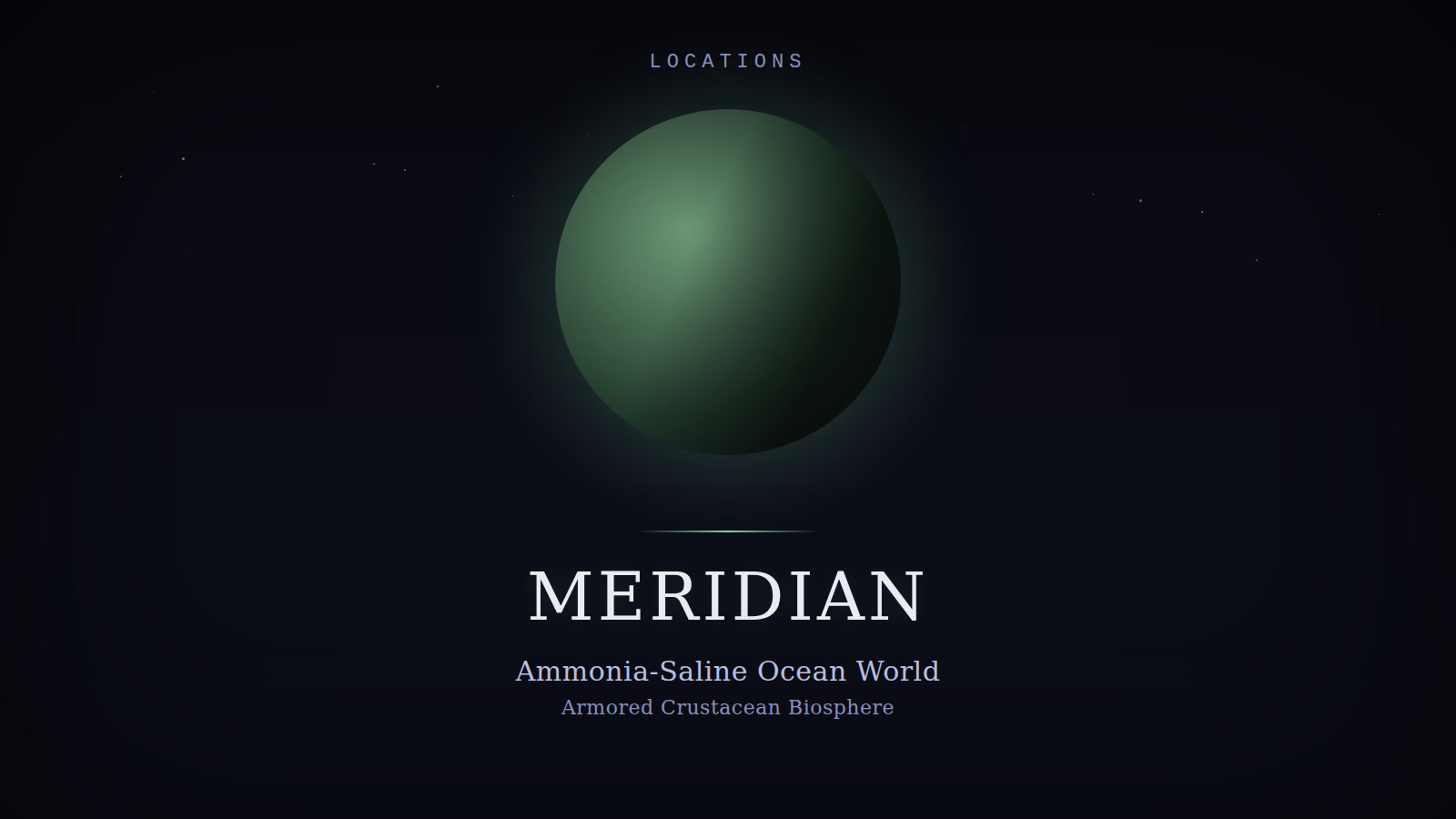
Every biosphere world's first survey report carries a line about breathable air. Meridian's carries a warning label instead.
Meridian is the third planet of the Halyx System and a subject world of the Cerebraun Hegemony. It is, by the same technical definition that covers Tír na nÓg, a genuine biosphere world — a stable, self-sustaining native ecology rich enough to need no life-support engineering at all. It is also, for humans, one of the most reliably lethal surface environments on record: a thick, halogen-heavy atmosphere and ammonia-saline ocean chemistry that no unshielded human tissue survives more than a few unprotected breaths of.
A Biosphere, Not a Wasteland
Meridian's hostility is not the barren, empty-world kind. Its shallow seas host one of the densest concentrations of complex native life so far surveyed: armored, segmented invertebrate life dominates every visible niche, from filter-feeding reef-builders the size of a closed fist to apex hunters that mass several tonnes and patrol the continental shelf margins in coordinated hunting groups. The chemistry that kills a human unprotected is, for Meridian's native biosphere, simply the water everyone breathes.
The Meridian People
The most advanced of Meridian's native crustacean lines are themselves sapient — a fact confirmed only after two separate Hegemony survey missions independently misclassified their reef-cities as geological formations. Meridian sapients build in secreted mineral composite rather than fired or forged material, favoring dense, load-bearing lattice structures that read, to outside eyes, as natural growths right up until someone notices the load-bearing lattice is arranged by deliberate design and updated generation over generation.
Meridian sapients communicate primarily through a combination of claw-percussion against shell and structure — audible and readable underwater at considerable range — and slower chemical signaling diffused directly into the surrounding water column, a channel Cerebraun administrators still rely on translation instrumentation to follow reliably.
Hegemony Administration
Meridian predates Cerebraun contact by a wide margin, and its sapients had already built stable reef-cities before the first Hegemony survey vessel logged the system. Under the terms standard across Cerebraun Hegemony subject worlds, Meridian retains day-to-day self-governance of its reef-cities under its own sapients' customary structures, while a resident Administrator-Voice holds final authority over trade, resource extraction, and defence posture on the Prime Ganglion's behalf.
The arrangement is a durable one rather than a settled one. Hegemony extraction interests focus on Meridian's deep-shelf mineral beds — the same chemistry that makes the ocean lethal to unprotected humans also concentrates several rare compounds Hegemony fabrication industries value highly — and Meridian sapients have registered formal objection to extraction pace through their Administrator-Voice more than once. The objections are recorded. Extraction has not slowed.
The Settlers Who Nearly Quarried a City
The first human settlers to reach Meridian arrived knowing less than the record did, through no fault of theirs: no message moves faster than a ship, and the expedition had launched on files a generation stale — files from the era in which two separate surveys had already filed the reef-cities as geological formations, and nothing yet said otherwise. The record declines to fix the expedition's year or its charter more closely than the story needs. What it fixes is the plan they arrived with: a sealed shelf-margin enclave for mineral work, sited against formations their instruments confirmed, correctly by every measure the instruments had, as dense natural mineral lattice. The survey was not wrong about the chemistry. It was answering a different question.
What stood between the first anchor bore and a diplomatic incident was a matter of days, and of one operator's ear. The settlers' hydrophones had been logging heavy claw-percussion since arrival and filing it, as the stale files directed, as biological noise; the traffic rose sharply as the siting work began, which the log annotated as fauna disturbed by machinery. What the duty operator eventually flagged was not the volume but the address — the percussion had begun answering the anchor survey's own test pulses, pattern for pattern, in what no disturbed animal does. Works were halted on that flag, hours before charges were to be set against an inhabited outwork of a living city. By the time a Hegemony proxy arrived with translation instrumentation, the expedition had already re-embarked its equipment on its own judgement — which is the fact the reef-cities are recorded as having weighed most heavily in declining to treat the approach as an act of war.
The incident that almost was is now Survey Corps teaching material of the first rank, filed beside the Sentinel: sapience is not obvious to instruments, and a technology need not look like one — a people who build in secreted mineral composite are exactly as easy to quarry as they are hard to see, and the doctrine that a surveyor treats no evidence of sapience as a statement about the survey was paid for here, in a near-miss the record keeps deliberately. The settlers themselves never returned as settlers. What their withdrawal bought is the standing arrangement below.
Human Presence
No permanent human presence exists on Meridian's surface, and none is expected to. Human visitors — Star Ranger crews included, on the rare occasion the Hegemony grants entry — operate exclusively from sealed orbital or submersible platforms, and only ever meet Meridian sapients through translation instrumentation and armored remote proxies. It remains, on every count that matters to the humans who have logged time there, the least hospitable biosphere world on record.
Sharing the Halyx System, close enough in-system that early survey logs once treated the two as a matched pair, is the Sentinel — a small, lifeless world whose only notable feature turned out to matter considerably more than its survey classification suggested.
See also: The Cerebraun Hegemony, Cerebraun, Tír na nÓg, The Sentinel.
Discussion
Show discussion
Comments are read after they are posted and anything unsuitable is removed. Posting needs a GitHub account; reading needs nothing.