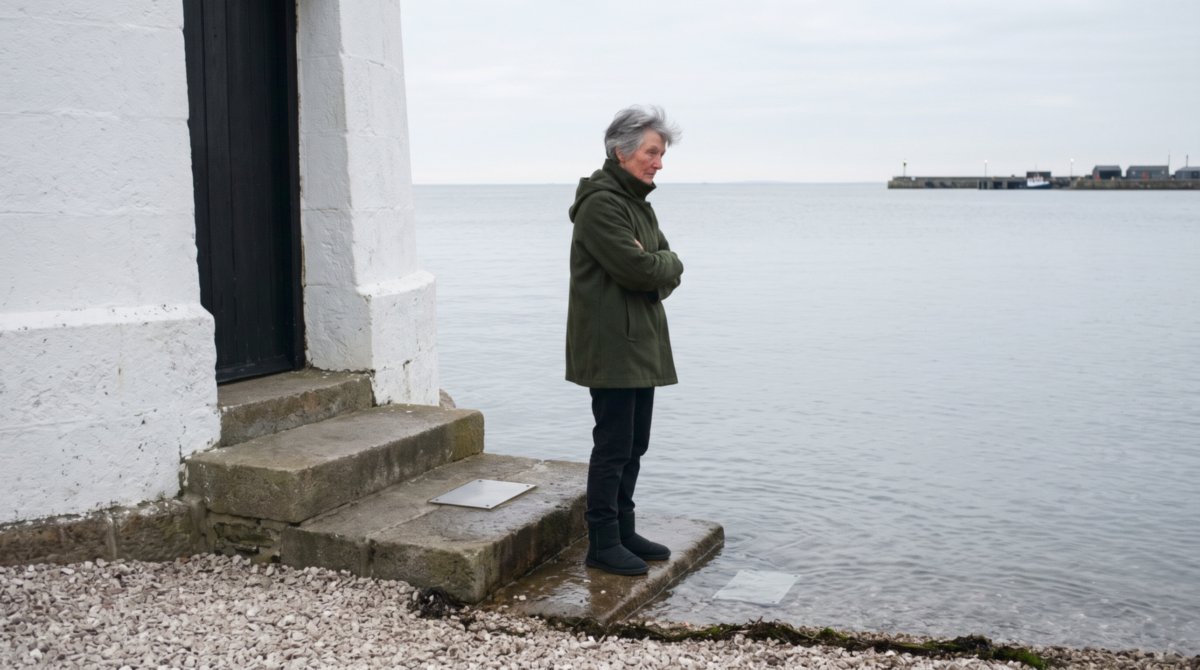
Nuala Beirne (Human, attendant of the Sceir Light)
- Time
- 2826 UCSD, Late Summer — a signal day, the falling tide, and the night after
- Location
- The Sceir Light, on the shore below Threshold Station, Earth
The signal came at its hour, and the clock was wrong by about the amount she had expected it to be wrong by, and she wrote it down.
That was the part of the job that went in the book. The Sceir Light had a lamp, a glass, a stair, a tide gauge on the landward steps and a clock that timed the character, and each of them was the Lights Board's, and had been the Board's since long before the first hull up the shore was laid, and what the Board asked of an attendant was that she keep them correct and write down what keeping them correct had cost. Glass. Movements. Seconds.
She read the signal, and read the clock against it, and applied the correction in the direction every correction in the book had gone, which was the only direction she had ever applied one in. Then the line. Date. Signal received. Clock reads. Correction applied, in seconds. Initials. The column had outlasted the hands that kept it and the instruments it was kept on, and she had not been tempted to add to it: a column that had asked the same five things for better than two centuries was not improved by a sixth. N.B.
Then she did the thing that was not in the column, which was to run a finger down the season's entries and add them.
Nine.
The last season before the new movement had come to nine as well. That had been the season she wrote to the Board, in the plain terms the Board preferred, that the corrections at the Sceir Light had been growing for some years and were now larger than a movement in good order ought to need, and would the Board consider a replacement. The Board had considered it for most of a winter and then sent one, and she had fitted it in the cold with the lamp out for a day and the glass stopped down, and it had cost the Board more than she was worth, and she had been glad of it. The new movement was a good one. It ran as true as any she had kept. The seasons since had run at seven and eight, and now this one had come to nine — the movement had nothing to do with it, as she had told the Board it would not, in terms the Board had read as a request for a movement.
She shut the book on the page and left it on the table, because the inspector was coming down on the falling tide and would want to see the page, and then she went down to the gauge.
The dry weeks had been long this year. The marsh behind the spit had gone pale at its edges and the wind was light from the west, which on this shore was as near to no wind as the shore came, and the water lay flat out to the horizon with the station's docks standing on it to the north like a line drawn on a chart. Thirteen years the station had been there. Its people called the light the light and the shore the shore, there being one of each, and came down the spit for the tide tables on a bad week and never for anything else, and she bore them no ill will for it. They had their instruments. Nothing afloat had steered by the Sceir Light in her time or in the time of the hand before hers; the traffic carried its own solutions and had done for generations, and the Board's register recorded the light's fixes as a formality against a failure nobody had invoked.
The gauge read what a gauge reads at that hour on that tide, and she wrote that down too. The Board's datum plate was set into the steps at the height the Board had set it. There was an older plate below it, and an older one below that, each a little lower, and the lowest stood under water at every spring tide now and had done since before her hand was in the book. She had never written to the Board about the plates. The gauge was read at the high water and the figure went in the book, and that was what a gauge was for.
The inspector was on the spit by then, a dark upright mark on the shingle a long way off, walking the way everybody walked the spit the first few times, with an eye on the water either side.
Discussion
Show discussion
Comments are read after they are posted and anything unsuitable is removed. Posting needs a GitHub account; reading needs nothing.