Nuala Beirne
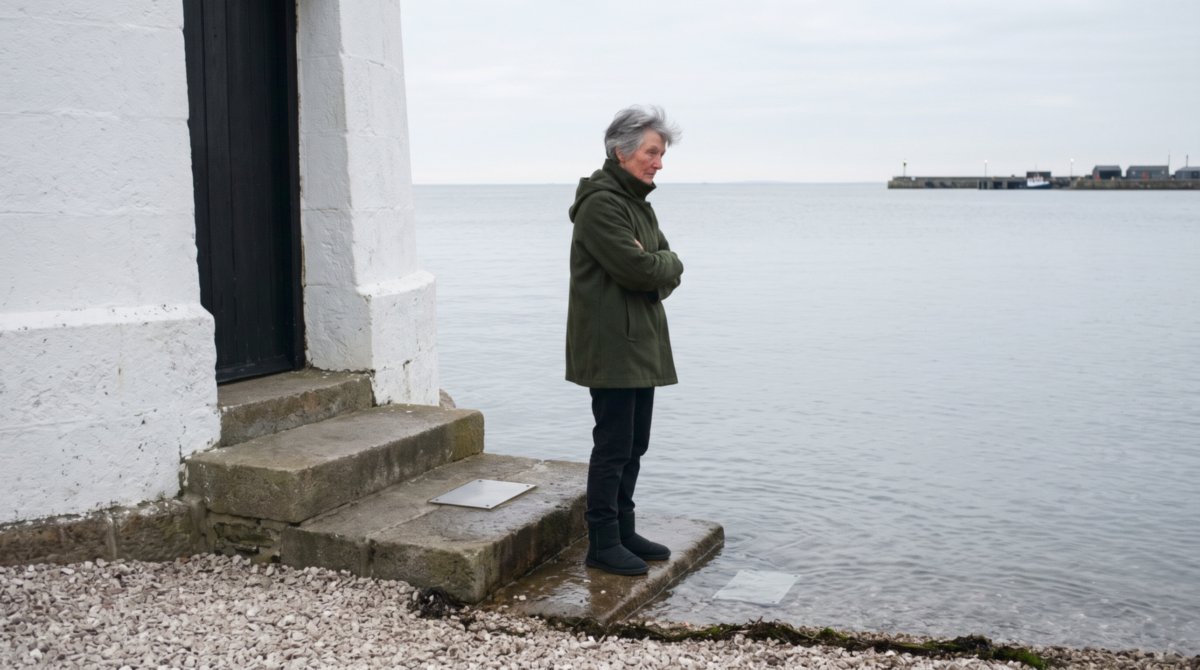
Nuala Beirne keeps the Sceir Light. The light has a lamp, a glass, a stair, a tide gauge on its landward steps and a clock that times its character, and each of them is the Lights Board's, and has been the Board's since long before the first hull of Threshold Station was laid up the shore. What the Board asks of its attendant is that she keep them correct and write down what keeping them correct has cost. She does, in the register's five columns, and initials the line N.B. The record meets her twice, a season apart, in 2826 UCSD: in late summer, when the Board's time signal came at its hour and she corrected the clock by about the amount she had expected and totalled the season at nine for the second time; and in early autumn, when a survey party of three from the station walked the spit on a falling tide and asked for the book. She is nobody's staff but the Board's, and the record renders her as she.
Known History
- Attendant of the Sceir Light in 2826 UCSD, the one posting the record holds her at. The register names a hand before hers, and nothing afloat has steered by the light in her time or in that hand's. How long the light has been hers, and from whom she had it, the record does not say.
- After the first season whose corrections came to nine, she wrote to the Board, in the plain terms the Board preferred, that the corrections at the Sceir Light had been growing for some years and were larger than a movement in good order ought to need, and would the Board consider a replacement. She told the Board the movement would make no odds, in terms the Board read as a request for a movement. The Board considered it for most of a winter and sent one, and she fitted it in the cold, with the lamp out for a day and the glass stopped down, in the winter of 2824 to 2825 UCSD, the winter before last as both chapters count it from 2826. It cost the Board more than she is worth, by her own account, and she was glad of it. It ran as true as any she had kept, and the seasons since came to seven, and seven, and eight.
- Late summer 2826 UCSD: the signal at its hour, the correction applied in the direction every correction in the book had gone, the line written, the season added and found to be nine, the second. The gauge read at high water against the Board's datum plate, with two older plates below it in the steps, each a little lower, the lowest under water at every spring tide. The Board's inspector came down on the falling tide, timed the character from the shingle and from the gallery rail and found it correct, ticked both boxes the Board's sheet gives a clock, found the register open on the table at the page, and wrote on the sheet Rate as previously noted. Nothing was written in the margin. The book went back up the stair to its shelf, and that night she lit the lamp at the hour and counted the character anyway. See Correction Applied (S01E00C10).
- Early autumn 2826 UCSD: a gale from the southwest, an hour and fifty of the falling tide, and Sir Galahad Thorne, Syra and Rook-7 at a door she had open before they reached it. Asked how often the clock needed correcting and whether anyone had ever written it down, she answered that everyone writes that down, and that nobody had ever asked for it, and went up for the book: three volumes, fourteen attendants, two hundred and seventeen years, every correction in one direction and the last of them hers. She was told she would want a receipt for the Board's property and should insist on one. The chapter leaves the book on the table with Syra's hand flat on it. See The Character of the Light (S01E01C03).
The Work
The column is older than anyone who has kept it. Date. Signal received. Clock reads. Correction applied, in seconds. Initials. It has asked the same five things for better than two centuries, through copperplate, poor pencil, ballpoint and pasted slips, through four complete replacements of the movement and fourteen hands, and she has not added a sixth. The work is the lamp and the glass; at the Board's hour it is the signal read against the clock, the correction made and the line written; at high water it is the gauge read against the plate and the figure entered; and at dusk it is the lamp lit and the character seen to turn, two flashes and dark, two flashes and dark, fifteen seconds group to group. The Board inspects the light on its ordinary schedule and has found it correct, to the standard the Board inspects against, as far back as the Board's sheets go.
One thing she does is not in the column. At the end of a season she runs a finger down the entries and adds them. The register is a maintenance record, and the Board's reporting requirements have never asked an attendant to report a correction; the sum is hers to make and nobody's to ask for. A Board inspector's hand in the margin, from a decade not this one, holds the Board's whole account of the matter, known at the Board as the ordinary account of the Sceir Light by inspectors who have never seen it written: Corrections continue. The tower has its own habit and always has. No action. She did not write it, and she has not written beside it.
Nothing on the water needs the light. The traffic that uses this shore carries its own solutions and has for generations, and the Board's register records the light's fixes as a formality against a failure nobody has invoked. The station's people call the light the light and the shore the shore, there being one of each, and come down the spit for the tide tables on a bad week and for nothing else. Asked on the stair, in the dark, why the light was still lit, she said: Because it's lit. That's the whole of it. A light you only put on when you know someone's out there isn't a light. It's a favour. Rook-7 logged the sentence verbatim and filed it under nothing.
Character Notes
She says a thing plainly and asks for the same. A visitor at the door is told what is the Board's and what is not before he has said what he came for, and is told how long the tide gives him and where the one bed is. She knew what the Rangers were by the coat, and was not surprised by Rook-7, which most people look at twice. The record has her in one posture more than any other: at the sill with her arms folded, looking at the water rather than at the room, which is how she looks at most things.
What she declines is as exact as what she keeps. She did not write to the Board about the plates in the gauge steps, because the gauge is read at high water and the figure goes in the book, and that is what a gauge is for. She is not asking for a second movement, and said so when the inspector told her that a remark to the Board would bring one. She wrote to the Board about the rate in the Board's own terms, knowing how the Board would read it, and was glad of what the Board sent. She bears the station no ill will for thirteen years of calling her light the light. When a Krenyi analyst told her that nothing in the book made the light important, that the light was an ordinary light kept correctly and what was unusual was the shore, she unfolded her arms and said it was the first sensible thing anyone from up there had said about it.
The Board's inspector, in the record's one account of her from the Board's side, knew the page before he read it: nine, and under it a season, and under that the line of a season's corrections in a hand that did not vary. The record agrees with him about the hand.
What the Record Does Not Hold
Her age, beyond a visitor's reading of somewhere past sixty; her birth year, where she was born, and her kin. How she came to the light, how long it has been hers, and whether she knew the hand before hers or any of the fourteen the register counts. What she looks like, beyond that reading and that she was dressed for the gallery rather than for visitors. Which way the corrections run, which she applies and the record does not name. Whether the book left the tower that autumn and whether she had her receipt for it, since the survey read two centuries of it and the chapter ends before the question is put. Whether she has heard what the survey made of the book once it left the table. Any chapter after early autumn 2826 UCSD. The record has her at the sill with her arms folded, the book on the table and the tide falling, and has asked her nothing else.
See also
- Correction Applied (S01E00C10), the signal day, the inspection and the night after, in her viewpoint and the inspector's
- The Character of the Light (S01E01C03), the survey party at the door and the register read from its first page
- Threshold Station, the station up the shore, and the forty seconds her book places well before it
- Instrument Drift, the record's word for two correct instruments disagreeing
- Boundary Zones and Concordant Edges, the flexure the station and the light share a shore with
- Sir Galahad Thorne, Syra and Rook-7, who walked the spit
Discussion
Show discussion
Comments are read after they are posted and anything unsuitable is removed. Posting needs a GitHub account; reading needs nothing.