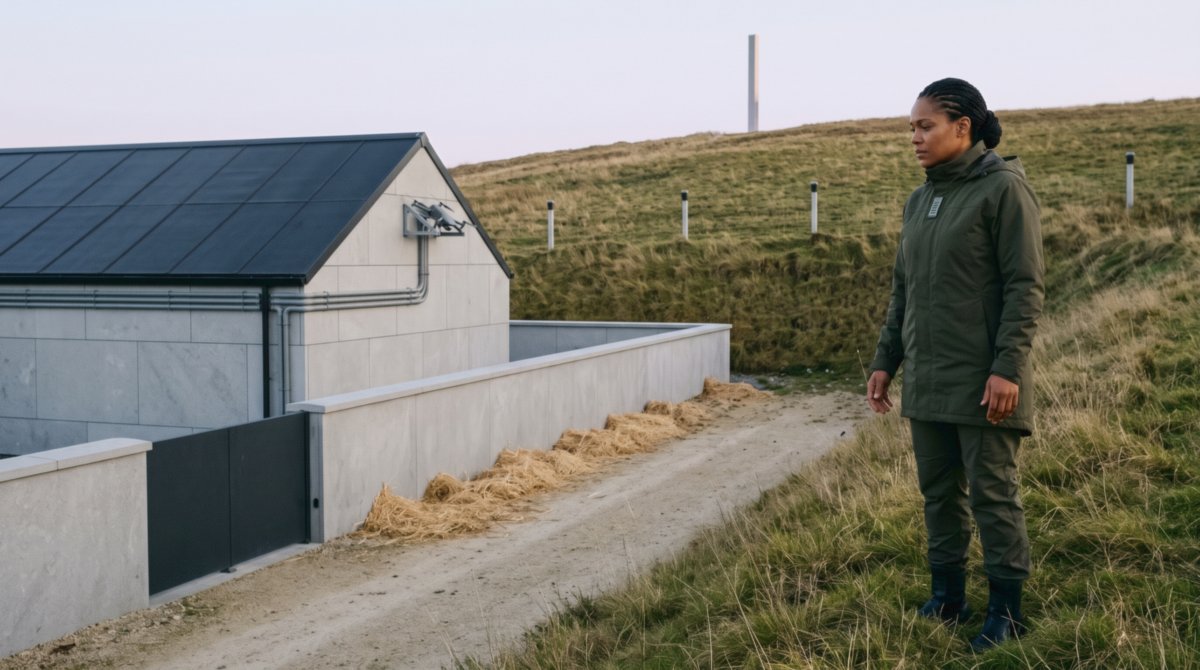
Senior Éilis Ní Mhurchú (Human, Celtic Union-born, Survey Corps)
- Time
- 2826 UCSD, Late Autumn — one still afternoon, and the morning after
- Location
- A Survey Corps boundary post and the holding below it, on a Celtic Union charter world the record does not name
The column the post logged on the minute was headed Type, and in two years at the post Éilis Ní Mhurchú had watched it say three things in every order three things can be said in.
That was the zone. The register called the whole far side of it Sí Gaoithe, which was the valley's old word for a dust-devil taken up by a survey for a universe, so that the word for a thing that lifted straw was now the Corps' word for a membrane, and nobody in the valley had been asked. The valley did not seem to mind. The post was two Rangers, a mast on the ridge and the Union's invitation — and of the three only the invitation could not be replaced from a hull.
She had the clocks, which were the Corps' and disagreed with each other by the usual amount, and the Etheric line, which was hers, since she held the certification and the other Ranger did not, and the strain channel, which was the Corps' and was the one that on most days said least. Type I was the clocks drifting and nothing on the line. Type II was the clocks going periodic and the line showing resonance, the neighbour's templates readable and displacing nothing. Type III was the clocks running apart and the line showing the neighbour's templates competing with ours for the right to be true here, and at every other site on the Corps' books Type III was an event with a name and a file. At this post it was a line in the minute log. The column went I, II, III, II, I on the minute and settled on nothing, and it had done that since before the mast, and the working hypothesis for why was on a page she had read and could not have measured.
A little after three by the post's own clock, and a little less after three by the other one, the column went I, II, III inside four minutes, which it did most weeks. Then the strain channel did a thing it had not done in her two years, which was resolve.
Ordinary shear was diffuse. The strain had somewhere to be, and it went there, and the channel showed it as a figure that rose and fell and belonged to no place in particular. This gathered. It drew in to a range and a bearing, a point, and held there, and the board gave her the duration counted backward from its end: fifty-one seconds, give or take the two the instrument was honest about. She had it after it had closed. The board had it after the ground did, which was the one fact about this site every officer who had ever kept the post had written into the log, and she wrote it into hers. Point resolution, post-event. No precursor.
The range and the bearing were the Ó Laoire top field.
She was down the hill inside twenty minutes, under the invitation, which covered the instruments, the ground inside the zone and a form. The goats were grazing. There was straw lying along the yard wall in a line the air had not made, and the hand instrument read the strain channel finding its floor again, nothing more, and the line read resonance, Type II, the post's ordinary weather. The drain column read blank. Blank was a finding — the instrument could read a drain, and she had pointed it at the place, and it had read nothing, as it had read nothing at every site on the register since the register began, and the page she had read did not say whether that meant there was nothing or meant the Corps had not yet found what to point it at.
The form was the Union's, by the agreement, with the Corps' columns on the back. The keeper of the holding gave her the time as near as he had it and the wind, which there had not been, and the animals, and the shears, and the door.
She tried the door herself. It opened outward on hinges hung to open inward, with no mark on the wood and no play in the hinge pins, and she wrote it as it was. One door. Opens outward; hung inward. No damage. Duration pending. The shears she wrote as the usual: one tool, wrong kit, returned by the householder before inspection, because households put things back and the form had long since stopped asking them not to.
Missing: none. He had looked twice. She wrote the none and not the twice.
The practices line was on the back, in the Corps' half, under the Union's heading, and she wrote the three of them as she had seen them. A bowl on the stone. A brush standing. Words at the door. The column beside it was the Corps' position and she wrote the position, because it was hers to write and she agreed with it: cultural practice; no measured correlation with incident rate. Then the classification box, where the register had only ever let anyone write one word, and she wrote it. Open.
The report would go up with the next hull, under the agreement, to a regional office that had filed every one of these the post had ever sent and had never sent a question back. There was nothing in the file to ask.
Discussion
Show discussion
Comments are read after they are posted and anything unsuitable is removed. Posting needs a GitHub account; reading needs nothing.