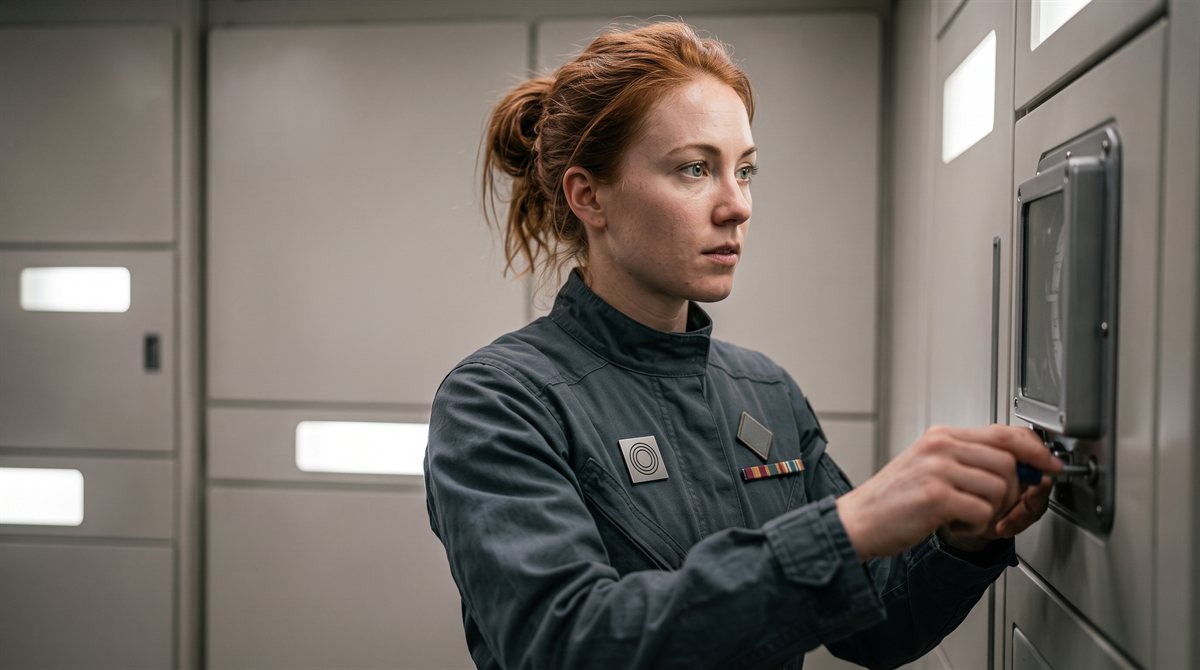
Cadet Tissadelle Shepherd (Human)
- Time
- 2826 UCSD, Early Autumn, Night
- Location
- Threshold Station, Dock Seven — the general operations watch
Dock Seven kept two times, and the watch log had one line for it.
Shepherd had found that out on her first night, forty watches ago, standing where she was standing now with the log open on the sill of the watch desk and the two chronometers on the wall opposite — the one above the pressure seal and the one above the inner hatch, the station's and the other one — forty seconds apart and both of them certain. The form's line said Time. It did not say which. So she had written both, the left one first and the right one after it, with a stroke between them, and initialled the line, and gone on to the next, which asked for the state of the seal and had only one answer.
She had done the same on every watch since. Nobody had said anything, which on a general operations watch was not approval and not its absence. It was what a cadet's log mostly got.
Tonight the Principal read it.
The Principal held the night watch the way a Principal holds anything a cadet is on: not present, and entirely responsible. She came down to the dock perhaps twice a week, at no hour a cadet could learn, and read the log standing, and initialled under the cadet's initial, and went back up. Shepherd had never once seen her strike a line. Tonight she read the time line and did not initial it, and turned back a page, and then back further, to a week Shepherd could have recited, and stood for a while with the book open across both hands.
"The log is kept in station time," the Principal said. "That is the left-hand instrument. It has been the left-hand instrument since before you were posted and it will go on being the left-hand instrument after you have gone, and nobody told you, which is mine and not yours." She let a page fall closed. "One time on the line, Cadet."
Shepherd had been waiting forty watches for the sentence, and had thought about what she would say to it on perhaps thirty of them, and had decided somewhere around the twentieth that most of what she had thought of was an argument, and that a cadet who argued for a reading had added something to it the instruments had not. So she said the one thing she could support.
"The watch had two times, Principal. The log records the watch."
"The log records the station." It was not said hard. "The station has one time. It is the one the transit windows are stated in, and the one the roster is kept in, and the one the survey office has filed three reports about not being able to make the other instrument agree with. If the right-hand reading goes into the watch log, then somebody reading the watch log for the time has two times and no way to know which one the watch was run on, and that is worse than one time and a known fault. A record you cannot read is not a record."
That was true. Shepherd had known it was true since the first night, and had written both times anyway, and had not until this minute had to put into words why — which she did now, carefully, because the Principal had stated a position and was owed one back.
"If I correct the right-hand reading to the left," she said, "the line says the instruments agreed. They did not. I can write which one the watch was run on. I cannot write that the other one said what it did not say."
The Principal looked at her for a moment in the way that is not an assessment, and is the thing an assessment is later made from.
"Then write which one the watch was run on," she said. "Left-hand first, marked as station time, on every line. The right-hand after it, if you must, and marked for what it is. Anyone reading for the time will find it where it has always been. Anyone reading for the other thing —" she did not say what the other thing was — "will find that too." She initialled the line, under Shepherd's initial, and then the forty before it, one by one, which took some time and was not required. "I am told the survey has new people and a robot," she said, at the door. "If any of them wants to read a general operations watch log, which no survey has wanted in my time, it goes through me."
Then she went up, and the dock was Shepherd's again, and both clocks were still certain.
She wrote the next entry the way she had been told. Left, and the two words. A stroke. Right. She had written it twice from the beginning because once was an opinion. The phrase was not hers, and she had never needed to ask whose it was. The forty-first line looked exactly like the forty before it with two words added, and she sat with that, and found that it was correct, and that it had cost her nothing she had not already paid.
Discussion
Show discussion
Comments are read after they are posted and anything unsuitable is removed. Posting needs a GitHub account; reading needs nothing.