Tissadelle Shepherd
Also known as: Shepherd, Tiss
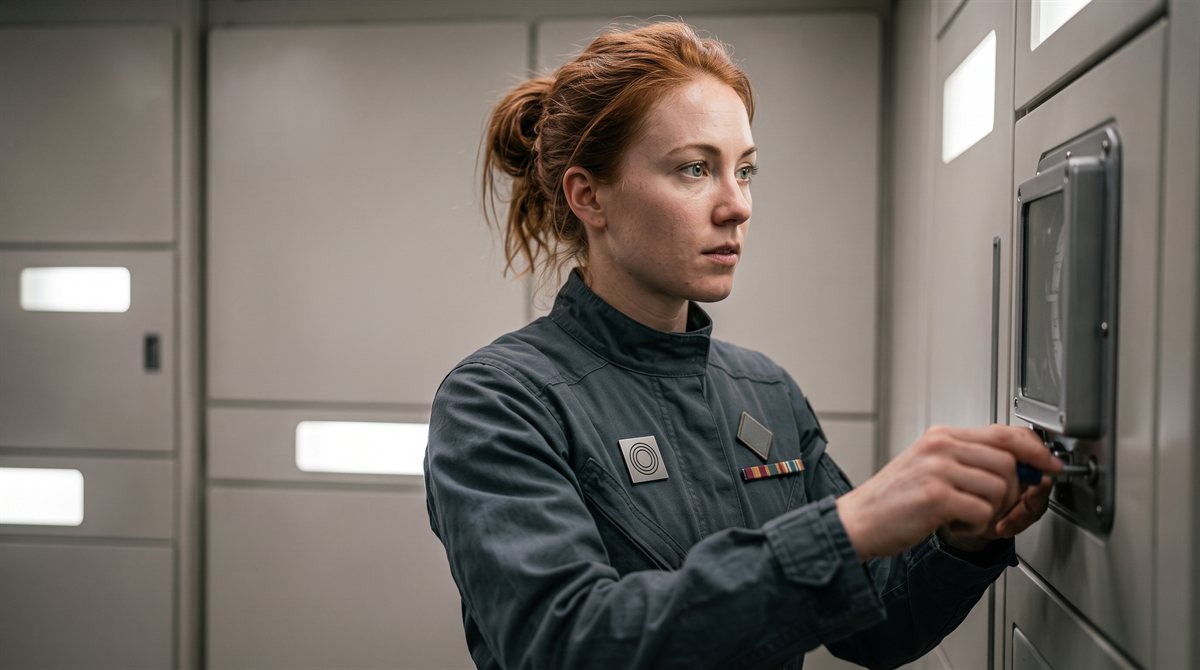
Cadet is the entry rank. It is where formal training meets first operational exposure, and where the qualities that will become most useful later are not yet rewarded in proportion.
Tissadelle Shepherd begins Season 1 there. She reaches the rank of Line Captain in Season 5, after four seasons of operational service that take her through most of the full rank ladder — several promotions a season, a pace well above the ordinary intake's. The distance between those two points is the structural spine of her arc.
At the cadet stage, she is already methodical where others are eager. She does not volunteer assessments she cannot support. She does not perform confidence she does not have. In the early ranks, momentum and initiative are more visibly rewarded than accuracy. She advances anyway.
By Season 5, these qualities have become load-bearing. A Line Captain who will not send Rangers into situations she cannot defend is exactly what boundary-proximate deployments require.
Rank Progression
Several promotions land each season rather than one — Shepherd's climb is compressed, not skipped:
- Season 1: Cadet → Deputy → Officer (general operations track) — the Deputy posting served under Zoe Smith on Eden's fold-approach watch in the late autumn of 2826 (What It Did Not Say (S04E00C01))
- Season 2: Officer → Senior → Principal, rotated onto the Survey Corps track — the posting that puts her on Hegemony telemetry duty, and the finding told under the Sentinel Signal, below, falls at the seam: the rotation begins in Season 2, the backlog she read as a new Principal belongs to Season 3, which opens in Late Winter 2828 with her already in the rank
- Season 3: Principal → Section Lead → Chief Ranger, rotated back onto general operations rather than staying Survey-track — Section Lead at Threshold by the summer of 2828, stating the station's transit windows (Aware of Weather (S03E02C01)); Chief Ranger by the spring of 2829, commanding the general operations section of a Survey Corps revisit to Counterpane (Honest Clocks (S03E02C02))
- Between Seasons 3 and 5 (2828–2831): Chief Ranger → Starwarden (late autumn 2829, a fold-approach post on the outward frontier the record does not name — Not Asked (S05E00C01)) → Archwarden (then styled Starwarden First Officer) → Line Captain
- Season 5 (opening): Line Captain
See Rank and the Chain of Command for what each rank on that ladder carries.
The season-by-season list above names the tracks she held rank on; it undercounts the rotations. Between and inside those postings, Shepherd's early career passes through almost every branch of every specialist corps the Rangers run — the Safety Corps testing, inspection and certification rotation at Eden between Seasons 1 and 2 (the first one on the record), the Survey Corps track proper in Season 2, and shorter certification rotations through Science, Navigation, Frontier, Engineering and Medical-support postings along the way — never long enough in any of them to sit a chapter-leader election, always long enough to hold the certification and know what the work costs the people who do it for thirty years.
The track changes are not indecision. Most Rangers who make Chief have spent the certification ladder on one specialization, heading toward the kind of deep technical mastery a Chief Pilot or a career boundary-safety officer represents. Shepherd never settles on one long enough to become that. What the rotations build instead is a generalist — a Chief who has personally worked general operations, boundary science, and the spaces between them — exactly the breadth a Line Captain needs to answer for Rangers she's sending into work she hasn't done herself, but has usually done something adjacent to. And it is why, at the hinge rank where the two career paths diverge, her direction was never really in question: the technical ceiling rewards thirty years of getting better at one thing, and Shepherd's one thing had turned out to be all of them. A generalist's only ladder is the command path. Her instructors read the rotations as a lack of focus early on. Her later record reads them as the reason she was ready for Line Captain a season before the timeline usually allows.
The breadth has a second axis the section above undercounts. Across those rotations Shepherd has worked beside colleagues from almost every sentient people known to the Star Rangers — not met at a reception or filed past in a corridor, but served with: watches shared, certifications co-signed, problems held jointly until they gave. The exceptions are structural rather than personal — a people the Corps knows is not always a people with anyone in service to know — and the record keeps no ledger of which peoples are on the list, because she doesn't. What the range built is what the rotations built, one layer further out: a commanding officer whose working assumption is that competence arrives in more shapes than any one world teaches, and who has been the stranger at enough other peoples' instruments to know what the courtesy costs in both directions. Whether a mind that already contains more than one way of being a person has a head start at meeting a colleague who senses the world otherwise is a reading others have offered on her behalf; she has never offered it herself, and would file it as one more claim past her evidence.
Character Notes
Shepherd does not mythologise the Rangers or the role. She treats the title as a job description. This makes her easy to work with and occasionally difficult to inspire — she is not moved by abstractions, only by clearly stated problems that have clearly available solutions.
She is aware that some situations do not have clearly available solutions. She handles this by continuing to work.
What she lacks, by the standards of rooms that grade on presence, is the performed kind of confidence — and the record of people misreading that is long enough by now to count as a pattern. Early instructors filed her rotations as a lack of focus. Boards meeting her for the first time have mistaken a Ranger who will not claim past her evidence for one who is not sure of it. The mistake has never survived acquaintance, and she has never spent effort correcting it ahead of schedule, because an assessment volunteered to manage an impression is exactly the kind she does not file.
The distinction — the one people who have served with her stop needing explained — is that the confidence is real; it is the performance she withholds. The cost is real too, and it is the nearest thing she has to an enduring weakness: it bills as slower belief, in rooms that would have taken a louder officer at volume, and she pays it every time rather than once, because the alternative is claiming certainty she has not earned. Whether that is humility or stubbornness depends on who is describing her. The people who have worked beside her longest decline to choose.
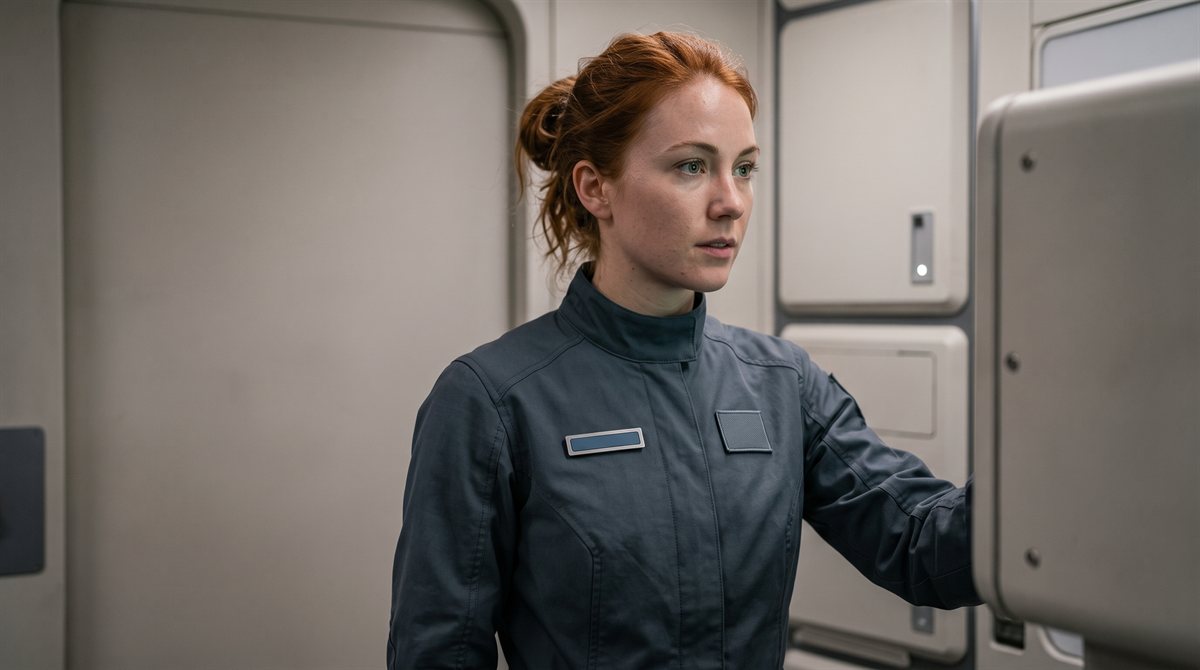
She is always formally dressed, and never more so than on duty. To rooms that grade on presence this looks like the performance she otherwise withholds, and it is the opposite of one. The uniform is the job description she treats the title as, worn where anybody can check it: correctly dressed, a Ranger has claimed nothing that is not already on the record — the rank is real, the certifications are real, and the coat says that and nothing further. It is the only statement about herself she makes without hedging, and she can make it precisely because it is not an assessment.
What carries her as a commanding officer, then, is not assurance projected at a room. She has watched officers lead by overconfidence, and by the harder trick of a harshness performed to look like it, and has declined both on the same grounds she declines every other claim she cannot support. What she leads with is attention. She notices what a posting is costing the people on it, earlier than they report it and usually earlier than they know it themselves, and adjusts the work before the cost compounds — which is why her crews' loyalty has always run a little ahead of her reputation. The result is a leader who is popular and capable without ever being notably confident, an arithmetic her crews have never once found strange. They are not following the certainty. They are following the person who noticed.
Two things the record has shown about her without naming, named here.
She is physically strong. It is a hill farmer's strength and not an athlete's: the Boirinn flock-holding was worked by hand, she was raised as hands on it before she was anything else, and two trainings and the field rotations — the Frontier circuit, the Engineering postings — have kept it up rather than made it. It shows the way everything else about her shows, in what gets done rather than in how she looks doing it, and nobody on her crews has ever remarked on it, which is the ordinary measure of a thing that has never once failed to be there.
And she is brave, in the sense the record can support and no other. Her own account of the last forty-one minutes aboard the Sufficient Cause is that she was not brave about it, and not frightened either, and that she could not tell whether that was steadiness or only the part before fear arrives; the page keeps her word — see What Came Off the Ship (S05E02C03). What the record holds instead is the shape of the thing: the arithmetic done three times, the harder order chosen because it was the one she could defend, every soul off the ship and her First Officer sent by a direct order and then a second — and, two seasons earlier, a Principal standing in a review chamber to be disbelieved about a signal until the finding was reproduced without her. Courage in her runs on the same economy as her confidence: real, spent where the work is, never performed. She would not accept the word. She has never yet declined the cost.
Her relationship to Karla Wender develops across the early seasons from distant chain-of-command awareness to direct operational contact, and then becomes formal. On Shepherd's promotion to Starwarden, between Seasons 3 and 5, Wender is assigned as her official mentor under the Corps' standing policy for the command ranks — the pairing that replaces, above Chief, what the Academy does by examination below it.
The assignment reads as obvious in hindsight and was not. Wender crossed the hinge rank from the technical ceiling, having spent an entire career getting better at one thing; Shepherd crossed it because a generalist's rotations had left her no other ladder. Two officers, opposite reasons, one rank — which is exactly why the pairing works. Wender is the one person senior to her who knows precisely what the crossing costs and arrived at it from the far side.
What Wender was already doing informally, the policy only named. She had been reading Shepherd's silences since the woman's year as a Senior, and had watched a former cadet outpace her own cohort by a rank and a half across four seasons — none of it assigned, all of it by then a habit. The formal pairing put a duty under something Wender had been doing anyway, which is the ordinary way that policy meets a Corps small enough for people to have already noticed each other.
The other standing figure in her career is Chief Ranger Galen Kane of the Frontier Corps, whose circuit she rode as the second of a pair during the early Frontier certification rotation her Rank Progression section undercounts. The mentorship never formally closed; it reversed direction. From Starwarden onward, Kane has been the advisor she trusts most — an officer with no place in her chain of command, no boundary certification, and no stake in anything she decides, which is, on her reading, the entire qualification. What she takes to him is never the science. It is the question his corps spends whole careers on and hers almost none: when leaving is the correct order.
Both relationships begin at Starwarden, in the same week of 2829 (Not Asked (S05E00C01)), and the coincidence is the point. The Corps assigned her one mentor and she kept another, and the two are not redundant: Wender is answerable for her and can order her, which is what makes the mentorship binding and what makes some questions unaskable inside it. Kane can order her nothing. Shepherd has never framed this as a preference between them, and would decline the framing. She has one adviser whose judgement she is required to take seriously and one whose judgement costs her nothing to hear, and she has never confused which is which.
Tobble
Shepherd is plural. Tobble is a headmate — a distinct person sharing one body with her, on the ordinary terms Concord personhood standards have recognised for well over a century. See Plural Minds for how little the cosmology has ever had to make of this.
Tobble is a ginger cat, and uses he/him. Not a costume, a coping image, or a figure Shepherd invented to make something easier — a nonhuman member, whose own identity is simply not the species of the body he shares. Asked during cadet intake why a cat, Tobble's answer went onto the record as because that is what I am, and the reviewing officer, to their credit, wrote it down and moved on to the next item.
The obvious mistake gets made constantly. The Smart Pet programme is established enough that a Ranger who mentions a cat is assumed to be mentioning an animal, and the assumption holds right up to the moment it is applied to a person. Agent Barsik's file is the study in how useful it is to be underestimated in that direction. Tobble's is the other half of it: being addressed as somebody's animal is only tradecraft when you chose it.
Shepherd corrects it once, precisely, and does not raise it again — the same economy she brings to a misread instrument. She does not explain the arrangement to a room that has not asked, and she does not treat it as a disclosure she owes anyone. What she will not do is let it pass uncorrected in front of Tobble, which is a different matter from minding on her own account, and is the distinction most people who get it wrong never notice her making.
Her file carries a plural registration and nothing further. Reviewers who go looking for a welfare concern in it find a mind with more people in it than the form has boxes for, all of them stable, none of them a symptom, and no finding to write.
Who fronts, and when
Shepherd lets Tobble front when she is working with cats and comparable animals. It is not an accommodation and not a quirk of hers to be indulged; it is the obvious allocation. He is better at it, and the system uses whoever is better at the thing in front of it — the same reasoning any competent crew applies to any watch.
The same principle accounts for the shape of her service record. Her rotation across corps and branches is wider than most officers manage, and reads from the outside as restlessness or as a career being managed by somebody else. It is neither. Different members front in different roles, and a system carrying that much range has more postings it can do well than a singlet does. The record is the honest trace of it rather than an anomaly in it.
None of which is instability. Hers is a harmonious, well-integrated system — the members work together, the handovers are unremarkable to everyone involved, and the arrangement has never once produced the incoherence a reviewer looking for it expects to find. The interest of the arrangement, if there is any, is administrative: the forms were built for one person per body and have been quietly wrong about that for a century.
The inner world
What the record can say of an interior it cannot inspect, it says on the system's own account — the only authority there has ever been on the subject. The account is this: the inner world Shepherd and Tobble share is structured like a high-fantasy role-playing game. Not dressed as one — there is scenery, and she has never itemised it for anyone — but structured as one: named places with rules, roles held the way a party holds them, work parcelled into quests that are taken up, carried, and not set down before they are finished, advancement earned rather than assumed. An imagination that keeps its own rulebook is, on the evidence of everything else on this page, the most Shepherd-like fact the record holds about her.
The architecture is load-bearing, not decorative. That different members front in different roles is the outside view of it; from inside, it is only the party fielding whoever's class fits the encounter — which is how one system carries a service record wider than most careers without ever experiencing the width as strain, and why the rotations that read as restlessness from the outside never were.
Tobble's own subsystem sits deeper than the questing layer, and runs on a different discipline entirely: far more ordered, far more scientific — kept records, checked procedure, arithmetic done twice because once is an opinion. Deeper describes structure, not standing; there is no hierarchy in it, and neither architecture is the truer one. They are two idioms of one working interior, and the officer the Corps sees is the collaboration showing — the romance kept where only the system can see it, and beneath the romance a registry. Which is why the Ranger who will not claim past her evidence has never once run short of somewhere to put what she cannot yet claim.
Asteria
There is a second member the record can name, on the same authority as everything above: the system's own account. She is called Asteria, and she has the face of Asteria Wessex as a younger woman — a woman Shepherd never met. Wessex had withdrawn to her chapter house years before Shepherd's cadet intake. What Shepherd had of her was Karla Wender's memory: Wender was Wessex's pupil while Wessex was still serving, and became Shepherd's mentor in turn, and a mentor's mentor arrives in the telling, described rather than seen. The image Shepherd formed from that telling is the form the member took. The name came with the image, and so did the chapter's word for the woman it was drawn from: when the system speaks of her as Asteria the Sage it is repeating Wender, not claiming anything of the Fellowship, in which the system has no standing.
The record does not say when she came, or why a mind would take a mentor's mentor for a member, and has not been asked to. It says what the registration says: more members than the form has boxes for, all of them stable, and now two of them with names. A painter who never saw her has since made a picture from the system's description, filed in the Codex as an artist's impression and as nothing more.
The Sentinel Signal
Season 3, working a backlog of archived Hegemony telemetry from the Sentinel under a routine Survey Corps data-exchange, newly made Principal, Shepherd did what pattern-recognition software had not been built to do: she stopped reading the world's unclassifiable EM pulse as data and ran it as audio. What generations of automated classifiers had filed as noise because it matched no known protocol, she flagged within one listen as something with phrasing, repetition, and variation — considerably harder to file, and considerably harder to ignore.
It is the one line on her record that has nothing to do with rank. Her instructors taught her to read instruments. Slipwave taught her to read the space between the notes. The Sentinel needed the second kind of reading, and nobody had thought to send it. See Filed Under Noise (S03E01C01) for the night itself, and Independent Verification (S03E01C02) for what it cost her to be believed about it.
Home Ground
Shepherd was born and raised on Tír na nÓg, the flagship world of the Celtic Union of Planets, on a flock-holding in the Boirinn Uplands kept by her mother, Órla Shepherd, and five generations of women before her. "Shepherd" is not a Ranger affectation — it is the family's working name, older than her enlistment by a couple of centuries.
By Season 5, the Union's standing information-sharing agreement with the Survey Corps gives her official reasons to return that her rank alone would not. What she notices on her own family's hillside once the uniform is off is a separate matter, and one the charter never anticipated needing to forbid.
Ten days later, back on duty, a fleet-wide anomaly bulletin puts her family's hillside back in front of her a second time — as an unattributed coordinate string, not a name. What she does with that is A Fraction of a Second (S05E02C02): not the whole truth, and not, she tells herself, a lie either.
What she was never permitted to do — and, tellingly, never once requested — was look into the hillside herself. The flag was as close as her rank let her stand: conflict-of-interest doctrine kept a Ranger off any formal survey of her own family's land, and Line Captain made even the informal versions impossible, because nothing a Line Captain does is quiet. A survey would have arrived with her name on it, and the name would have arrived with the Corps — the exact attention six generations of the holding's women had kept rules to avoid drawing. So the follow-up went to the fleet, the fleet's sweep found Dock Seven before it ever walked the Boirinn coordinate, and the question she grew up beside outlived her career unanswered. Who finally answered it — from the civilian side, out of the Union Land Registry's own files, in the years after the loss — is her cousin Sorcha Shepherd's story, along with what the clan came to suspect about the abruptness of the official account, and what the solving actually proved about the flag's four clean lines.
Before the Charter
Before Eden, there was nearly a different uniform. Shepherd trained for the Gardaí on Tír na nÓg — coursework finished, boards passed — and left two weeks short of the oath, for reasons she has only ever described as more like the pull of the sky than the push of anything on the ground. What the training left behind never demobilised: evidence discipline, interview patience, and the settled conviction that the difference between what you know and what you can show is not a gap in the job but the job itself — the trait her Ranger instructors would later grade as method and her early cohort read as reluctance. See Testing, Inspection and Certification (S02E02C01) for the rotation posting that put the almost-Garda and the Ranger in the same corridor: a Safety Corps testing, inspection and certification rotation at Eden between her Season 1 ladder and the Season 2 Survey rotation, remit three nouns wide, and the first time the two trainings had to share a form.
Her way into the Corps was the Music Corps. She was taken on as a Novice of its Xenomusicology branch, provisional and under evaluation, with the branch's study to carry, how the peoples the Rangers meet understand music, or whatever stands in its place, in their cultures and in their bodies, and a placement to hold, which in the branch's files was the Slipwave project and on Eden's dock circuit was a band. Roughly a year before the college confirmed her Cadet standing, Shepherd sang and wrote for Slipwave, a small band on Eden Space Habitat's civilian arts circuit. The band never recorded a studio album and never played anywhere Shepherd would later call a stage. Two dock-circuit recordings survived and outlasted the band itself: the Star Rangers Anthem, which cadet cohorts adopted at musters unofficially, and Ballad of the Stars, a slower companion recording that circulates quietly rather than being sung — neither confirmed nor denied as hers in public.
She does not bring it up. She also does not leave the room when someone else does — which has gotten harder now that the anthem circulates well past the Corps. She has not played with Ashgrove and Calloway in years; a promotion track that outpaces her own cohort by a full season leaves no room for it, and she has never pretended otherwise. See Slipwave for what the band became without her.
Gallery
Discussion
Show discussion
Comments are read after they are posted and anything unsuitable is removed. Posting needs a GitHub account; reading needs nothing.