Sorcha Shepherd
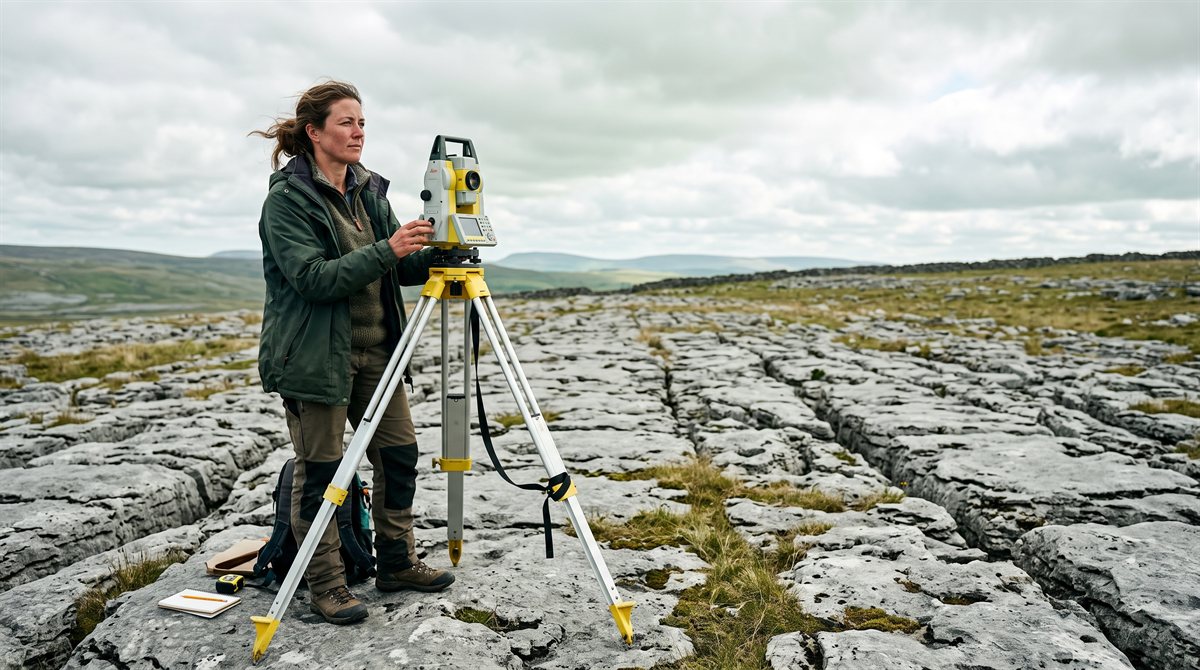
Sorcha Shepherd holds the croft adjoining Órla's, on the far side of a grazing boundary the two households disputed, comfortably and without resolution, for the better part of a decade — the ordinary weather of clan life in the Boirinn Uplands, and the dispute Órla was still narrating on the climb the last afternoon her daughter ever walked the hill. Four days a week Sorcha is elsewhere: a cartographic surveyor with the Union Land Registry, the office that has been measuring Tír na nÓg's townlands since before the Union had a fleet, and filing the measurements whether or not they agree with the ones before.
It is the registry that taught her the distinction her clan would later need: that a record can be wrong, and a record can be unfinished, and the second is worse, because nobody argues with it.
The Notification
The word that came up the hill in mid-autumn 2831 was official, brief, and complete in the way only an incomplete account ever is: catastrophic boundary failure, vessel not recovered, Line Captain Shepherd's position logged at the failure point. The uplands translated it the way civilians translate that sentence everywhere — an explosion — and the abruptness did the rest. A woman who had walked the flock line in early autumn was, by mid-autumn, a coordinate string and a hero's citation, delivered by a liaison officer who could not answer the second question anyone asked him, because the inquiry record was open on Threshold Station and closed to everyone standing in that kitchen.
The clan's arithmetic was short and it did not balance. Home in early autumn. Ranger surveyors asking after the uplands by winter — polite, credentialed, and unwilling to say why. Lost in between, eleven hours from anywhere, with no wreck to stand beside and a citation instead of an account. Some of the holding's people said cover-up out loud, at the council house, more than once. Órla, who had spent a lifetime declining to invent reasons, refused to join them and refused to correct them, which everyone present understood was not the same as disagreeing.
Sorcha did not say cover-up. She said, in the registry's own vocabulary, that the file did not close — and then, because that is what her trade does with a file that does not close, she went and walked the ground.
What the Registry Held
Her cousin, she understood later, could never have done what she did next, and it had nothing to do with ability. A Line Captain cannot quietly walk her own family's land with an instrument, because nothing a Line Captain does is quiet: the survey arrives with her name on it, and the name arrives with the Corps. A registry surveyor pulling her own townland's files is, by contrast, the least remarkable event in the building. Nobody looked twice. That was the whole of her advantage, and she has since heard enough about her cousin's career to know exactly what the family resemblance is worth: one of them was underestimated into a command track, and the other was underestimated into an archive, and neither of them wasted it.
What two centuries of the registry's own paperwork held, once she stopped reading it as paperwork:
- The Hollow does not survey. Every measurement of the Shepherd croft since the first Union chains returns a different distance from the house to the Hollow's edge, each filed as correcting the last, none ever questioned. Correction is what a registry does; it took a Shepherd to notice that the corrections never converged.
- Somebody had noticed before, once, and been tidied. A land-survey entry generations old recorded the pale wood's leaf behaviour and was filed under general flora anomaly — a clerk's phrase doing then what clerks' phrases always do, making a question look like an answer. It was never flagged for follow-up. It sat in the registry the way the sixth report sat at Eden: unread, correct, and waiting.
- Her own instruments agreed with neither of her own instruments. At the Hollow's edge, a certified rangefinder returned two distances on successive passes, both inside tolerance, both stamped valid. She logged both readings and attached the calibration certificate before anyone could ask for it, on an instinct she could not have named and her cousin could have.
By the spring of 2833 she had assembled, from civilian records and her own boots, what six generations of the holding's women had kept rules about and what the Survey Corps' fleet bulletin had reduced to an unattributed coordinate string: the Hollow is a thin place — ground where the distance between things is a matter of ongoing negotiation rather than fact — and the clear water, the uncut pale wood, and the dusk rule were never customs. They were operating procedures, kept by people who had the discipline before anyone offered them the theory. The registry's file on the townland now closes. She is the one who closed it.
What the Solving Proved
The part Sorcha did not expect was what the solving showed her about her cousin.
She found the fleet bulletin's trail in the end — the Boirinn coordinate flagged for formal survey priority ten days before Dock Seven, grounds citing a documented marker class and nothing else, four clean lines that disclosed no name, no croft, and no six generations. She read those four lines the way she reads a boundary stone that has been reset flush and true, and understood that the flag was her cousin's, that her cousin had known, and that the flag had been built so the family would never appear in it. The clan's suspicion had been aimed at the Corps hiding what killed her. What Sorcha could actually prove was smaller and harder to say at a council house: her cousin hiding what she loved, inside a record built to be second-guessed, so well that it took another Shepherd two years to see the join.
What she has never solved, and says so plainly, is Dock Seven itself. The public account of why every other soul came home rests on superior protocols and practical boundary knowledge, and Sorcha has read enough tidy corrections to say in public exactly what she says about it: not that it is false — she cannot show that — but that it is incomplete, and that an incomplete account filed as a complete one is the only kind of record she has ever known to stay wrong forever. The inquiry file is open on Threshold and closed to her. She keeps her copy of everything anyway, the way the registry taught her: a survey that will not close is not finished. It is waiting for somebody to walk the ground again.
Character Notes
The grazing dispute with Órla was never settled and never mentioned again after mid-autumn 2831; the two households simply began moving each other's strays back without comment, which in the Boirinn Uplands is a treaty.
The Survey Corps team that finally walked the Boirinn coordinate found the registry had sent someone first, with two centuries of local data, better boots, and a standing rule about being off the ground by dusk that she declined to explain and they, to their credit, kept. Her data went into their file; their instruments confirmed hers; neither party recorded who had been more surprised.
A note on naming, for anyone cross-referencing the roster: Sorcha Nic Dhiarmada, valley warden of Gleann na gCaorach on Drithane, shares this Sorcha's given name and — more confusingly — her family's trade, being a shepherd by occupation where Shepherd here is a surname six generations old in the Boirinn Uplands. The resemblance is the entire relation. No descent, no branch of the holding, and no contact of any kind is recorded between the Boirinn croft and the Drithane valleys, and the coincidence should not be allowed to imply one. Sorcha Lichata, the itinerant healer, carries the name as well and is likewise no relation.
See also: Tissadelle Shepherd, Órla Shepherd, Sorcha Nic Dhiarmada, Sorcha Lichata, What the Hill Keeps (S05E02C01), A Fraction of a Second (S05E02C02), Dryadic Trees, Tír na nÓg.
Discussion
Show discussion
Comments are read after they are posted and anything unsuitable is removed. Posting needs a GitHub account; reading needs nothing.