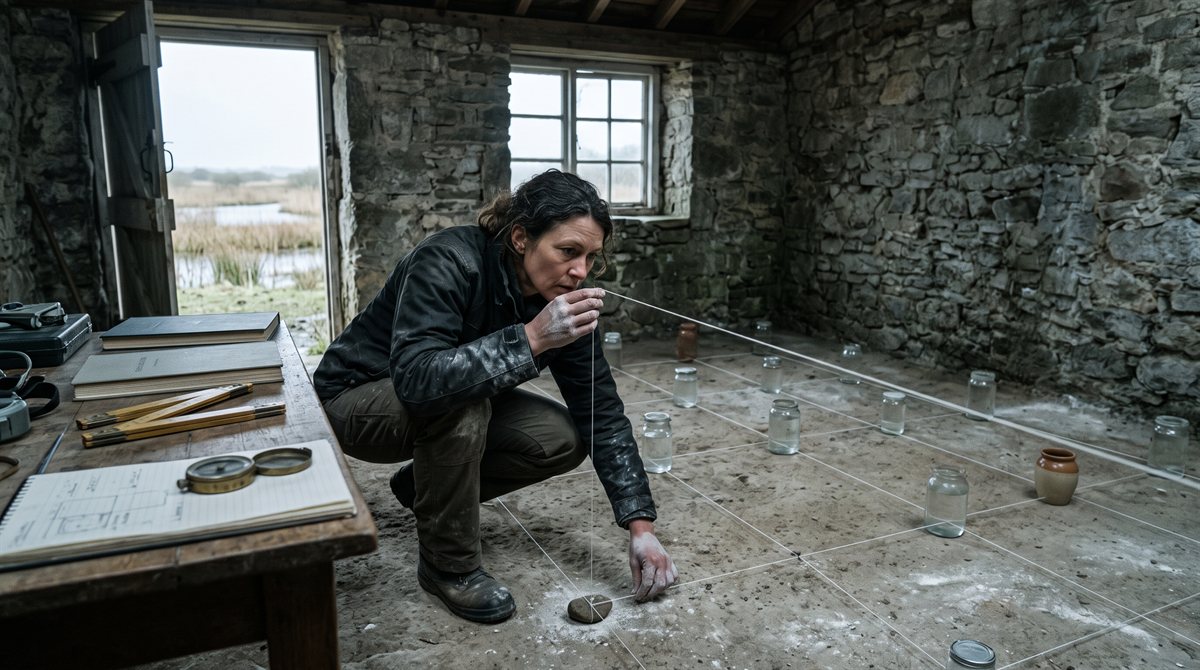
Elvira (Person, kind not established, later called 'the Enchantress')
- Time
- 2826 UCSD, Late Autumn, Before Dawn
- Location
- Marsh Causeway, Sub-station Outpost
Elvira dreamed that she did it, and knew it for the first thing wrong with the dream before she was awake enough to know she had been asleep.
In the dream the chalk took. That was how the village believed it went: the Enchantress draws the line, and the line does what she wants. In the dream it went that way. The circle held on the first setting, which circles did not, the thread ran down into the chalk and the chalk into the ground and the ground answered, and Aldera, who had been sitting outside the ring matching nothing, stood up inside it. Stood. On two legs, at the height of a person, the tabby markings gone to a coat and the paws gone to hands, and the face still a cat's face, level with her own, wearing the expression Aldera kept for people who had made a decision about her without asking.
Elvira had, in the dream, been pleased. That was the second thing wrong with it.
She woke in the cold hour before the marsh light, and did what she did with a failed circle, which was to take it apart in order rather than all at once.
The mechanism first. A working did not take on the first setting. It did not take on the fourth. It produced a measurable result or it did not, and the result was never a shape, because Etheric structure expressed through the substrate and a cat was not substrate. The working in the dream had been the village's working, the one she had spent three years declining to be credited with, and the dream had handed it to her whole and let it run. She noted that she had recognised it as the wrong mechanism even while it was working, and had not stopped.
The shape second. A cat was not a person standing up. Whatever the marsh was loose about, the world was strict about that: she had been told as a girl which shapes it kept and which it did not, by someone who was careful about such lists, and a person's frame on an animal's face was on the second list, near the top. The dream had built it anyway, and built it well. That was the part that would have frightened someone else. It did not frighten her; it interested her, in the exact way a well-made forgery interested her, and she set the interest aside because it was not the point.
The pleasure third, and last, because it was the one that was hers. She had wanted something that could speak to her. She had wanted it enough that a dream had made it out of the only other person on the causeway, and she had stood in a chalk ring and been glad of it.
The outpost was Type II oscillatory and the Interval was narrow here. Dreams at a thin place were on the record; her predecessor's books held eleven, and hers now held one. The doctrine on them was short and she agreed with it: weather, not a message, and never evidence about who sent it, because nothing did. The marsh had supplied the strangeness. She had supplied the wanting.
She wrote it in the record book, under the date, in the column for observations she had not intended to make. Dreamed a working that took on the first setting and changed the shape of a person to suit me. Mechanism was the village's. Wish was mine. No action. Then she went out to the stones and reset the circle, which failed, correctly, as it had the night before.
Only one of the two things she had supplied and been supplied with was on the list of what she was here to measure. She measured that one.
Discussion
Show discussion
Comments are read after they are posted and anything unsuitable is removed. Posting needs a GitHub account; reading needs nothing.