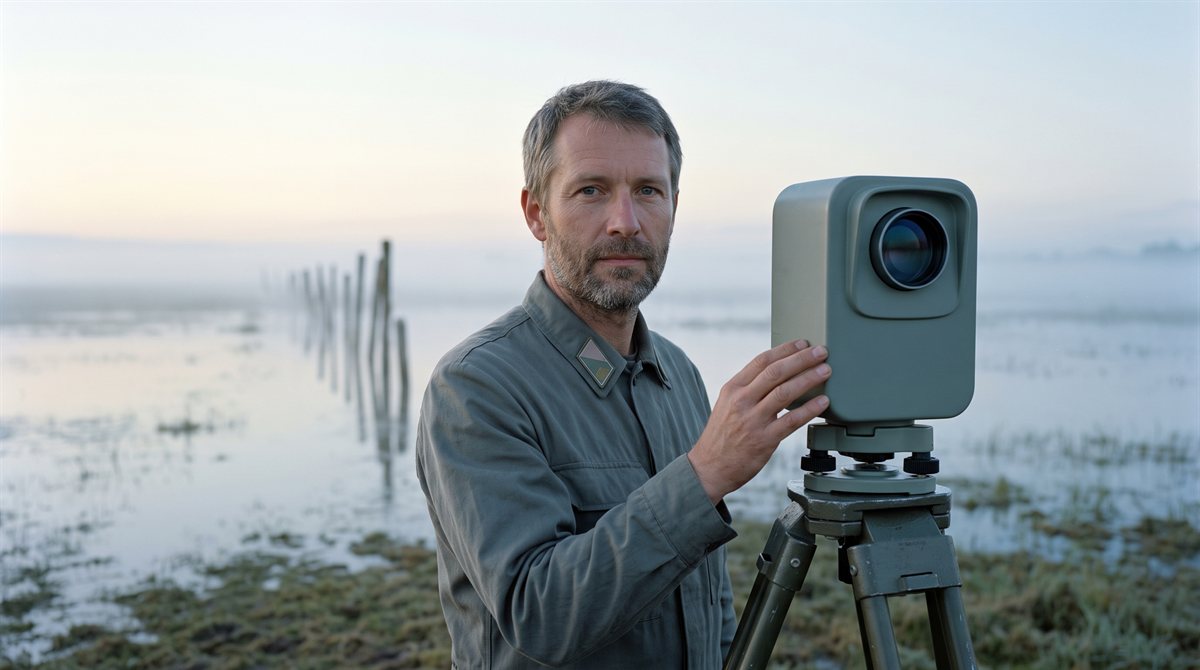
Sir Galahad Thorne (Human)
- Time
- 2826 UCSD, Late Autumn, Morning
- Location
- Threshold Station, Transit Ring
The leak alarm didn't sound like an alarm at first. It started as a stutter in the overhead strip lights — two flickers, a held breath of normal, then a third — and Thorne had spent enough years at boundary-proximate postings to know that rhythm meant a system deciding whether a fault was real before it committed to telling anyone.
It decided. By the time he reached the transit ring, the stutter had become a full station alert, klaxon and all, and the decision had apparently been made without him.
Section G had sealed correctly — one of the parts of this day nobody was going to have to be ashamed of, later, when the report got written. But a hull-fitter named Petrenko, three minutes from the end of his shift, had been on the wrong side of the inner door when it closed, and was now losing air on a schedule nobody in this room controlled. There was a service corridor route. It would take six minutes to walk. Rook-7's estimate for useful consciousness on the trapped side of that door was under three.
Thorne did the arithmetic once, the way he did every arithmetic that mattered — not to be sure of the answer, but to be sure he wasn't flinching from it. Six minutes did not fit inside three.
Dr. Iona Vale was already at the ring console when he arrived. No wasted motion getting there, which told him she'd started moving the instant the alert cleared her own desk, not the instant someone remembered to call her. She was reading the corridor feed with a stillness he'd learned to recognize at exactly one other kind of table: the stillness of someone doing arithmetic that killed people if it came out wrong.
"Can we move him?" he asked.
"Only if I keep visual lock." She didn't look up. "Direct line of sight, this ring to his endpoint. I am not placing a body I can't see arrive."
She pulled one camera feed, discarded it before he'd finished reading what was wrong with it, and switched to a manual optical channel routed through an emergency inspection port that had sat in six years of maintenance logs as decorative. Her jaw set.
"I have a lane," she said. "Narrow. Unstable. If that particulate plume crosses it before the pulse completes, the lock fails, and I am not doing this twice inside a minute to find out what that costs him."
He looked at the power board instead of asking her to repeat any of it. The transit draw request was already climbing past what he could authorise without a second signature — a rule that existed for good reasons on every ordinary day, and was, today, precisely the kind of exception the charter's own drafters had built room for and then made him personally responsible for using correctly.
"How much does this cost us?" he asked, because the question mattered, and because asking it aloud was the only apology he had time to make in advance.
"Enough that life support notices if you make me do it twice."
He keyed the authorisation anyway, and did not let himself imagine, until considerably later, what the other answer to that question would have cost the man on the far side of the door.
Discussion
Show discussion
Comments are read after they are posted and anything unsuitable is removed. Posting needs a GitHub account; reading needs nothing.