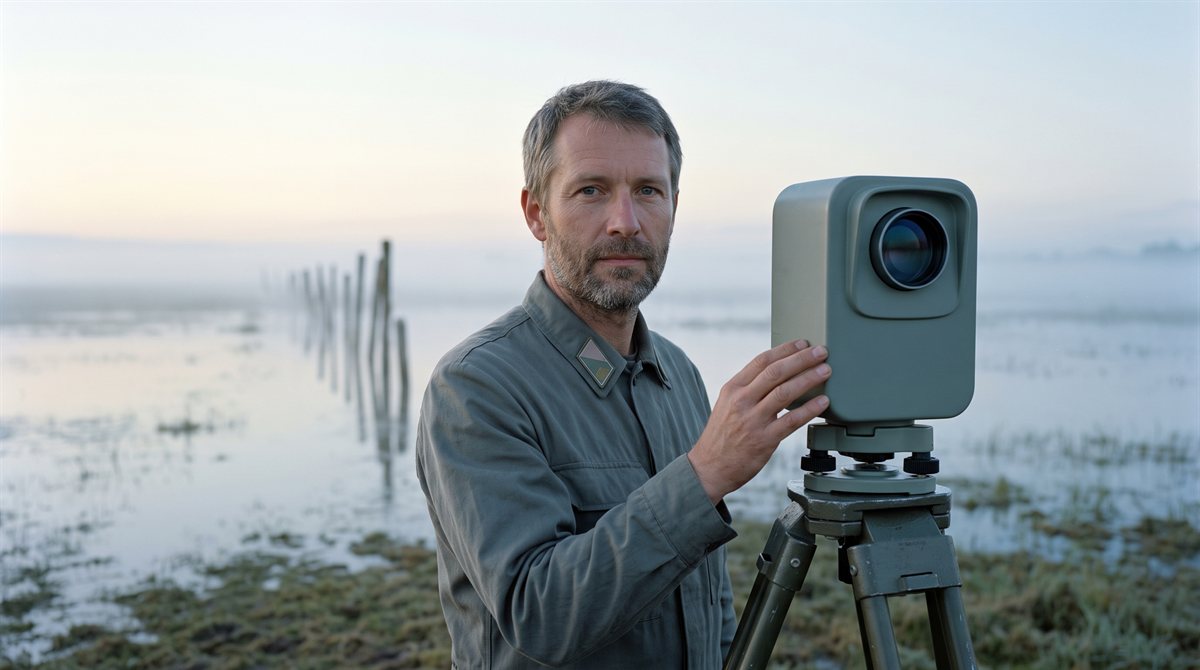
Sir Galahad Thorne (Human)
- Time
- 2826 UCSD, Late Autumn, Morning
- Location
- Marsh Causeway, Sub-station Outpost
He had brought the rest of the file because he had said he would, and because a man who discloses everything except one thing has not disclosed everything.
The outpost in daylight was smaller than it had any right to be. Chalk in jars, sorted by grain. Thread on a rack, by weight. Water in four vessels, and a written note beside each saying where it had been standing and for how long. Twelve years of reading other people's field records had taught Galahad to tell the difference between a person who kept order because they had been trained to and a person who kept order because disorder cost them something. This was the second kind.
Elvira read the last of the survey pages the way she had read the first of them: fast, without comment, going back twice.
"You had all of this in the third week," she said.
"I did."
"You could have brought it in the third week."
"I could have."
She let it go, which he had expected. It was not the thing she was annoyed about, and she was precise about her annoyances.
What she was annoyed about was on the table under her own hand, in her own writing, in the plain vocabulary she insisted on: That should have been harder. Find out why it wasn't.
Galahad had read it upside down when he came in, and had been holding the same thought since, and was not going to say it.
Because he knew one reason it might not have been harder. It was not a good reason. It was not evidence. It was a memory of a terrace garden at a house called Dún Rí, in 2806, when he was seventeen and had gone with his father on an errand about a boundary of the ordinary sort — a field line, a wall, an argument two families had been having politely for a century.
He had wandered off the terrace, because he had been seventeen. There had been a gate at the bottom of the garden and something wrong with the light beside it, and he had said so out loud, in the word his own household used, which was a folk word and meant nothing.
And a young woman on the step had said: No. Look at what's under it.
He had said he did not know what was under it.
She had said, The layer underneath. It moved. Not the ground — the layer underneath the ground. Watch it again and you'll see it isn't the light that's wrong.
He had watched it again. She had been right. It had taken him eight more years to join the Survey Corps and another decade after that to meet anyone else who talked that way, and he had never once, in twenty years, found the phrase in a manual.
He had used it on this causeway, in the mud, at their first meeting, on purpose.
She had looked at him as though he had produced it from nowhere.
Discussion
Show discussion
Comments are read after they are posted and anything unsuitable is removed. Posting needs a GitHub account; reading needs nothing.