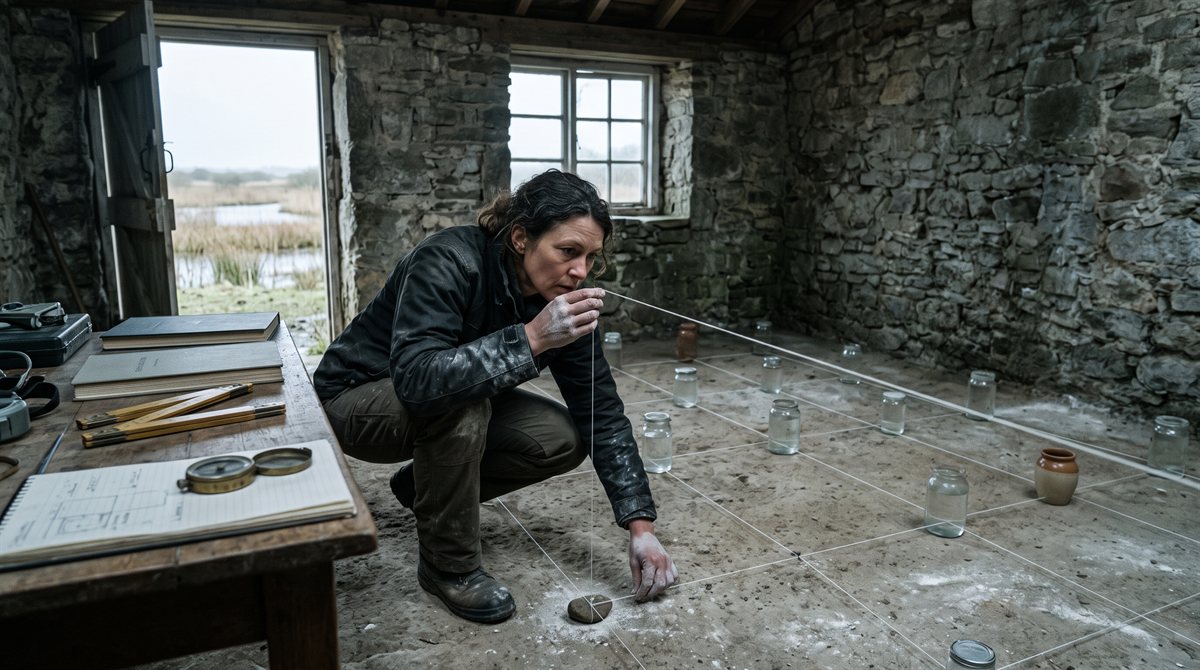
Elvira
- Time
- 2826 UCSD, Late Autumn, Morning
- Location
- Marsh Causeway, Sub-station Outpost
The survey man had a tell, and Elvira had been three weeks working out what it was.
It was not deception. She had grown up around people who lied for family reasons and could recognise the shape from across a room, and this was not that shape. It was closer to the way a person holds a cup they have already decided is too hot: a small, constant management of something they are not going to put down and not going to mention.
He asked questions he already had answers to. That she had noticed in the first week and filed as ordinary — half the Survey Corps did it, checking a witness against the record without saying so.
What was not ordinary was the vocabulary.
He used her words. Not the Corps' words, which she had learned to translate into and out of. Hers — the ones she had built for herself out of nothing, in an outpost, alone, over three years, because the official glossary had no term for a thing she could measure. The layer underneath. Pattern substrate. A working that needs a monument hasn't finished.
She had assumed, at first, convergence: two people looking at the same mechanism long enough will arrive at similar language, the way two smiths arrive at similar tongs. That was a reasonable model and she had held it for a fortnight.
It had a defect. Convergence gets you the same idea in different words. It does not get you the same words.
"Where did you learn to talk about it like that?" she asked. She had asked before, in the mud, without her voice, and he had declined to answer an expression, which was a thing a person could do honestly.
He looked up from the file. He took slightly longer than the question needed.
"From someone better at it than me," he said. "A long time ago."
"A teacher?"
"No." He squared the pages. "She wasn't teaching. She just didn't like the word I'd used."
Elvira waited, and he did not go on, and she found that she had stopped reading the page in front of her.
She did not experience deep fear. She had understood for years that this was structural rather than earned, and she had built a practice on top of it that required standing in a Type II oscillation and continuing to take measurements. It was very rarely inconvenient.
It was inconvenient now, because it meant that whatever had just moved through the room had to be identified some other way than by how it felt, and she had nothing to identify it with except a man being careful.
Discussion
Show discussion
Comments are read after they are posted and anything unsuitable is removed. Posting needs a GitHub account; reading needs nothing.