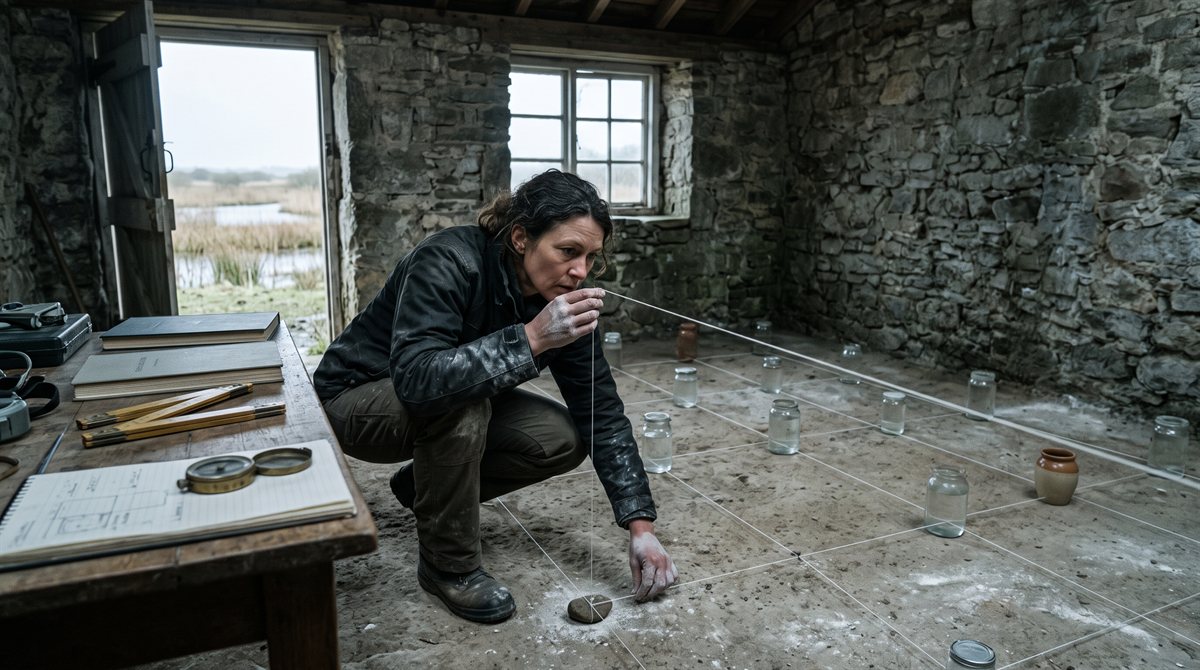
Elvira (Person, kind not established)
- Time
- 2826 UCSD, Early Winter, Evening
- Location
- Marsh Causeway, Sub-station Outpost
They came out along the causeway at the hour when the stones stopped being warm, and Elvira knew before they reached the outpost that something had been signed.
Not here. The causeway was quiet in the way it had been quiet since the grove, which was the ordinary way, and she had stopped checking it a week ago and then noticed that she had stopped, and filed both. Whatever had been signed had been signed somewhere else. Thorne carried it the way he carried everything he was not going to say: the cup too hot, held level.
The Krenyi analyst carried nothing she could read at all, and Elvira noted that too, because it was unusual for her not to be able to read a person, and because she did not find it uncomfortable.
"We want the books," Syra said, at the door. No greeting; Elvira had not expected one and would have revised her model of the analyst downward if one had come. "The ones from before you. The station's forty seconds is older than the station's file. Yours is older than the station."
"Mine is older than me," Elvira said. "Come in."
She took the predecessor's books down from the shelf above the water vessels. Eleven volumes, the hand getting worse across them, the last one stopping in the middle of a page. Syra took the first and sat down with it at the composite table and became, immediately and completely, a person reading, and did not move again.
Thorne stayed in the doorway. He looked out at the stones.
The light was going. It went differently here in winter, not down but sideways, and the old post at the end of the causeway, the one the reeds had half taken, did the thing it did at this hour, which was to stand in a light that was not quite the light everything else was standing in.
"There," Thorne said. He was tired enough to be talking to himself. "By the post. Where it's —"
And he said the word.
It was a folk word. It meant nothing. It was the word the kitchen at Dún Rí had used for a draught with no door behind it, for a candle that leaned the wrong way, for the places on the terrace where the cat would not sit. She had used it herself, once, when she was small, and the household sage had looked at her over whatever he was writing and said: Not that. That word is for people who have decided not to look. Look at what's under it. The layer underneath.
She had not liked the word since.
She had not liked it on a terrace step in 2806 UCSD, in the last of an autumn afternoon, with a boy of seventeen standing at the bottom of the garden with his hands in his pockets saying it about the light beside the gate — the badly sited gate, the one with the latch, where the cat would one day stand for one breath and then turn the other way. His father had been in the house with the warden about the field line. The field line had been an argument for a century and would be one for a century more and nobody on either side minded very much, which was why it was still an argument. The boy had wandered off the terrace because the field line was not interesting and the garden was. He had looked at the light by the gate and said the kitchen's word for it, in the voice of someone who had been taught the word at a kitchen table too, and she had been annoyed in the exact and limited way she was annoyed now, twenty years later, in a doorway on a marsh.
No, she had said. Look at what's under it.
I don't know what's under it.
The layer underneath. It moved. Not the ground. The layer underneath the ground. Watch it again and you'll see it isn't the light that's wrong.
He had watched it again. He had been right to; it had moved again; she remembered that he had not said anything clever about it afterwards, which she had thought well of, and that his father had called him from the house, and that he had gone.
That was all. She had not kept him. She had not kept the afternoon. There had been no reason to; he was a boy from a house across a field line, and the light by the gate had been doing that for years, and nothing he had said or she had said had done any work. She had not forgotten it, because forgetting was a failure of keeping and she had never undertaken to keep it. It had simply not been there, until a tired man in her doorway used the word, and then it was there whole, with the step cold under her and the smell of the roses that had no business blooming so late.
Elvira stood very still in the outpost and did what she did with a failed circle, which was to take it apart in order.
The man first. He was the boy. The beard and the twenty years and the Corps had not changed the thing she had noticed on the step, which was that he looked at a wrong thing twice before he said anything about it. She had revised her model of him upward three times in the autumn for that quality, and had not once thought to ask where he had learned it. She had assumed six stations. It had been one garden.
The words second, and this was the part she minded. The layer underneath. She had written, in her own hand, in her own record, that she had built her vocabulary alone at this outpost out of nothing, because the official glossary had no term for a thing she could measure. She had believed it. It was wrong in the one way she cared about: not the idea, which was hers, but the words, which were not. The words were the sage's. She had been given them as a girl, had given them from the step to a boy at the bottom of the garden because he had used a word she did not like, had come to an outpost seventeen years later and found she needed a term, and had reached for the one that was there and called it her own. It had been a reconstruction. She had filed it as an invention.
She noted, for the record, that it was the first time in three years she had been wrong about a word.
The third thing she took apart last, because it was the one that was hers. She just didn't like the word I'd used. He had said that at this table, a month ago, with the file squared under his hands, and she had stopped reading the page in front of her and had not known why. She knew why now. He had been carrying it for twenty years, through six stations and a marriage he did not talk about and a Corps that had no entry for the phrase, and she had let it go before his father's voice had finished calling him in.
Behind her, Syra turned a page.
Discussion
Show discussion
Comments are read after they are posted and anything unsuitable is removed. Posting needs a GitHub account; reading needs nothing.