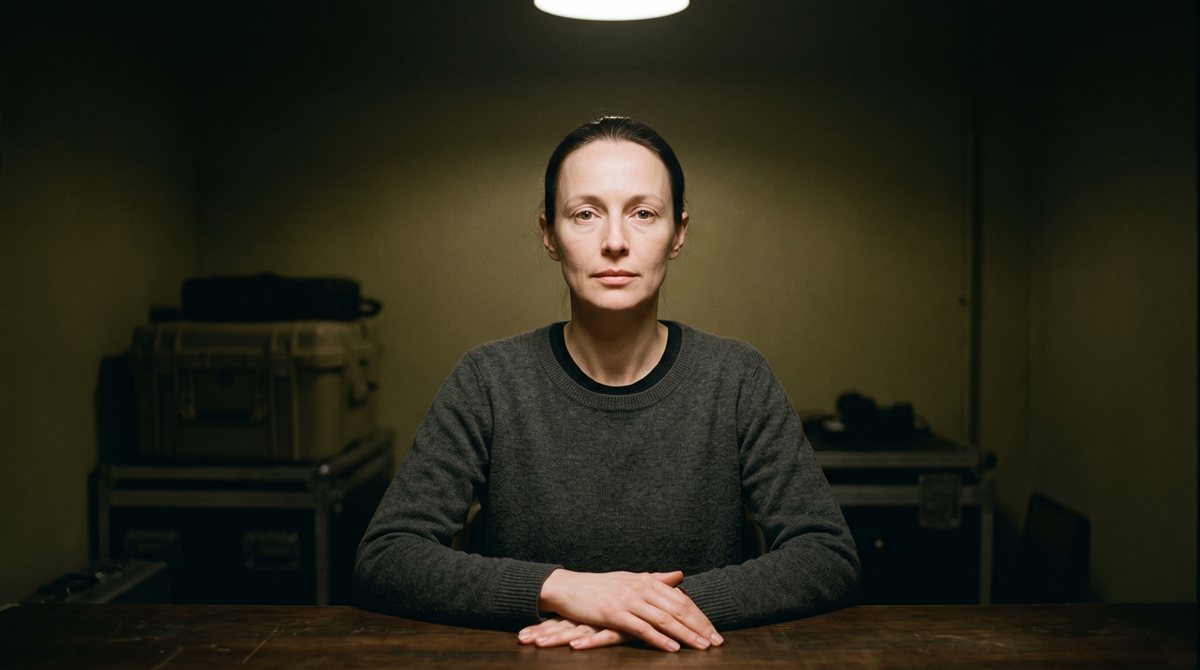
Syra (Krenyi)
- Time
- 2826 UCSD, Early Winter, Evening
- Location
- Marsh Causeway, Sub-station Outpost
The predecessor had been a careful keeper and then had stopped being one, and Syra could date the change to within a season from the hand alone.
That was not what she had come for. She noted it and kept reading. The books were measurements: water levels in four vessels, the phase of the moon against the state of the stones, the dreams, which the predecessor had entered in the same column as the weather and which Syra approved of entirely. The forty seconds was not in them. Nothing in them was forty seconds. The outpost had never kept a clock good enough to notice, which was itself a finding, and she wrote it down.
She was aware of the room, because she was always aware of the room; it cost her nothing and she had never learned how to stop.
Thorne was in the doorway doing what humans did after a Pelagos Minor, which was to stand somewhere quiet and be unable to use it. He had signed the word success with a hand that was not steady and had noticed it was not steady and had signed anyway, and Syra had thought better of him for the whole sequence and said nothing, because it was his and not a measurement. Now he had said a folk word at a post, and the practitioner had gone still.
Syra knew stillness. It was the first thing anyone noticed about her people and the last thing anyone understood, and she had spent most of a hundred and fifty years watching humans read it as composure, which it was not, or as coldness, which it was not, or as a surface with nothing under it, which was the human report about the human. So she was exact about what she was watching now. The practitioner had not frozen. Freezing was a startle that had failed to resolve into movement. This was the other thing: a body that had stopped shifting because shifting was noise, so that whatever it was reading could be read clean.
The lamp on the table guttered, the way lamps did here when the stones changed temperature, and Thorne's shoulders came up a finger's width before he knew they had, and the practitioner's did not. She turned her head toward the lamp at the speed of a decision rather than a reflex. Then she turned it back.
Syra had a reading. She was clear with herself about the word. A reading was what the body returned; a finding was a measurement with error bars that would stand in an inquiry, and there was no instrument in the Survey Corps or out of it that measured what she was reading, and she was the last person in the room who would offer one as if there were. She filed it where she filed sensations: as hers, unsupported, and not for the record.
There was a second reason she would not say it, and it was not professional. What are you, really was the one question her people declined, every time, in every register it was asked in — not out of secrecy, since a Krenyi asked said plainly that there was an answer and that they would not give it, but because the question read a person backward from a kind and stopped attending to who was in front of you. She had declined it for a century and a half. She was not going to put it to anyone else. Whatever this woman was, she was the person who had kept these books in this order and had taken an anchor out of a grove in one attempt, and that was what was present, and Syra attended to what was present. It was the whole of her courtesy.
The practitioner came to the table and sat down across from her, and said, without preamble, which Syra also approved of: "I had something wrong in my record. I want to correct it while I know what the correction is."
"Say it."
"The phrase I use for the substrate. The layer underneath. I wrote that I made it here, alone, out of nothing. I didn't. I was taught it as a girl. I gave it to him" — a tilt of the head at the doorway, no more — "twenty years ago, and came here and built it again and thought it was mine."
Syra considered this on its merits, which was the only way she considered anything.
"Does it still do work?"
"Yes."
"Then it's yours now. A term belongs to whoever is measuring with it. Where it was made is a fact about the past." She turned a page. "Write both. The correction and that it costs you nothing."
The practitioner looked at her for a moment — not long, and not in the way humans looked at Syra when they had just decided she was unkind. Then she said, "It does cost me nothing," in the tone of someone confirming a reading against a second instrument, and took her second book from the shelf and wrote.
A human told that a thing they had believed their own had in fact been given to them generally did one of two things, in Syra's experience, and both of them took a while. This woman had done neither. She had taken the correction, checked it, filed it, and gone on, with nothing in her hands or her shoulders to show that anything had been set down.
Syra had watched that done before, at tables where everyone present answered to Nai. She did not say so. It was a reading, and she did not file readings, and the woman across the table had not asked.
Discussion
Show discussion
Comments are read after they are posted and anything unsuitable is removed. Posting needs a GitHub account; reading needs nothing.