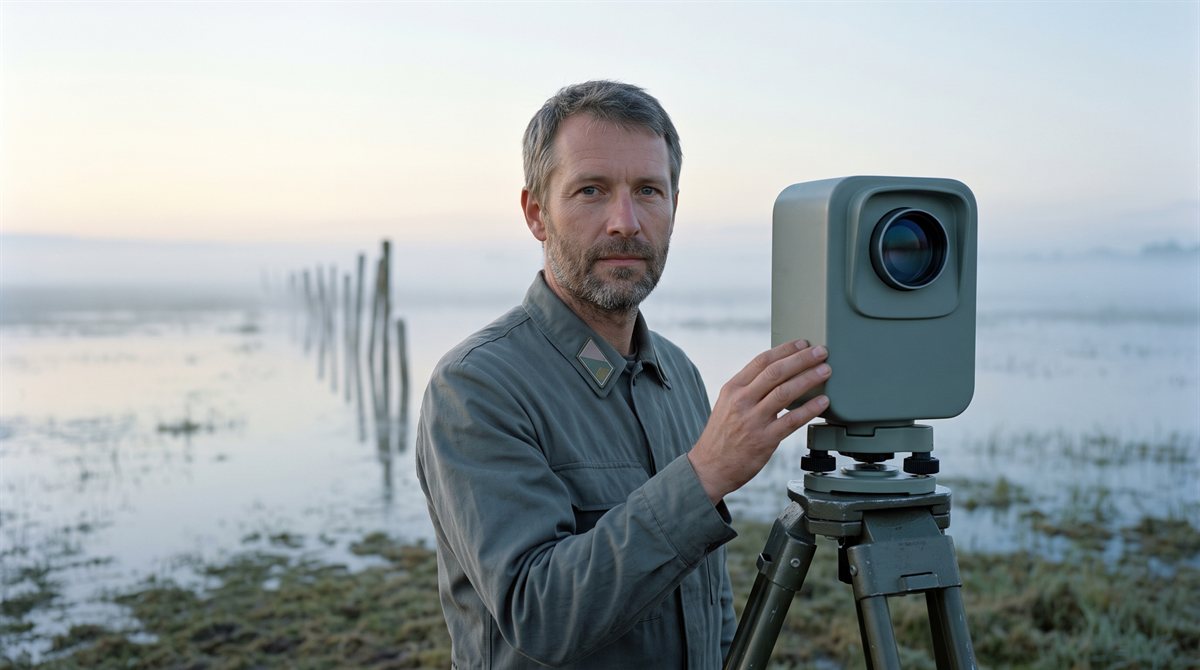
Sir Galahad Thorne (Human)
- Time
- 2826 UCSD, Early Winter, Evening
- Location
- Marsh Causeway, Sub-station Outpost
She came to the door when Syra had the fourth book open and the light was gone, and stood beside him looking at the post, and said: "I was on the step."
He did not say anything. He had been waiting a month for this sentence and had not once imagined it would arrive as a statement of fact about geography.
"Your father was in the house about the field line. You came down the garden with your hands in your pockets and said the kitchen's word for the light by the gate. I didn't like it." A pause of the ordinary length. "I still don't."
"You remember."
"No." She said it carefully, the way she said anything she did not want misheard. "I didn't keep it. There was nothing in it to keep — a boy, a word, a light that had been wrong for years. You said the word again just now and it came back whole. That isn't remembering. Remembering is when you have been carrying something. I hadn't."
He thought about twenty years of carrying it. Six stations. A phrase he had used on purpose in the mud at their first meeting, to see what her face would do, and what her face had done was be impressed, every time, and he had received it every time as a thing he had failed to earn.
He had tried one other reading, in the third week, late, and he would put it in no report either. That the causeway had done it: that a Type II interface sitting under an outpost for three years could carry a person across the gap he had been failing to do the arithmetic on, so that the woman on the step and the woman in the mud were twenty years apart for him and not for her. It had lasted the length of time it took to open the manual. Oscillatory interfaces were non-displacing; the Corps had measured it on more membranes than he had postings, and the table said detectable, non-displacing in the same flat type it said everything. And her own account put her at Dún Rí in 2822, warden-heir, sixteen years after the step and four before the mud, which left nothing for a boundary to have skipped. The causeway had done nothing to her. It had been wrong about the right thing, that reading: the gap was real, and it was not in the time.
"I used it to test you," he said. "The phrase. More than once."
"I know. Aldera logged it." The smallest movement at the corner of her mouth. "She logs everything. She doesn't tell me unless I ask. I asked."
"And you were —"
"Impressed. Yes. Because I thought I'd made it and you'd arrived at it independently, which would have been remarkable." She looked at the post. "It wasn't remarkable. It was the same garden."
The reeds moved. The wind was ordinary here now, and he still noticed every time it was.
"I kept it for twenty years," he said, not as a complaint. It was simply the figure.
"I know. You shouldn't have had to." She said it in the plain voice, and he understood that this was what she had for an apology, and that it was a better one than most. "It was the sage's, not mine. I only passed it on. I've told the analyst and written it down. It's in the record now, where it should have been."
He found that he had nothing to add to that, which did not happen to him often, and that the thing he had been carrying since the third week was no lighter and no heavier, only shared, which was not what he had expected and was better.
Discussion
Show discussion
Comments are read after they are posted and anything unsuitable is removed. Posting needs a GitHub account; reading needs nothing.