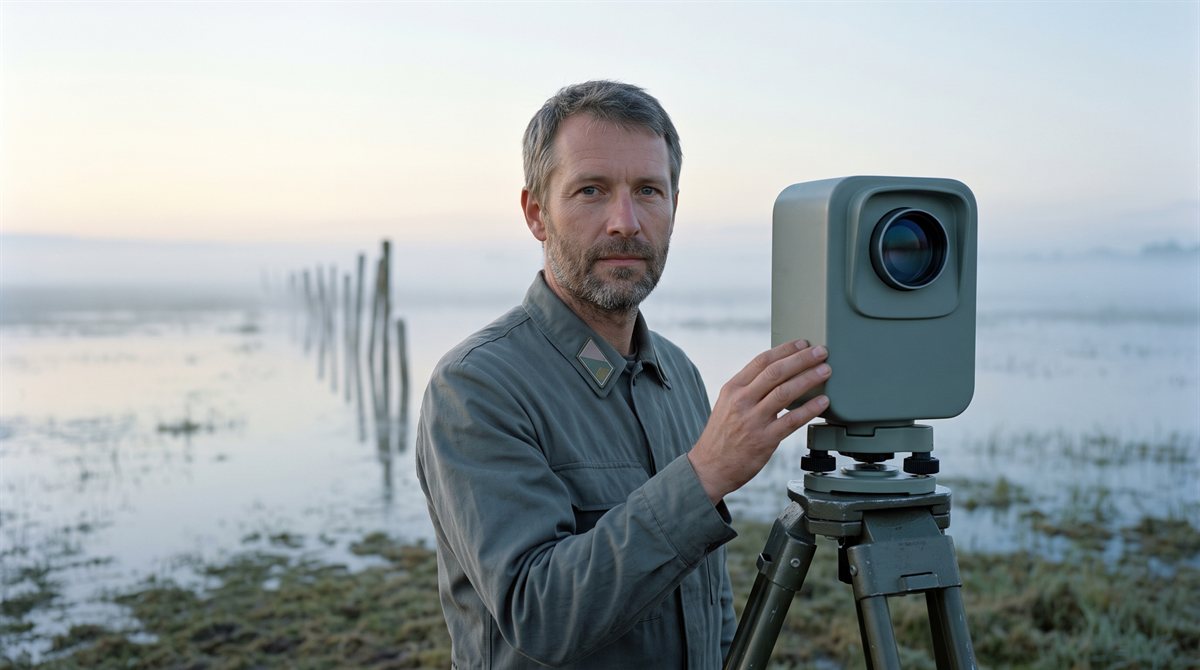
Sir Galahad Thorne (Human)
- Time
- 2826 UCSD, Early Winter, Morning
- Location
- Marsh Causeway, Sub-station Outpost
He brought the clock himself, because a thing the station had decided to lend was a thing somebody from the station should carry, and because the analyst's finding had been plain enough that he had not wanted it to sit in a file for a week before anyone acted on it. The outpost has never kept a clock good enough to notice. Syra had written it as a finding. He had read it as an instruction.
It was a field chronometer in a sealed case, the kind the Corps issued to a party that would be away from a station for a season, set that morning against Threshold's two clocks and carried along the causeway at a walk, with the case under his coat so the cold would not get at it before the wall did. The marsh in early winter was the colour of the sky, and the sky was the colour of the chalk, and the stones were dry and dark and did not look like anything.
Elvira had the niche cut before he reached the door. She had chosen the north wall, above the water vessels and their four notes, at a height she could read without stooping, and she had been at the chalk with a short blade since first light, by the look of the floor. The chalk here was not clean. It came out in soft white slabs with flint in it, and the flint came out when it chose to, in flakes with an edge on them a surgeon would have been glad of.
"It wants a flat seat," she said. "The bracket's wider than the case."
"The bracket's the station's idea of a wall."
"The station has never seen this wall." She was working one-handed, the other flat on the chalk beside the cut to feel it, and she did not look round. "Hand me the case. I'll offer it up."
He unwrapped it and gave it to her, and she set it in the niche, and it rocked, and she took it out again and went back to the chalk with the blade. He watched the flint come away. He had been going to say something about gloves — the Corps issued them with the chronometer, in the same case, for exactly this — and he did not, because she had cut a niche in chalk every winter for three years and he had cut none, and a man who had spent the autumn finding out how much he had not told her was not going to begin the winter by telling her how to hold a knife.
The flint went in under the heel of her hand. He saw it go, and saw her see it, and saw that nothing else about her moved: the hand came away from the wall, the blade went down on the shelf, point inward, and she looked at the cut the way she looked at a circle that had failed, for what it told her and nothing else. It was not deep. It bled the way a cut on the heel of a hand bleeds, generously and at once, and she had none of the cloth the Corps also issued and he had not brought, so she pressed the hand to her coat and said, "Take the case," and held it out with the other, and the case was wet where she had been holding it before the blade slipped.
He took it. He turned it to the window to see whether the blood had reached the seal, and it had not, and he set the case on the shelf and wiped it with his sleeve, and by then the back of his right hand had begun to sting.
He knew it before he had a name for it, which was the wrong way round for him and the right way round for what it was. The sting first. Then the place: the fourth of his six stations, a hatch rim with a burr on it nobody had filed, a Section Lead with her forearm opened to the elbow, and himself holding the dressing in place while the medic gloved, and not gloved himself, and the inside of his wrist coming up in a weal while the medic worked, and the Section Lead watching it with the interest she gave to any reading and saying, in the voice her people used for anything true, I told you in your first week. It fades. It had faded. It had taken two days, and he had been told the mechanism three times in those two days by three people, and once, before, by her, in his first week, as her people did, because withholding it would have cost someone something.
He looked at his hand. The skin where the case had lain against it was reddening along the line of the blood, and under the red a weal was coming up, as a nettle raises one, and it stung as a nettle stings, and he had felt it before, and the clinical file called it the plainest field sign there was, where no instrument was to hand.
He did not look at her. He looked at the hand, because the hand was what he had, and twelve years had taught him that what you had was what you described, and that the moment you began describing something else instead was the moment the report stopped being yours.
Twenty years. A face that had not moved a day inside them. A woman who had taken an anchor out of a grove in one attempt and written that should have been harder and meant it. The analyst gone still at the table in the lamplight while this woman turned her head toward a guttering lamp at the speed of a decision, and Syra, who filed nothing she could not support, filing nothing. He had declined to assemble it. He had told himself for a season that a pattern with a sample size of one was a thing you held, and he had been right, and the sample size had just changed on the back of his hand.
"Elvira."
"It's nothing." She had the hand away from her coat and was looking at it. "It's closed."
"Mine isn't."
He held it out, back uppermost, where the light was. She looked at it. Then she looked at her own, at the heel of it, where the cut had been, and where there was now a line shut and pink, the way a cut looks on its second day, in a hand that had been bleeding freely a minute before.
He said it plainly, because he had learned once, the expensive way, what it cost to leave the important sentence unsaid on the grounds that there would be a better occasion, and because there was not going to be one.
"I've had this before. Once. On a posting, from a cut I helped dress." He kept his voice where it was. "I was told what it was before it happened, by the person whose blood it was, because her people tell you early. The clinical file keeps it as a field sign. Where there's no instrument to hand." A pause of the ordinary length, which he made himself leave. "Krenyi blood, on a human's skin."
He stopped there. He had described what was on his hand and what the file called it. He was not going to describe her. He had spent twelve years teaching junior surveyors that the thing you were looking at and the thing you concluded were two entries, and that the second one was not yours to write on somebody else's page.
Discussion
Show discussion
Comments are read after they are posted and anything unsuitable is removed. Posting needs a GitHub account; reading needs nothing.