Elvira (Krenyi, learned here)
- Time
- 2826 UCSD, Early Winter, Morning
- Location
- Marsh Causeway, Sub-station Outpost
She had the hand up in the window light, his, and she read it the way she read anything, from the edge in.
The mark first. It lay where the case had lain, in the shape of the wet on the case, and nowhere else: the skin red along that line and raised a little, as if something had brushed it. She had seen a nettle do it. She had not seen a nettle do it in the shape of her own hand.
Her own hand second. She turned it over and looked at the heel of it. The cut was closed. It had closed by the time she had found nothing to press on it and pressed her coat there instead, which was how long cuts took to close on her and always had, and she had been told as a girl that she healed well and had filed it, young, under things a body did, some bodies better than others. She had never once turned it round. A thing that had always been so was a thing there was no reason to measure, and she had grown up in a house that was careful about which things got measured.
She did not take the third thing apart yet. She set it to one side where she could see it, because it was going to be the one that was hers, and she had learned at this table a week ago that the one that was hers went last.
The file third, then. She had read the Corps' general references on the analyst's people in the third week of the autumn, for the analyst's sake, the way she read the manual on any instrument she was going to have in the room. She remembered the sentence on fear. They do not experience the deep-fear response that shuts down clear thinking. She remembered reading it and thinking it a sensible way to put a thing she had never found a sensible way to put, and going on to the next sentence, which had been about fury. She had not turned that round either. It had not occurred to her to. She had been reading about the analyst.
The survey man was standing where she had left him, with his hand out and the sentence finished, and he had not added anything to it, and she noted that, because she had seen men add things to a sentence like that until there was nothing in the room but what they thought. He had said what was on his hand and what the file called it. He had not said what she was. She found that she had revised her model of him upward again, in the smallest increment she had, and that the model was now about as high as it went, and that she had nowhere left to file the revision but with the rest.
"The file," she said. "What does it want. For a finding."
"A sample. A medic. Not a hand."
"Then it'll have one. I'd rather it was a finding than a sign." She let go of his hand. "Tell the station. Tell the analyst first; she'll want it from the record and not from you. If there's a form, I'll fill it. If there's a receipt, I'll insist on one."
Something went across his face that she filed as the first thing he had found funny since Pelagos Minor, and he did not say what it was, and she let him keep it.
Now the third thing.
She had been nine. There had been a wall at Dún Rí, the terrace wall where the roses were, and a fall off it, and a knee opened on the edge of the step, and the household sage had dressed it himself because the footman had been sent for and the sage had been nearer. He had put on gloves to do it. Thin ones, the kind he wore for the glass. She had asked why, because she asked why about everything then, and he had said the salve stained, and had dressed the knee, and the knee had been closed by supper, and she had been told she healed well.
She did not know whether the salve stained. She had never seen it on anything.
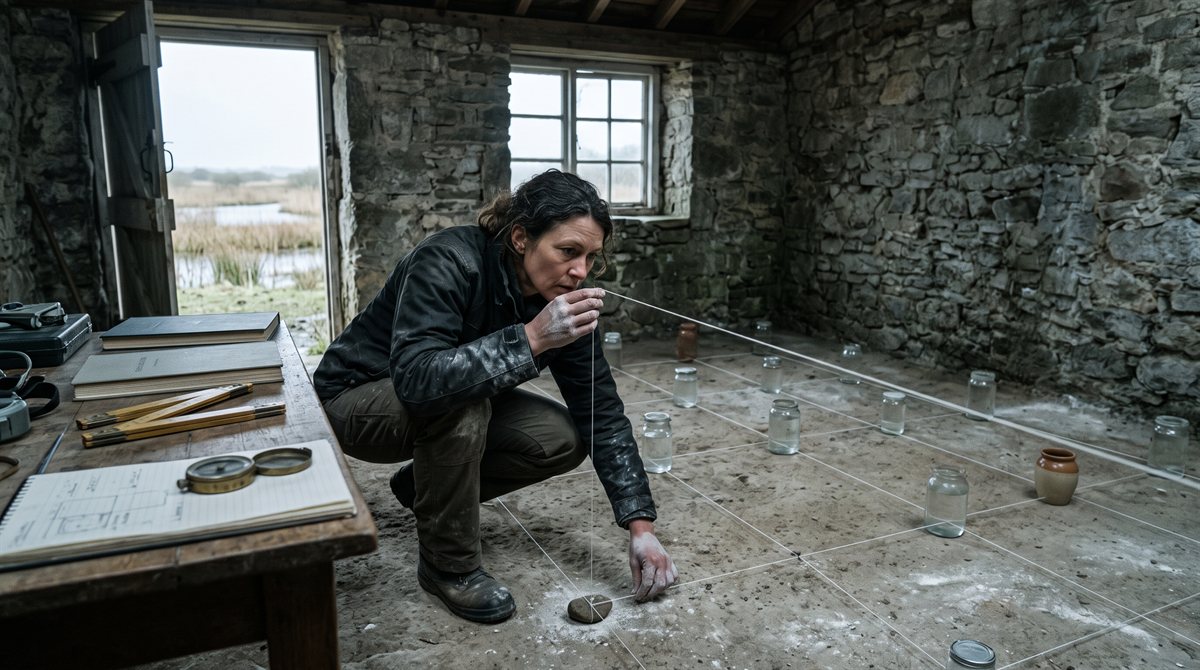
She stood in the outpost with the chalk dust on the floor and the clock on the shelf and took that one apart as far as it would go, which was not far. The sage had put on gloves. He had given a reason. The reason might have been true. He had been of the house, and the house had lied, for family reasons, in a shape she had known from the inside the way one knows a draught, and she had never known what the lies were about, and she had checked a week ago at this table whether any of it had been about her and had noted that it had not moved.
It had moved now. She was exact about how far. As far as a pair of gloves and a reason she had not tested, and no further; the sage was not in this room and the question was, and she had no instrument for what a careful man had known then, or had not, and had said or not said for reasons that were the house's. She noted that it had moved. She noted that she had checked. She noted, because it was true and because she did not like leaving a true thing out of the record on the grounds that it was hers, that she had wanted it to move, and had wanted it for some time, and that the wanting had been there under the three years and under the step, and that the survey man had not put it there, and had only, this morning, with his hand out, declined to look away from it.
She would not hide it. She found, checking, that she had not considered hiding it, which was not a decision; she had simply gone straight to the form and the receipt, and had noticed afterwards that there had been another road and that she had not seen it. She filed that too. It was a fact about her, and she was collecting those this morning.
"Give me the case," she said. "The seat's flat now. I want the station's time on that shelf before I write anything down, so I know what time I wrote it."
Discussion
Show discussion
Comments are read after they are posted and anything unsuitable is removed. Posting needs a GitHub account; reading needs nothing.