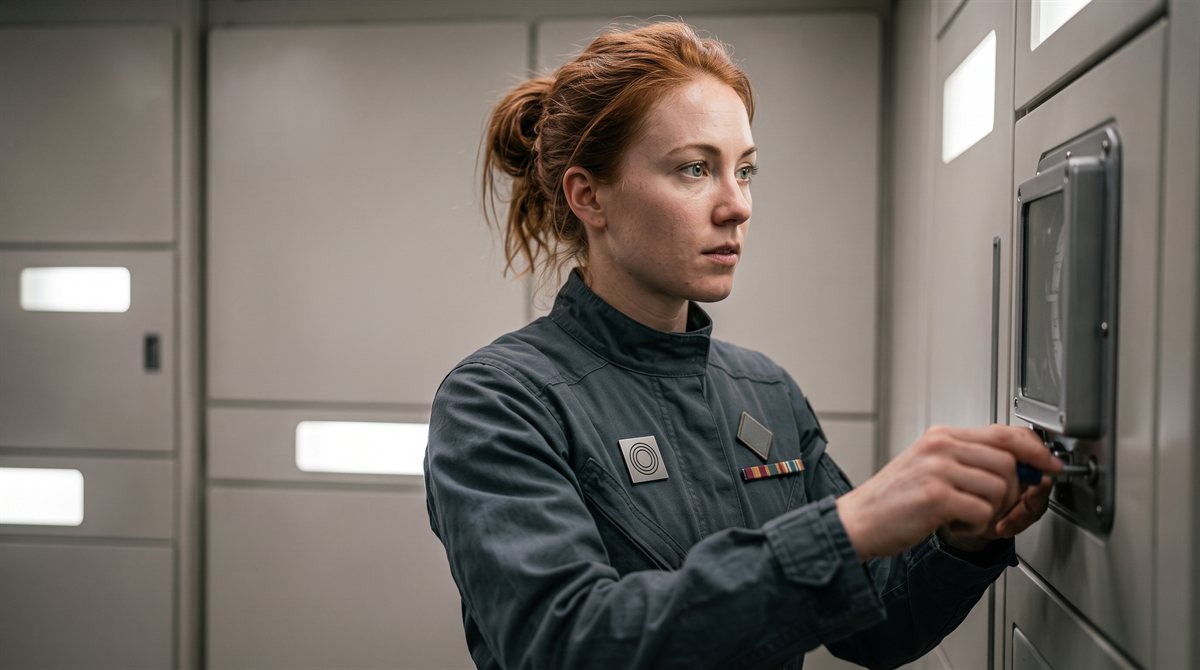
Principal Tissadelle Shepherd (Human)
- Time
- 2828 UCSD, Late Winter, Six Days Later
- Location
- Halyx Relay Station, Halyx System — Survey Corps Review Chamber
Six days was not long enough for a case this old, and everyone in the room seemed aware of it, which did not make the room any less uncomfortable to sit in.
There were three of them behind the review table and one of her in front of it, which was the standard configuration for a reclassification hearing and did not, on its own, mean anything. What meant something was the way the review chief opened with the transcript of her original log rather than the waveform itself: Recommend reclassification. Signal exhibits structured repetition with variation inconsistent with mechanical origin or degraded beacon function. Read aloud, in a flat procedural register that was not unkind, it sounded exactly like what it was — a Principal eleven days into rank, four hundred and twelve files into a shift, filing a professional opinion that happened to arrive by way of a headset instead of a spectrum display.
"Talk me through the method," the review chief said. Not hostile. Careful, in the way people are careful when they have already decided the finding is probably right and are still obligated to make sure it survives contact with a harder question than is it true.
She talked them through it. The four seconds. The phrase that came back eleven seconds later, almost the same and not quite. She did not say it sounded like music to the review board, because she had learned somewhere on the way here — she was not certain exactly when — that a Principal who wanted a finding to survive review did not hand a table of three careful people a sentence that easy to dismiss. She said: periodic structure with non-identical recurrence, consistent with authored variation rather than mechanical repetition or signal degradation. Same finding. Harder to file under noise.
They put the raw waveform through independent analysis while she sat and did not fill the silence, which she had also learned somewhere, and which cost her more than talking through the method had. Twenty-two minutes. The confirmation came back exactly where she already knew it would.
"The classification stands as reopened," the review chief said. "For the record — your log entry did not claim intelligent origin. That distinction is the only reason this survived first pass. If you'd written it's a message, we would not be having this conversation; we'd be having a different one, about you." A pause that was almost, not quite, approval. "Keep filing the distinction you're actually entitled to. Not the one that would make a better story."
She said she would. She meant it. She had never wanted the better story; she had wanted the true one, which was a smaller thing and harder to be believed about, and she had just watched exactly how much smaller and harder in real time.
Walking out, she thought, not for the first time this week, about a hillside she was not supposed to think about on duty, and a rule that lived there: you don't ask why until you're ready to carry the answer. She had asked. The review chamber had made her carry it in front of three people who outranked her, in language flat enough to survive them. That was, she was beginning to understand, simply what carrying it looked like from the inside of an institution instead of a hillside.
Discussion
Show discussion
Comments are read after they are posted and anything unsuitable is removed. Posting needs a GitHub account; reading needs nothing.