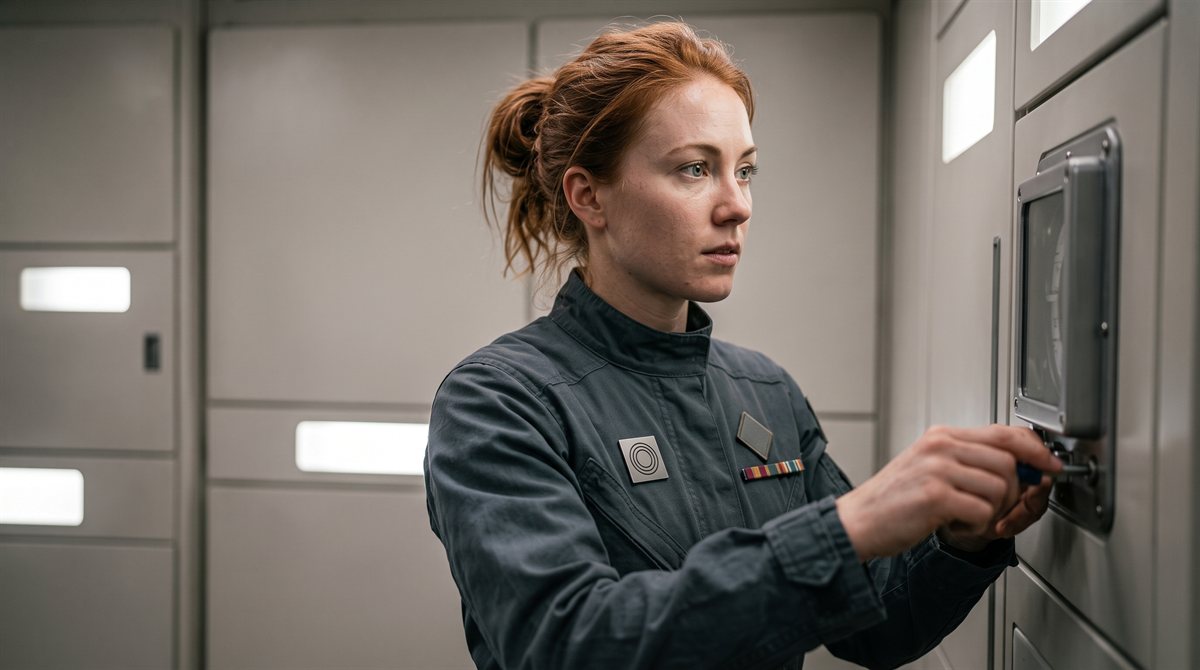
Section Lead Tissadelle Shepherd (Human)
- Time
- 2828 UCSD, Early Summer, The First Day Back
- Location
- Threshold Station — the Chief Ranger's office; Dock Seven, the general operations watch
Dock Seven kept two times, and the watch log had one line for it, and the line had one reading on it.
She had come down at no hour a cadet could learn, because that was how the Principal had come down when the watch was hers, and because a Section Lead who had been given the watches to set and the people on them to answer for was owed one look at the dock before she set anything. Not present, and entirely responsible. She had not understood the manner when she was on the receiving end of it, and she had copied it anyway, as one copies a thing one has been read by, and she found, with the log open on the sill between her and the cadet, that she understood it now, in the way a person understands a word by having to say it.
The cadet had stood up. She told the cadet to sit, and the cadet sat.
The two chronometers were where they had been. One above the pressure seal and one above the inner hatch, the station's and the other one, each of them certain. She did not look at them yet. She read the log, standing, back from tonight's line, page by page, at the speed she read anything she was going to initial, and the time line carried one reading, every watch, marked station time, left-hand instrument, in a cadet's hand that was not hers and had never written two.
"The log is kept in station time, Section Lead," the cadet said. Not asked; offered, the way a thing is offered that was learned on the first night and has not once been needed since. "The left-hand instrument."
"Yes," Shepherd said.
Somebody had told this one. On the first watch, by the sound of it, which was forty watches sooner than anyone had told her, and the telling had been correct, and the gap she had stood in for forty nights writing two times with a stroke between them had been closed by somebody who had read her log and understood what the form had failed to say. The practice had not outlived her. The form had been explained instead, which was the right fix and the smaller one, and the smaller one was the kind that held.
Then she looked at the right-hand instrument.
Forty seconds. She had counted it on forty-one nights and it had not moved, and it had not moved since, through a survey that had read two centuries of a lighthouse keeper's corrections and come back with the same number and no cause. Thirteen years the station had carried it. It was outside the log by standing practice. It was certain, and it was on the wall, and it was not written anywhere a Section Lead initialled, and nobody on this dock was going to write it unless she said so.
She had a sentence. She noticed that the way she had noticed a sentence at Halyx with her hand already drafting it, and it was the same sentence in a different uniform: that there was a second reading in this room, and that nothing on the sheet in front of her showed anyone had been asked. It was true. It was also not the log's. The log recorded the watch, and the watch was the station's, and the station had decided thirteen years ago which instrument was the station's and had never been wrong about which one it had decided. A Section Lead who wrote the right-hand reading into the time line under her own initial had not corrected anything. She had made a claim about what the dock was for, on a form that asked for the time, under the initial of a cadet who had done exactly as told.
What was hers was the window. Not the clock. The window was stated from her desk, and the readings that put its edges there were the Survey's, and the Survey had thirteen years of them, and she would read every one before she stated anything, and when she stated it she would state the width the readings supported and not the width the traffic plan had been written around before anyone asked. That was the sentence she was entitled to. It was due in the summer. It was not due tonight.
Tonight she was entitled to an initial.
She wrote it under the cadet's, on the time line, with nothing struck and nothing added, and closed the log, and told the cadet the watch was in good order, which it was. The right-hand instrument read forty seconds later than the log as she went up, as it had on her first night, and it was outside the log by standing practice, and the practice was hers now to let stand.
Discussion
Show discussion
Comments are read after they are posted and anything unsuitable is removed. Posting needs a GitHub account; reading needs nothing.