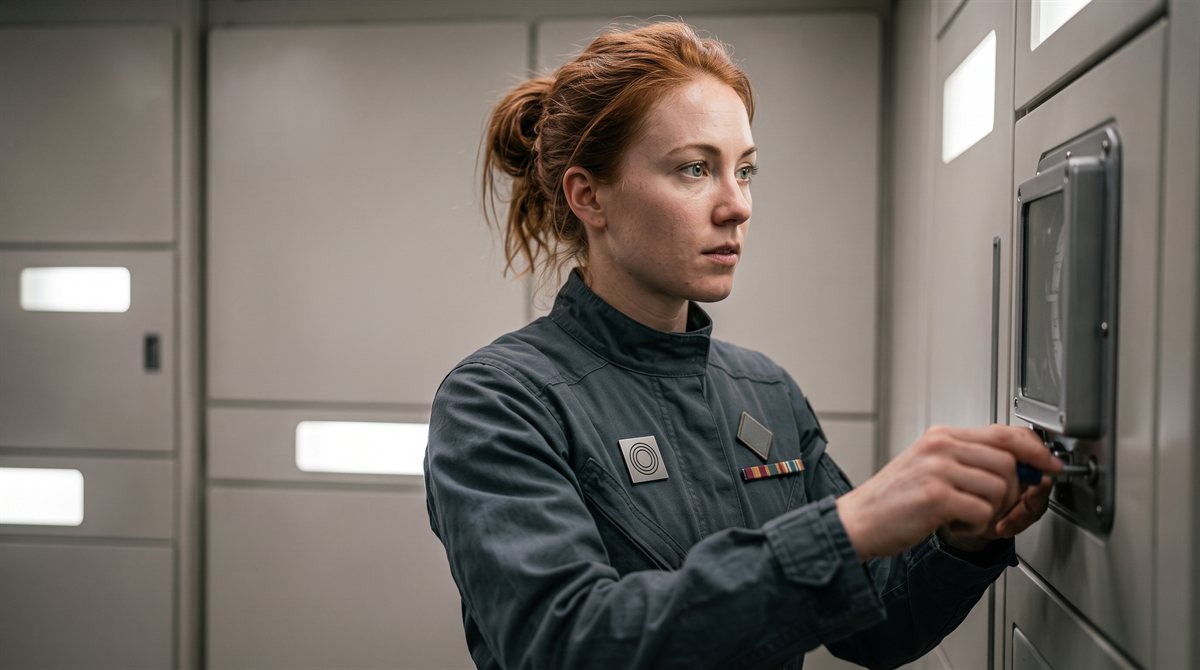
Line Captain Tissadelle Shepherd (Human)
- Time
- 2831 UCSD, Early Autumn, Ten Days Later
- Location
- Threshold Station, Boundary Survey Archive
The bulletin was routine in the specific way that made routine things dangerous to read quickly: forty pages of cross-referenced anomaly filings, compiled by an archivist whose unsigned annotations she had learned to recognise the shape of years before she ever learned the name behind them. Sen's notes did not editorialise. They simply put two things next to each other that nobody else had thought to put next to each other, and let the adjacency do the arguing.
Item fourteen was the Marsh Causeway grove, cross-referenced against her own service record from a season she rarely thought about anymore. Dryadic-type Etheric anchor. Leaf phase-lag, sub-second, consistent across seven specimens. She had read that description exactly once before, in a briefing that had cost her nothing to sit through.
Item sixteen cost her considerably more.
Union land-survey entry, filed under general flora anomaly, never flagged for follow-up. Leaf phase-lag consistent with item fourteen's marker. A coordinate string. Nothing else — no name, no croft, no six generations of women keeping a rule they'd never been given the reason for. Just numbers, the way every unimportant thing in an archive is, eventually, just numbers.
She had the coordinates converted before she'd finished deciding whether she wanted to know.
Boirinn Uplands. Close enough to the Shepherd holding that "close enough" was doing no real work as a hedge.
She sat with the bulletin open in front of her for four seconds — the exact length of time, she noted with the part of her mind that never fully turned off, that it had taken her to know the Sentinel's pulse wasn't noise, a lifetime and a rank ago. Then she did the thing that was, she was fairly sure, the only version of this she could live with: she flagged item sixteen for formal survey priority, cited the phase-lag consistency with item fourteen as grounds, and said nothing else. Not where she'd stood. Not whose land it was. Not what it had cost her mother to be given the reason instead of the rule.
It was not the whole truth. It was, she told herself, checking the sentence the way she checked every sentence before she filed it, not a lie either. A Line Captain reviewing a fleet-wide bulletin had flagged a coordinate on the strength of a documented marker. That this Line Captain also happened, privately, to know exactly what stood on that coordinate was not a fact the flag required her to disclose.
She was aware this was the second time in ten days she had drawn that particular line. She was aware, too, that a line drawn twice in the same place was starting to look less like an exception and more like a policy.
She filed it anyway. That was, increasingly, simply what the job looked like from here.
Discussion
Show discussion
Comments are read after they are posted and anything unsuitable is removed. Posting needs a GitHub account; reading needs nothing.