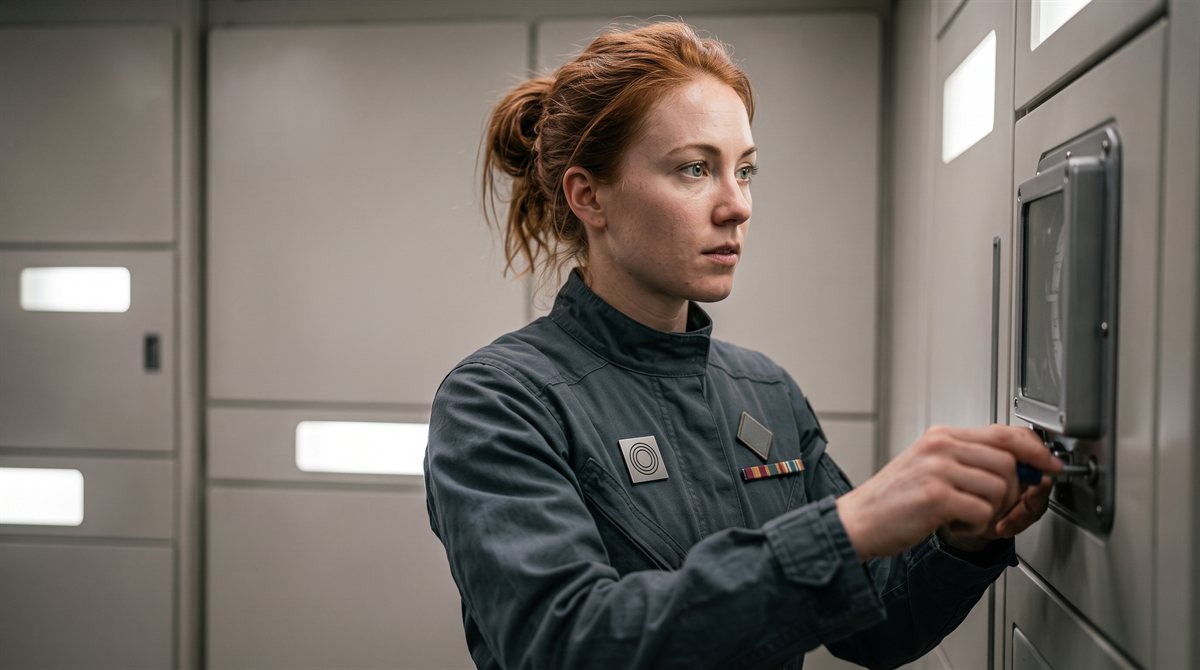
Line Captain Tissadelle Shepherd (Human)
- Time
- 2831 UCSD, Mid-Autumn — Dock Seven, the Last Stand
- Location
- Threshold Station, Dock Seven, and the boundary beyond it
The survey she had flagged ten days ago went out fleet-priority, and fleet-priority meant a hull, and the hull it meant was hers.
That was the part nobody warned a Line Captain about. You cited your grounds in four clean lines, and four clean lines were enough to put the Sufficient Cause on the Threshold approaches in mid-autumn, sweeping a marker class rather than a coordinate — pale bark, a leaf-phase lag of a fraction of a second, and the two older Union land-survey entries the Survey Archive had logged under unrelated classifications and never flagged for follow-up. She had asked for the class to be looked at. She had not specified who should have to look.
The sweep found the marker on the third day, in the thin water off Dock Seven, and then it found something the marker had nothing to do with.
Shepherd read the return twice, once for content and once for what the content was for, and then she read it a third time, which she almost never did.
An aperture. Open.
She checked the fold log for a transit and found one, logged, licensed, and closed out four months ago. So the transit had happened. The transit had finished. And the aperture the transit had opened was still there, four months later, held.
A fold is an aperture opened, crossed, and collapsed. She had learned that as a cadet from a woman who taught it as a fact about the universe rather than a fact about engineering, and she had never once had cause to doubt her. The collapse was not a courtesy. The collapse was the definition. A thing that opened and did not collapse was not a fold that had gone wrong. It was something else that had never been a fold at all, wearing the paperwork of one.
"Comms," she said. "Threshold. Boundary desk, not the duty officer."
She put the Sufficient Cause in closer, and at forty kilometres she stopped, because she could see them now without instruments, which was itself a finding she would have to write down.
The dock crews called them tapers. They came in off the thin water in loose drifts, a few hundred at a time, and they held a light the way a wick holds one — not emitting, exactly; sustaining, until they didn't. Survey had classed them years ago and the class had settled the matter: Class III, non-sapient, pattern-matching rather than strategy, no standing anywhere in the Cascade and no protection from it either. Two generations of Threshold's boundary handbooks called them a hazard, and were right to. A drift of tapers through a docking approach had killed people.
They were going into the aperture. Not past it. Into it, in a steady unhurried line, the way a thing goes toward what it has been built to go toward, and the aperture was doing something to them that Shepherd watched for six seconds and then stopped watching, because she had the finding and did not need the rest of it.
What came out the other side went into holds. She could see the holds. They were painted.
Discussion
Show discussion
Comments are read after they are posted and anything unsuitable is removed. Posting needs a GitHub account; reading needs nothing.