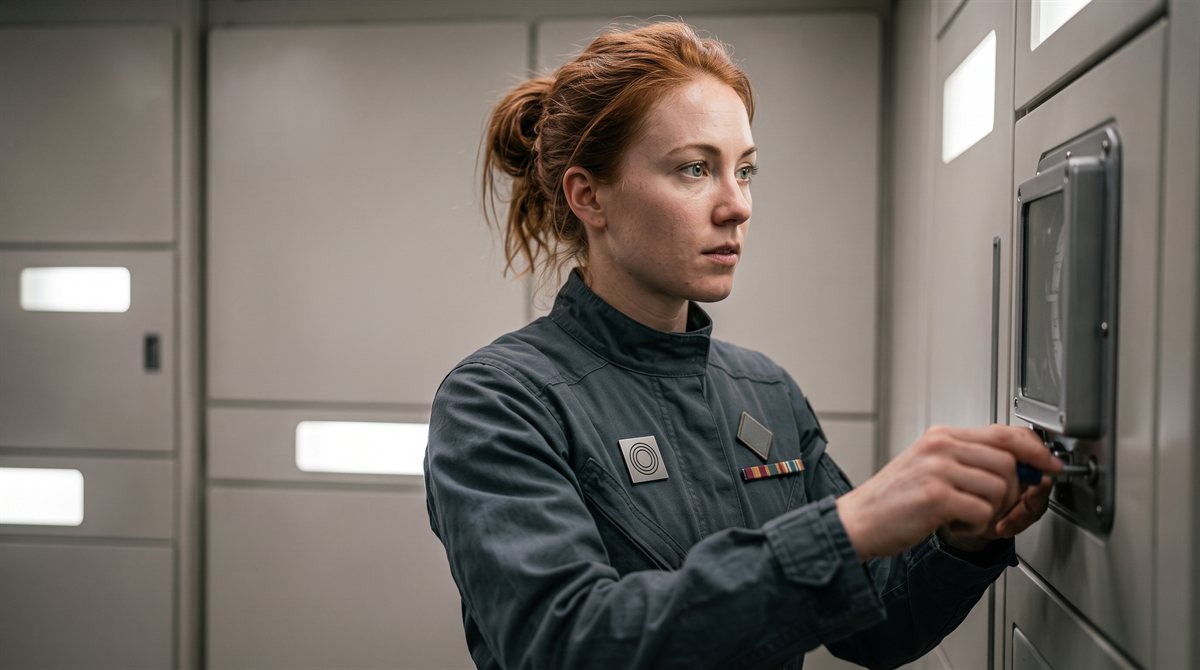
Line Captain Tissadelle Shepherd (Human)
- Time
- 2831 UCSD, Mid-Autumn — Dock Seven, the Last Stand
- Location
- Threshold Station, Dock Seven, and the boundary beyond it
The concern was called the Hyperfold Yield Combine, and it traded as Hyperfold, and it had a licence.
Shepherd read the licence while the Sufficient Cause held station, and it was, as far as it went, in order: transit rights, a survey exemption, a rendering permit, and an inner-system counsel's opinion appended in full confidence that no clause of it required the aperture to close. The word hyperfold appeared nine times in the filing and was not a term for anything. It was not the Survey Corps' word, it was not a folding engineer's word, and the one place it did appear in the literature was a glossary entry explaining, with some restraint, that people who used it had misunderstood two different phenomena and welded them together. The Combine had taken the mistake and put it on the hull.
That told her more than the licence did. A concern that could not correctly name the thing it did for a living had not been careless. It had chosen a word that sounded like the physics and committed to nothing.
There was a market for what they rendered. She looked that up too. Tapers went into fold-transit stabiliser, and stabiliser made apertures cheaper to hold, and cheaper apertures made more tapers reachable. It closed. Every part of it closed except the aperture, which was the only part that was supposed to.
She raised the Combine's operations lead on an open channel and put it plainly, because putting it plainly was the procedural step and because she wanted it on the record that the step had been taken. The lead was courteous. The lead cited the licence. The lead observed, correctly, that the Star Rangers held no jurisdiction over a licensed commercial operation in open water absent a finding, and asked, without any edge at all, which finding she was making.
"None yet," Shepherd said. "I'm asking you to close the aperture."
"We're not able to do that."
"Not permitted, or not able?"
There was a pause of about the right length for a man to consult somebody, and then the lead said, "I'd have to come back to you on that," and Shepherd understood that she had her answer and that it was worse than either of the two she had offered him.
She convened a Field Triumvirate at 0410.
She did it by the clause and she did it in the open, because that was the entire point of the clause. Herself, ranking Line Captain. The Sufficient Cause's Archwarden. The next most senior Starwarden reachable, which was Dock Seven's, joining by relay with the boundary desk listening and the log running. She stated the three conditions and made each of them stand on its own before she took the next: procedural approaches tried and failed, which was the channel she had just closed; no local law enforcement present or reachable in time, which in open water eleven hours from anything was not a judgement call; and the third, which was the one she made herself say slowly.
That waiting for the chain of command would cost the thing the decision was meant to save.
The thing the decision was meant to save was not the tapers. She said so, on the log, in as many words, because a Field Triumvirate action was a judgement three officers made on a record built to be second-guessed, and she had never in her life given an order she could not defend afterward. The tapers had no standing. She was not empowered to act for them and did not claim to be. What she was acting on was four months of a held aperture in a boundary zone eleven hours from a station with nine hundred people on it, and an operator who could not tell her whether closing it was something he was not allowed to do or something he could no longer manage.
The Triumvirate carried. She logged the dissent, because there wasn't one, and logging that there wasn't one was also the clause.
Then she took the Sufficient Cause in to close the aperture, and the aperture, when the Sufficient Cause reached it, turned out to have been the smaller of the two problems for some time.
Discussion
Show discussion
Comments are read after they are posted and anything unsuitable is removed. Posting needs a GitHub account; reading needs nothing.