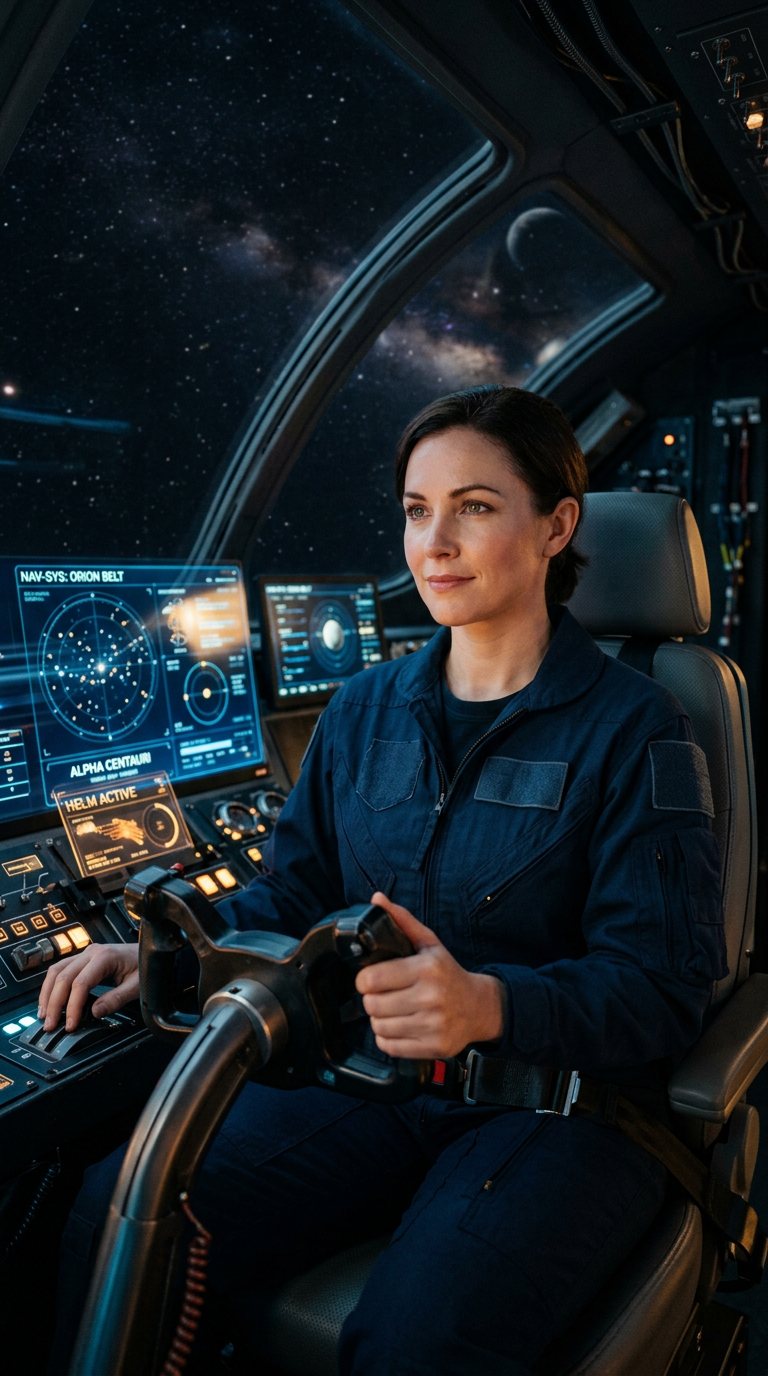
High Captain Karla Wender (Human)
- Time
- 2831 UCSD, Late Autumn, Fifty-Three Days After Dock Seven
- Location
- Threshold Station, the High Captain's office and the Survey Archive
The submission arrived on a Tuesday, which Wender noted and then declined to find meaningful.
It came through the Council's liaison officer, who had been on the station eleven days and had the look of a man who had stopped expecting to sleep in his own bed before the inquiry closed. He put it on her desk the way people put down a thing they have been asked to carry and would rather not have been. He was not unkind about it. He was tired in the specific way of somebody administratively capable, still making correct decisions, and running out of whatever correct decisions cost, and Wender had commanded long enough to know that this was not a man to be argued with but a man to be given, if it was at all possible, a Tuesday.
It was not going to be possible.
The submission was lodged with the inquiry by counsel for a body of inner-system licensed fold operators — the same body that had spent the seasons before Dock Seven saying in public, and in some detail, that Ranger neutrality was an expensive habit and the Corps' boundary expertise was a story it told about itself. Now it said two things, and said them well.
The first was the survey. A Line Captain on fleet-inspection review had flagged a Union land-survey entry for fleet-priority survey, citing her grounds in four clean lines. The coordinate flagged lay, by the Union's own public register, on land held under the name Shepherd, in the Boirinn Uplands of Tír na nÓg, for six generations. The Line Captain had disclosed no interest. The sweep her flag produced had found, on its third day, a licensed operation belonging to a concern that had declined Safety Corps certification and could not be compelled to hold it, and by the end of that day the concern no longer existed. Counsel did not use the word pretext. Counsel wrote that the word was for the inquiry to choose, and then built the paragraphs so that only one word fitted.
The second was the hull. The same officer had convened a Field Triumvirate on her own motion, sat on it as ranking officer, carried it without dissent, and taken a Ranger vessel inside twenty kilometres of a held aperture, after which the aperture had failed catastrophically and every hull on the Combine's registry within nine hundred thousand kilometres had been lost. Counsel quoted a recruiting page. Practical boundary knowledge. Counsel let the phrase sit next to the figure and did not comment on it.
Wender read it twice, once for content and once for what the content was for.
Everything in it was from the record. That was the craft of it. The Triumvirate log had been built so that anyone who wanted to pull it down would have to say which specific piece they were pulling, and counsel had said which piece — not the conditions, each of which had been made to stand on its own, but the grounds. The submission cited the log for every fact it needed and disputed none of them. It disputed what the facts were for. It quoted every line of the flag except the fourth.
The liaison wanted a response by the end of the week. The Council would answer the second claim itself, he said, and would prefer that the Corps answer the first.
The second she could have answered in her sleep. She had read that log twice fifty-three days ago looking for the place where it stopped being right and had not found one, and she could put that on a page in an hour.
The first she could not answer at all. Not because it was true. Because she did not know whether it was.
She had watched Shepherd read item sixteen twice, and she had decided not to ask. It had been doctrine, that decision, and she had built the doctrine on purpose over four seasons so that good officers would keep bringing her the truths that were hard to explain, and it had never once cost her anything she had to pay in public. The only honest sentence she owned was I did not ask her, and I will not now say what she would have said — and in the grammar of a submission that sentence was a confirmation. The other sentence, there was no interest, was a claim past her evidence, which was the one thing the officer it would have defended had never in her life put on a record.
"The Corps does not answer the first claim," she said.
"That will read as —"
"I know how it will read."
She was aware that a High Captain who left a claim of that shape standing on an inquiry file, unanswered, beside the name of an officer who was not present to mind, was writing a line in her own record as well, and that the Council had ways of remembering. She weighed it honestly, because pretending a cost was zero was how you paid it by surprise. Fifty-three days ago she had declined to sign a citation because every sentence in it was true and the sum was a lie. She was declining now for the same reason from the other side: she could make every sentence of an answer true, and its sum would be a claim she could not support.
She set the stylus down.
State your grounds and say nothing further. It had been Shepherd's policy, drawn in the same place twice in ten days until it stopped looking like an exception, and Wender had let her keep it. She was finding out what the policy cost when the woman who held it was not there to hold it.
Discussion
Show discussion
Comments are read after they are posted and anything unsuitable is removed. Posting needs a GitHub account; reading needs nothing.